
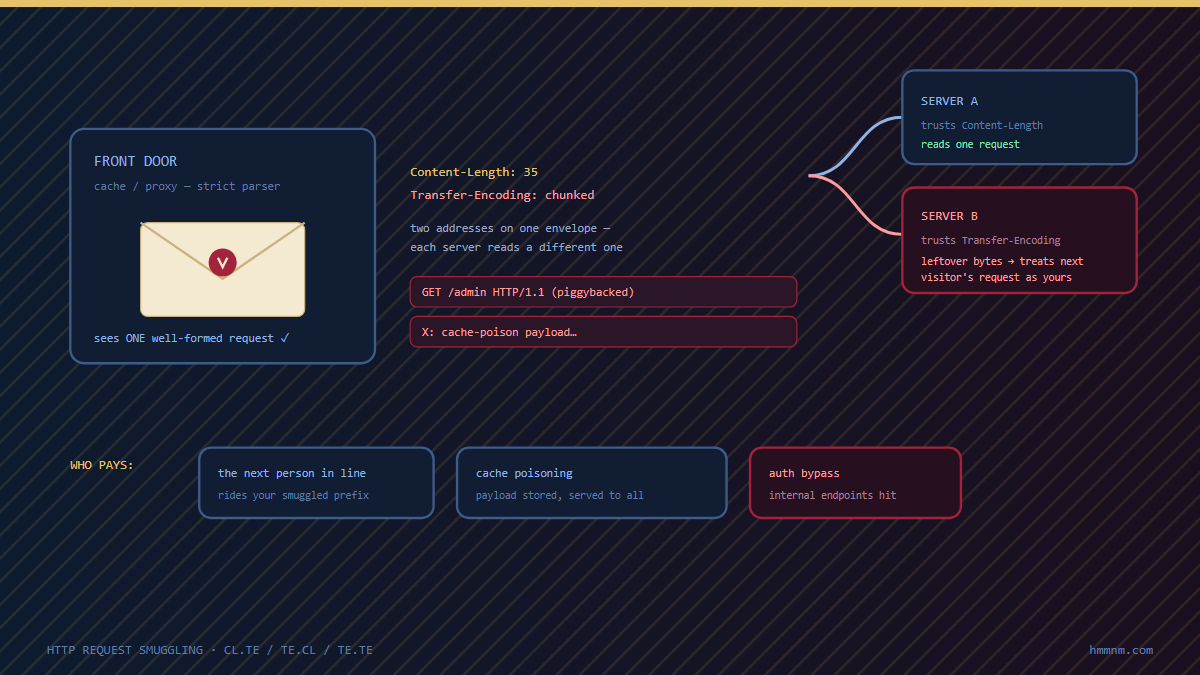
http request smuggling hides a malicious request inside a legitimate one by exploiting disagreeing front-end and back-end servers about where one request ends and the next begins. The front server reads one request; the back server reads two — and the smuggled prefix hijacks whatever innocent request comes next, usually another user’s. The consequences land precisely on your defences: WAFs inspect the visible request and never see the smuggled one, rate limiters count the wrong things, and caches store attacker-controlled responses under other people’s URLs. Any stack with a proxy, load balancer, or CDN in front of an application server is a candidate; the fix discipline is strict protocol-level configuration alignment, ending response-splitting ambiguity on both layers, and treating cache-control headers as security-critical configuration rather than a performance afterthought.
Your web application firewall logs a perfectly ordinary request: a POST to /login, size 37 bytes, all headers clean, no rules triggered. Two seconds later a user complains their account page shows someone else’s session. The WAF never saw the second request — because technically, there was no second request. There was one HTTP/1.1 request containing two, and your reverse proxy and your application server disagreed about where the first one ended.
That is HTTP request smuggling: not an exploit of a bug in your code, but of a disagreement between two pieces of infrastructure about the grammar of HTTP itself. It has lurked since the protocol’s early days, was dramatically systematised in 2019 research that showed the entire CDN-and-load-balancer ecosystem affected, and keeps resurfacing every time a new proxy, tunnel, or HTTP/2-to-HTTP/1 downgrade lands in front of an application. This article covers how the ambiguity works, the three classic flavours, why your WAF and cache are the real targets, and the hardening that closes the gap.
The Ambiguity: Two Ways to Say “This Request Is Over”
HTTP/1.1 gives a request two length-encoding mechanisms, and legacy behaviour lets them both be present:
- Content-Length (CL) — “the body is exactly N bytes”
- Transfer-Encoding: chunked (TE) — “the body is a series of chunks, ended by a zero-length chunk”
- If both headers appear, the specification says chunked wins; but parsing quirks, header-folding, and obs-fold tricks make different servers disagree about whether TE was really there at all.
One request, two readers, two truths:
POST / HTTP/1.1
Host: target
Content-Length: 6
Transfer-Encoding: chunked

0

X
Front-end reads CL: body is 6 bytes → request complete, pipeline the rest cleanly.
Back-end reads TE: body ends at the 0 chunk → X is the start of the next request on the connection.
That trailing X is the smuggled seed. Whatever bytes the attacker places there become the unauthenticated prefix of the next innocent request that reuses the connection — a victim’s GET, another tenant’s API call, an internal admin path the front end would never forward directly.
The Four Canonical Flavours
| Flavour | Front-end parser | Back-end parser | Smuggling mechanism |
|---|---|---|---|
| CL.CL | Different CL values honoured | Second CL wins | Byte-count mismatch desyncs stream |
| CL.TE | Content-Length | Chunked | Front counts bytes; back ends early — leftover bytes prefix next request |
| TE.CL | Chunked | Content-Length | Front ends at 0-chunk; back is still waiting → next real request gets appended to smuggled body |
| TE.TE (obfuscated) | TE disabled/ignored via obfuscation | TE honoured | Header-obfuscation tricks (Transfer-Encoding : chunked, X:, wrong casing, doubling) break one side’s TE recognition |
The TE.TE obfuscation family is why smuggling refuses to die: every new front-end brings new quirks about which malformed TE headers it recognises, accepts, or silently strips — and the whole attack only needs the two layers to quirk differently.
HTTP/2’s arrival did not retire the class; it reshaped it. Where your edge speaks H2 but the origin still speaks HTTP/1.1, a downgrade sits in the middle — and 2021’s “browser-powered desync” research plus the H2 request-tunnelling variants showed that an H2-only front end can still desync the downstream H1 connection (H2.CL and H2.TE descend directly from the classics). Assume any H2→H1 bridging tier is a smuggling candidate until tested.
Why the Real Target Is Your Defences, Not Your App
The distorted request itself rarely breaks the application. What makes smuggling a headline risk is which security control it lands on:
1. WAF bypass — the smuggled request was never inspected
The WAF sits on the front-end’s understanding of the request: method, path, and body it parsed. The back-end executes a different request that the WAF literally never materialised. SQLi payloads, path traversal, and internal-API probes ride inside the desync zone — invisible to rules no matter how well tuned. Every smuggling finding in a pentest should immediately trigger the question: which rules have been trusting the front-end parse all along?
2. Cache poisoning and cache deception — the wrong response stored under the wrong key
When the smuggled prefix lands on a request whose URL is cacheable, the response to the smuggled content gets cached and served to every subsequent user of that URL. Two dominant patterns:
- Cache poisoning: the attacker crafts the prefix so the origin’s response contains attacker-controlled content (redirect target, injected script via header reflection); the cache stores it — persistent, cross-user impact from one request.
- Cache deception: flipped perspective — the attacker tricks the cache into storing a victim’s private response under an attacker-choosable, public-looking key. The classic: append a path suffix the origin’s router ignores (
/account/settings/nonexistent.css), the origin returns the account page, the cache — keyed on the.css-looking URL — stores the private page, and the attacker simply fetches/account/settings/nonexistent.cssand receives the victim’s data.
3. Access-control bypass — internal routes reached via the desync zone
Front ends enforce routing policy: “/admin only from the internal VPN.” A smuggled request never goes through the front end’s router during its lifetime — the routing decision already happened for the innocent carrier request. The back-end serves the internal endpoint; the response gets stitched to whatever connection state is lying around.
4. Rate limiting and audit gaps
Limiters count front-end requests; the smuggled shares one count with its carrier. Audit trails log the carrier, not the payload. A patient attacker proxies through your own infrastructure indefinitely.
How Testers Actually Find It — And How You Can Self-Test
Modern methodology, condensed:
- Map the tier topology first. Which CDN, which load balancer, which app server, which HTTP versions at each hop? Smuggling potential exists at every boundary where parsing responsibility changes hands — including origin-side tunnels and sidecars.
- Differential timing probe. Send the ambiguous candidate; if the response arrives after an extra timeout (the back-end got left mid-request waiting for more body), something desynced. Differential-response and connection-state probes extend this.
- Obfuscation dictionaries. Run TE-obfuscation variants (
Transfer-Encodingcasing, whitespace, tab-vs-space, junk headers before TE to trigger differing parsing lengths) systematically; automation exists in open-source toolkits, but the interpretation — knowing which tier quirked — remains manual judgement. - Confirm harmlessly. Confirm with a second request on the same connection that visibly inherits the prefix (a reflected path or a timeout difference) rather than an actually-malicious payload. Professional testing of smuggling never poisons real-user caches.
- Downgrade-path testing for H2 edges. Explicitly test H2→H1 bridging tiers; they are the trigger for the modern variants.
Self-test cadence: after any infrastructure change — new CDN feature, new load-balancer firmware, new middleware, HTTP-version toggles — because the vulnerability class lives at tier boundaries, not in your application release.
The Fix Discipline
Smuggling can’t be patched at the application layer. The discipline is protocol-alignment and ambiguity-elimination at every tier pair:
- Normalise, don’t just forward. Front-end tiers should rewrite each request into unambiguous form: exactly one length mechanism (Content-Length on full reads or chunked for streaming), TE header canonicalised or fully stripped after decoding, redundant headers removed. A front end that re-serialises requests kills the ambiguity source for everything behind it.
- Reject, don’t repair. Requests with both CL and TE, with malformed TE values, duplicated conflicting CLs, or obs-folded header tricks should be rejected — not auto-corrected. Lenient repair is where differing quirks are born.
- Pin HTTP versions deliberately. Where HTTP/2 is terminated at the edge, prefer H2 (or H3) end-to-end to the origin, or ensure the bridging tier does full normalisation on downgrade. An unpinned downgrade path is a standing invitation.
- Treat Cache-Control as security configuration. For pages with any user-specific content: explicit
Cache-Control: no-store(orprivate, no-cacheper semantics); caches must never derive cacheability from extension sniffing; origin routers must return 404 on unknown path suffixes rather than ignoring trailing garbage — the single change that kills most cache-deception variants. - Segment your tiers’ trust. Backend/admin endpoints should not be routed by headers alone; per-segment authentication of internal traffic closes the “internal route via desync zone” class.
- Test the whole stack, not the parts. Component-level “we’re RFC-compliant” proves nothing — the vulnerability is the pair’s disagreement, and only end-to-end differential testing finds it.
FAQ: HTTP Request Smuggling
What exactly is HTTP request smuggling?
An attack that exploits differing interpretations of where an HTTP/1.1 request ends between a front-end server (proxy, CDN, load balancer) and a back-end server. By sending a request whose length headers are contradictory (Content-Length versus Transfer-Encoding), the attacker makes the two layers disagree; leftover bytes become the prefix of the next request on the connection — hijacking another user’s request the security infrastructure never inspected.
Can it happen on HTTP/2?
Yes. Where an H2 edge bridges to an HTTP/1.1 origin, the downgrade step reintroduces the classic ambiguity (H2.CL and H2.TE variants), and H2-only tunnelling variants exist as well. HTTP/2’s binary framing ends the ambiguity only when it is used end-to-end; every downgrade tier is a candidate for testing.
Why doesn’t my WAF catch smuggled requests?
Because the WAF inspects the request as parsed by the front end — and the smuggled payload lives in bytes the front end never surfaced as part of that request. The back-end executes a different request than the one the WAF materialised. This is structural: no rule set can inspect bytes its parsing layer never delivered, which is why the fix belongs at protocol-normalisation level, not rule tuning.
What is the difference between cache poisoning and cache deception?
Both abuse caches via request handling. In poisoning, the attacker causes the cache to store a malicious or attacker-controlled response under a URL other users request. In deception, the attacker causes the cache to store a victim’s private response under an attacker-chosen, public-looking URL (classically by suffixing a cacheable-looking extension the origin router ignores), then simply fetches that URL to receive the victim’s data.
How do I know if my stack is vulnerable?
Only end-to-end testing tells: map the tier topology, then run differential probes (timing discrepancies, connection-state differences) with obfuscation dictionaries against each boundary where parsing responsibility changes hands. Component compliance claims are meaningless for this class — the vulnerability is precisely the disagreement between components. Repeat after any infrastructure or HTTP-version change.
What’s the single highest-value fix?
Request normalisation at the front-end tier: decode and re-serialise every request into exactly one unambiguous length representation, strip contradictory headers, and reject malformed combinations outright. Combined with explicit no-store cache directives on personalised routes and 404-on-unknown-suffix routing, this closes the practical exploit paths for the entire class.
Key Takeaways
- Smuggling is a parsing disagreement, not an app bug: CL/TE ambiguity (and its H2 downgrade descendants) makes the front end and back end read different requests off one connection — the attacker’s bytes become the next innocent user’s request prefix.
- Your defences are the target: WAFs never see the smuggled request, caches store the wrong responses (poisoning and deception), rate limiters under-count, audit logs record the carrier. Treat smuggling as a security-control bypass class first.
- Any tier boundary is a candidate: CDN→LB→origin→sidecar tunnels, especially H2→H1 downgrades. Test every pairing, because the vulnerability lives in the pair’s disagreement.
- Fix at protocol level: normalise (single length mechanism, canonical TE), reject contradictions and obs-folded tricks outright, pin HTTP versions deliberately, and make origin routers 404 on unknown suffixes.
- Make Cache-Control a security decision:
no-storeon anything personalised, cacheability never derived from path extensions, and tier-trust segmentation for internal routes — cache hygiene is smuggling’s blast-radius limiter.
References
- James Kettle (PortSwigger) — “HTTP Desync Attacks: Request Smuggling Rebellion Breaks the Internet” (2019) and “Browser-Powered Desync” (2021): the systematising research of the class
- HTTP/1.1 message syntax specification (RFC 9112) — Content-Length and Transfer-Encoding precedence rules
- Web Cache Deception (Omer Gil, 2017) and cache-deception follow-up research — the suffix-trick private-response class
- PortSwigger Web Security Academy — request-smuggling labs and TE-obfuscation technique catalogue
- OWASP — reverse-proxy and caching hardening guidance
- Internal: One Key to Rule Them All — multi-layer estates multiply both secrets and parsing boundaries worth auditing
{“@context”:”https://schema.org”,”@type”:”FAQPage”,”mainEntity”:[{“@type”:”Question”,”name”:”What exactly is HTTP request smuggling?”,”acceptedAnswer”:{“@type”:”Answer”,”text”:”An attack that exploits differing interpretations of where an HTTP/1.1 request ends between a front-end server and a back-end server. By sending contradictory length headers, the attacker makes the two layers disagree; leftover bytes become the prefix of the next request on the connection, hijacking another user’s request that the security infrastructure never inspected.”}},{“@type”:”Question”,”name”:”Can request smuggling happen on HTTP/2?”,”acceptedAnswer”:{“@type”:”Answer”,”text”:”Yes. Where an H2 edge bridges to an HTTP/1.1 origin, the downgrade step reintroduces the classic ambiguity (H2.CL and H2.TE variants), and H2-only tunnelling variants also exist. HTTP/2 removes the ambiguity only when used end-to-end; every downgrade tier remains a testing candidate.”}},{“@type”:”Question”,”name”:”Why doesn’t my WAF catch smuggled requests?”,”acceptedAnswer”:{“@type”:”Answer”,”text”:”The WAF inspects the request as parsed by the front end. The smuggled payload lives in bytes the front end never surfaced as part of that request, while the back end executes a different request than the one the WAF materialised. The gap is structural, which is why the fix belongs at protocol-normalisation level rather than rule tuning.”}},{“@type”:”Question”,”name”:”What is the difference between cache poisoning and cache deception?”,”acceptedAnswer”:{“@type”:”Answer”,”text”:”In poisoning, the attacker makes the cache store an attacker-controlled response under a URL other users request. In deception, the attacker makes the cache store a victim’s private response under an attacker-chosen public-looking URL — classically by suffixing a cacheable-looking extension the origin router ignores — then fetches that URL and receives the victim’s data.”}},{“@type”:”Question”,”name”:”How do I know if my stack is vulnerable?”,”acceptedAnswer”:{“@type”:”Answer”,”text”:”Only end-to-end testing tells. Map the tier topology, then run differential probes (timing and connection-state discrepancies) with obfuscation dictionaries at every boundary where parsing responsibility changes hands. Component compliance claims are meaningless — the vulnerability is the disagreement between components — and testing should repeat after any infrastructure or HTTP-version change.”}},{“@type”:”Question”,”name”:”What is the single highest-value fix?”,”acceptedAnswer”:{“@type”:”Answer”,”text”:”Request normalisation at the front-end tier: decode and re-serialise every request into exactly one unambiguous length representation, strip contradictory headers, and reject malformed combinations outright. Combined with no-store cache directives on personalised routes and 404-on-unknown-suffix routing, this closes the practical exploit paths for the class.”}}]}
Part of our Web Application Pentesting: The Complete Guide series.