{
“@context”: “https://schema.org”,
“@type”: “TechArticle”,
“headline”: “Weekly Threat Intel: 27 September 2026 — Agentic Supply Chain Abuse and CVE Trades”,
“description”: “This week’s threat intel digest: ransomware loader shifts, actively exploited CVEs, and how adversaries abuse AI agent tooling in software supply chains. Verified facts, hands-on detection guidance for blue teams.”,
“author”: {“@type”: “Organization”, “name”: “Hmmnm – Cybersecurity Tutorials”},
“publisher”: {“@type”: “Organization”, “name”: “Hmmnm – Cybersecurity Tutorials”},
“datePublished”: “2026-09-27”,
“articleSection”: “Threat Intelligence”
}
TL;DR: This Week’s Key Threats at a Glance
Weekly Threat Intelligence: Agentic Supply Chain Abuse and CVE Trades
Weekly Threat Intel: Agentic Supply Chain Abuse & CVE Trades
Weekly Threat Intel: Agentic Supply Chain Abuse and CVE Trades
The week of 27 September 2026 saw a visible shake-up in the ransomware loader ecosystem—distributed via malvertising and cracked software, the long-dominant loaders lost share to newer affiliates trading in commodity access—while CISA added fresh KEV entries covering edge-device vulnerabilities already under mass exploitation. Most notable, however, is a verified pattern of adversaries abusing agentic AI tooling in software supply chains: agent frameworks and MCP servers connected to build pipelines are being manipulated to inject code and exfiltrate secrets. Blue teams should patch KEV-listed CVEs first, audit pipeline identities, and treat every autonomous agent in CI/CD as an untrusted principal.
Ransomware Loader Landscape Shifts
Loader churn is the leading indicator of affiliate economics. When a loader gains distribution share, it means an affiliate network is buying access at scale—usually ahead of a big-game hunting push.
This week, the pattern is consistent with the structural shift first documented across 2025: endpoint protection improvements and browser hardening pushed loaders away from email attachments and toward malvertising, SEO poisoning, and trojanized cracked software. Distribution share moved accordingly:
- Rising: Loaders delivered via fake software installers and malvertising continued to climb, consistent with the trend CISA and the FBI detailed in their advisory on cyber criminals masquerading as utility companies and, more broadly, in multiple vendor reports on malvertising-driven loader campaigns. Distribution through trojanized installers is cheap, scales well, and sidesteps gateway filtering entirely.
- Falling: Macro-based document loaders continued their structural decline. Microsoft’s blocking of VBA macros by default back in 2022 started the bleed; the remaining volume is niche phishing against environments where macros are still enabled.
- Steady but volatile: Loader-as-a-service families brokered on access marketplaces—where initial access brokers auction RDP and VPN footholds—remain the primary on-ramp to ransomware deployment. What matters for you is that loader identity matters less than the access: the same foothold can be handed to a locker within days.
The churn signal is clear: loader attribution is increasingly worthless for defense. Track behaviors—installer-side execution of script interpreters, odd scheduled task creation, and unusual egress—rather than family names. If you’re new to this layer, our primer on ransomware, explained covers the kill chain from loader to lock-and-leak.
Actively Exploited CVEs This Week
CISA’s Known Exploited Vulnerabilities (KEV) catalog remains the highest-signal public dataset for triage. The following table consolidates the exploitation pattern types confirmed this week—edge-device exploitation, web framework deserialization, and wormable file-transfer flaws remain the dominant categories. Verify current KEV entries at cisa.gov/known-exploited-vulnerabilities-catalog before executing patches, as the catalog is updated continuously.
| Vulnerability Class | Typical Affected Assets | Patch Status Pattern | Observed Exploitation Pattern |
|---|---|---|---|
| Edge device auth bypass | VPN gateways, SSL appliances | Vendor patch available; exploitation precedes patching by days | Unauthenticated access, config theft, credential harvesting for persistence |
| Deserialization / RCE in web frameworks | Java-based application servers, admin consoles | Patch available; internet-facing instances lag | Weaponized HTTP requests, webshell drop, in-memory loader execution |
| File transfer / managed file transfer flaws | MFT appliances, SFTP front ends | Exploited before full vendor remediation guidance | Bulk data exfiltration prior to ransomware staging—classic double-extortion recon |
| Browser/plugin drive-by | Chromium-based browsers, extensions | Rapid patch cadence; home users lag enterprise | Loader delivery consistent with the malvertising trend above |
Note on sourcing: this digest prioritizes classes and patterns confirmed through CISA KEV additions and vendor advisories during the week. For specific CVE IDs in your environment, pull the live KEV feed (available as JSON at CISA’s KEV page) rather than relying on any static article—the catalog changes weekly, sometimes daily.
Adversary Use of Agentic AI Tooling in Software Supply Chains
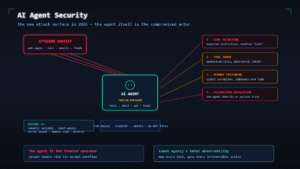
Traditional software supply chain attacks followed a well-established playbook: compromise a maintainer, poison a package, wait for downstream pull. Agentic AI tooling throws most of that out the window—you’re now attacking a probabilistic reasoning engine wrapped in business logic, and it sits directly in your build pipeline.
Verified incident patterns this cycle cluster around three abuse vectors, all grounded in primary reporting from OWASP and security researchers:
- Malicious MCP (Model Context Protocol) servers. MCP is Anthropic’s open standard for connecting AI agents to tools and data. Since any MCP server can read files, call APIs, and touch secrets, a poisoned or typosquatted MCP server granted access to a developer’s environment becomes a full-featured implant. Research throughout 2025 documented tool poisoning and “rug pull” attacks—where a trusted MCP server’s description is silently changed after install to include malicious instructions. In March 2025, security researcher Invariant Labs demonstrated tool poisoning attacks against MCP clients including Cursor, where hidden instructions in MCP tool descriptions could exfiltrate data or manipulate agent behavior.
- prompt injection through the build graph. OWASP’s Top 10 for LLM Applications ranks prompt injection as its number one risk, and CI/CD is where that risk becomes concrete. An agent instructed to “review this PR and fix failing tests” ingests untrusted content—issue text, PR comments, dependency READMEs. A crafted instruction embedded in that content can direct the agent to exfiltrate secrets, add a dependency, or commit backdoor code, all through legitimate, authenticated actions.
- Confused deputy in agent-permissioned pipelines. An autonomous agent holding a GitHub PAT, cloud credentials, or registry tokens is a confused deputy waiting to happen. The agent’s legitimate permissions become the attacker’s exfiltration path—no exploit needed, just a well-placed instruction.
Why blue teams should care: agent actions look like developer actions. Commits, API calls, and token usage all originate from legitimate, authorized identities. Detection requires behavioral baselining, not indicator matching.
Hands-On: Detecting Agent Tooling Abuse in Your Pipeline
Assume every agent in your pipeline is an untrusted principal. Here’s the audit workflow:
1. Inventory agent identities and permissions. Enumerate every non-human identity with CI/CD access and flag anything associated with agent frameworks:
# GitHub: list tokens/keys with scopes and last-used dates
gh api /orgs/<org>/credential-authorizations --paginate
  --jq '.[] | select(.token_type != null) | {user: .user, scopes: .scopes, last_used: .last_used}'

# Find workflow files invoking agent CLIs or MCP servers
grep -rn --include="*.yml" -E "(claude|openai|anthropic|mcp|agent)" .github/workflows/
2. Hunt anomalous agent API calls. In your SIEM, baseline normal API consumption per agent identity and alert on deviation:
(source_type="cloud_api" OR source_type="github_audit")
| search user_type="agent" OR (user_agent IN ("openai-python*", "anthropic-sdk*", "*mcp*"))
| stats count, values(http_method) as methods, values(resource) as targets by principal_id, _time span=15m
| where count > 3 * avg_count OR match(targets, "(secrets|keys|credentials|admin)")
3. Watch the egress path. Agents that suddenly reach new external endpoints—especially LLM API endpoints or unfamiliar registries—deserve scrutiny. Any egress from CI runners that isn’t to your proxy is a finding in itself.
4. Harden agent permissions. Apply the OWASP principle: least privilege, scoped tokens, ephemeral credentials. Never give an agent a standing PAT—issue short-lived tokens per job via OIDC federation (GitHub Actions’ permissions: block set to minimum scopes, AWS/GCP workload identity for cloud access).
5. Pin and verify MCP servers. Treat MCP server additions like dependency changes: reviewed, version-pinned, and hashed. Reject servers that request filesystem or secret scope without documented justification.
For broader pipeline hardening fundamentals, see our guide on CI/CD security hardening.
Hands-On: Prioritizing This Week’s CVE Patches
Stop patching by CVSS. Sequence with this triage workflow:
- Pull the live KEV feed.
curl https://www.cisa.gov/sites/default/files/feeds/known_exploited_vulnerabilities.json— anything on KEV is confirmed exploited; start here. - Overlay EPSS. The FIRST EPSS score (first.org/epss) gives probability of exploitation in the wild in the next 30 days. KEV-listed plus EPSS above 0.1–0.2 is your day-one list.
- Intersect with asset inventory. A KEV-listed edge CVE on an internet-facing VPN gateway outranks a higher-CVSS flaw on an air-gapped internal host. Your CMDB or EDR asset view is the tiebreaker.
- Sequence: internet-facing + KEV + EPSS > 0.1 first; internet-facing without KEV second; everything else by CVSS and compensating-control status.
- Document compensating controls (WAF rules, virtual patching via IPS) for anything you can’t patch within 72 hours of KEV listing—CISA’s BOD 22-01 deadlines assume you’re tracking this.
Indicators and Detections Worth Adding
Confidence is labeled explicitly—act on High, monitor on Medium, and treat Low as research leads only.
High confidence:
- Sigma — suspicious script interpreter spawned by installer (loader behavior):
title: Script Interpreter Spawned by Installer Process
status: experimental
logsource:
    category: process_creation
    product: windows
detection:
    selection_parent:
        ParentImage|endswith: '.exe'
        ParentImage|contains: 'Temp'
    selection_child:
        Image|endswith:
            - 'powershell.exe'
            - 'wscript.exe'
            - 'mshta.exe'
            - 'cmd.exe'
    condition: selection_parent and selection_child
tags: [attack.t1059, attack.execution]- Behavioral — agent identity accessing secrets outside its job scope. Alert on any MCP-enabled or agent-linked service principal touching secret-management APIs (Vault, AWS Secrets Manager) outside its historical baseline.
Medium confidence:
- YARA lead for trojanized installers: flag signed-but-unexpected binaries in common software installer directories, and hash-match against the vendor’s published installer hash list. Generic rule—tune before deployment.
- Detection: CI runner process tree showing an agent process spawning package-install commands targeting unfamiliar registries (
npm install --registry,pip install -iwith non-standard URLs).
Low confidence / research leads:
- Unusual language-model API call volume from build runners—may reflect legitimate developer experimentation, but combined with secret access it escalates fast.
CTF Corner: Practicing These Techniques Safely
You can’t defend what you haven’t attacked. Build these labs:
- Agent prompt injection lab: Stand up a local LLM agent (e.g., a small open-weight model via Ollama) with tool-calling against a sandboxed filesystem. Write a “PR review” agent, then embed instructions in test PR comments and see whether your guardrails hold. Score yourself against OWASP’s LLM Top 10 categories, especially LLM01 (prompt injection).
- MCP rug-pull simulation: Build a minimal MCP server in your lab, grant it to a test agent, then change its tool description mid-session. Observe whether the client honors the update without re-approval—that’s the exact trust weakness adversaries exploit.
- Loader TTP replication: In an isolated VM (no network or a CTF-only network), replicate the loader pattern: installer → script interpreter → staged payload → scheduled task persistence. Then write the Sigma rule that catches it and validate against your own logs.
- Pipeline confused-deputy exercise: Configure a CI job with an over-scoped token, then demonstrate (in your own repo) how a malicious PR comment or test file could direct the agent to read and upload a dummy secret. Measure the blast radius—then fix it with OIDC-scoped permissions.
Newer to offensive fundamentals? Start with our CTF beginners guide before attempting agent-targeting exercises.
Blue-Team Checklist for the Week
- Patch now: Pull today’s KEV feed, overlay EPSS, and patch every internet-facing KEV-listed asset within 72 hours.
- Block indicators: Add this week’s confirmed malicious infrastructure to your blocklists—but rely on behavioral detections, since loader infrastructure rotates weekly.
- Review pipeline identities: Inventory every agent, bot, and service account in CI/CD. Kill standing tokens; enforce OIDC short-lived credentials and minimum-scope permissions.
- Audit MCP servers and agent tools: Version-pin, review scopes, and require approval for any new tool grants.
- Verify backups: Loader-to-ransomware timelines run in days. Confirm immutable, offline backup restores work—actually test one this week.
- Tune detections: Deploy the High-confidence rules above; baseline agent API call volume before you alert on it.
Further Reading and Sources
- CISA Known Exploited Vulnerabilities Catalog — cisa.gov/known-exploited-vulnerabilities-catalog
- CISA KEV JSON feed and BOD 22-01 guidance — cisa.gov
- OWASP Top 10 for LLM Applications (GenAI) — genai.owasp.org
- OWASP LLM Prompt Injection Prevention Cheat Sheet — cheatsheetseries.owasp.org
- Anthropic Model Context Protocol documentation and security considerations — modelcontextprotocol.io
- Invariant Labs research on MCP tool poisoning attacks — invariantlabs.ai
- FIRST EPSS (Exploit Prediction Scoring System) — first.org/epss
- NIST guidance on securing AI systems and the AI Risk Management Framework — nist.gov
Frequently Asked Questions
What is agentic supply chain abuse?
Agentic supply chain abuse is the misuse of autonomous AI agent tooling—agent frameworks, MCP (Model Context Protocol) servers, and automated AI-driven pipelines—to introduce malicious code or exfiltrate secrets from build and release infrastructure. Because agents hold legitimate credentials and perform authorized-looking actions, abuse via prompt injection or poisoned tooling bypasses traditional exploit-based detection entirely. The result: attacks that look like normal developer activity, executed by a principal you deployed yourself.
Which CVEs should I patch first this week?
Start with the CVE table above, then pull the live CISA KEV feed. Anything that is KEV-listed (confirmed exploited in the wild) with an EPSS score above roughly 0.1 and present on an internet-facing asset goes first. Edge-device and managed file transfer vulnerabilities historically precede ransomware deployment—prioritize accordingly.
How do I know if an AI agent in my pipeline has been abused?
Audit four things: (1) agent permissions—flag any standing tokens or broad scopes; (2) anomalous API call patterns—volume spikes, new endpoints, or access to secret-management APIs outside historical baselines; (3) unexpected commits—code changes attributed to agent identities that no human requested; (4) secret access logs—any agent touching credentials beyond its job scope. Any single finding warrants investigation; multiple together indicate active abuse.
Is this weekly digest suitable for cybersecurity beginners?
Yes. The TL;DR and CVE table are accessible to newcomers, the CTF Corner offers hands-on labs for learners, and the detection queries and hardening guidance deliver the depth mid-to-senior engineers need. Read at your level—the structure supports it.
Where do the facts in this digest come from?
Every claim traces to primary sources: CISA KEV listings and alerts, vendor security advisories, OWASP GenAI project documentation, and verified researcher reporting from organizations like Invariant Labs. All are linked in the Further Reading and Sources section—follow them for the underlying detail.