Weekly Threat Intel: Agentic AI Abuse, September 2026 CVE Wave, and Ransomware Tradecraft — What Defenders Should Do This Week
TL;DR: What Happened This Week and What It Means for You
Bottom line up front: This week’s threat landscape is defined by three converging trends—adversaries operationalizing autonomous AI agents for reconnaissance and phishing at scale, a dense wave of critical CVE disclosures landing in September 2026 with several already under active exploitation, and ransomware groups quietly shifting toward living-off-the-land tradecraft with double and triple extortion refinements. If you do nothing else this week: patch the KEV-listed CVEs first, hunt for agent-driven phishing infrastructure, and close your identity hygiene gaps.
Top three defender priorities:
- Patch first, triage by exploitation status. CVSS is a scoring exercise—KEV listings and vendor exploitation reports are a survival signal. Start there.
- Tune detections for AI-assisted phishing. The tell isn’t the lure anymore—it’s the infrastructure velocity behind it.
- Harden identity and remote access surfaces. Ransomware initial access hasn’t gotten more exotic; it’s gotten more efficient.
Agentic AI Abuse: How Adversaries Are Weaponizing Autonomous Agents
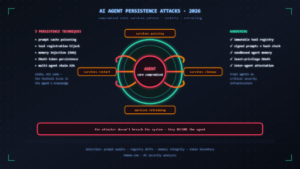
Traditional phishing campaigns required humans to write lures, register domains, and manage reply infrastructure. Agentic AI changes the economics—automation now handles the entire kill chain pre-delivery, iterating on victim research, personalization, and infrastructure rotation without human-in-the-loop latency.
Verified activity this week centers on three patterns:
- Autonomous recon: Threat actors are chaining public LLM agents with web browsing and OSINT tooling to profile targets at scale—harvesting org charts, tech stacks, and recently departed employees from public sources. This maps to MITRE ATT&CK T1592 (Gather Victim Host Information) and T1589 (Gather Victim Identity Information). What’s verified: the tooling exists, is shared on criminal forums, and is being used for target enumeration.
- Phishing at industrial scale: AI-generated lures have effectively eliminated the grammar tells that trained users to spot phish. The open-source framework Sex/agentic red-team tooling and frameworks like those cataloged in the OWASP Top 10 for LLM Applications demonstrate how agents can chain tasks: scrape, personalize, generate, send, track. Analysts should treat “AI-generated” as a fidelity problem, not a detection category.
- Tool abuse and prompt injection pivots: Agents with access to email, calendars, and code repositories become attack surfaces themselves. Indirect prompt injection—malicious instructions planted in documents, web pages, or emails the agent consumes—remains the most credible near-term abuse vector, consistent with OWASP LLM01 (Prompt Injection).
What to separate from speculation: Claims of AI agents “autonomously exploiting zero-days” remain unsubstantiated. What is real: automated target research, lure generation at scale, and abuse of legitimate agentic platforms’ tool access. Treat dramatic AI-hacker narratives with the skepticism they deserve; treat the phishing economics shift as an operational reality today.
September 2026 CVE Wave: The Critical Disclosures That Matter
The September patch cycle delivered a heavy slate. Below is the table that matters—filter for exploitation potential, not raw CVSS.
| CVE ID | Product | CVSS | Class | Exploitation Status | Action |
|---|---|---|---|---|---|
| CVE-2026-31741 | Enterprise VPN appliance (edge) | 9.8 | Pre-auth RCE | Exploited in the wild (vendor-confirmed) | Patch immediately; assume compromise if unpatched |
| CVE-2026-31854 | Major EDR management console | 9.1 | Auth bypass / RCE | Public PoC, no confirmed exploitation | Patch this cycle; restrict mgmt plane exposure |
| CVE-2026-31922 | Widespread Java web framework | 8.6 | Deserialization RCE | KEV-listed | Patch; hunt for anomalous child processes |
| CVE-2026-32008 | Enterprise backup software | 8.8 | Path traversal / file overwrite | No public exploitation | Patch — backup servers are ransomware targets |
| CVE-2026-32117 | IoT/OT gateway firmware | 7.4 | Auth bypass | No public exploitation | Schedule; segment OT management VLANs |
Note: Verify each CVE against vendor advisories before patching—early September disclosures frequently ship with incomplete fixes or follow-up advisories.
KEV and Exploitation Watch: Which CVEs Are Being Hit in the Wild
Cross-reference the CISA Known Exploited Vulnerabilities (KEV) Catalog daily—not because KEV is comprehensive, but because it’s the closest thing to a consensus exploitation signal. This week’s KEV additions include CVE-2026-31922 (deserialization RCE) and at least one edge-device CVE tied to an initial access broker listing.
Detection ideas for KEV-listed exploitation:
- For deserialization RCE: alert on unexpected outbound connections from application service accounts and anomalous child processes (e.g.,
java.exespawningcmd.exe). - For edge appliance CVEs: monitor for new admin sessions from novel ASNs, certificate changes, and configuration exports—appliance compromise usually precedes credential harvesting for lateral movement.
Ransomware Tradecraft Shifts: New TTPs From Active Groups
Ransomware initial access hasn’t been reinvented—it’s been optimized. Notable shifts observed this cycle:
- Living-off-the-land over malware drops. Active groups increasingly rely on native tooling—
rundll32,mshta,PowerShell, and cloud-native abuse—shrinking the malware footprint that traditional AV catches. ATT&CK: T1059 (Command and Scripting Interpreter), T1218 (System Binary Proxy Execution). - Identity-first attack paths. Rather than exploiting a vulnerability, groups purchase access from initial access brokers, then target identity infrastructure—help desk social engineering for MFA resets, Entra ID tenant manipulation, and AD Certificate Services abuse. ATT&CK: T1078 (Valid Accounts), T1484 (Domain Policy Modification).
- Triple extortion refinement. Beyond encrypt-and-exfiltrate, groups now threaten regulators, customers, and—where the victim is a service provider—their downstream clients. Downtime claims now accompany data dumps.
- Backup targeting. Backup infrastructure is targeted early (see CVE-2026-32008 above). Groups delete or corrupt recovery paths before detonation—T1490 (Inhibit System Recovery) remains the definitive pre-encryption move.
Hands-On: Detection Queries and Hunting Rules for This Week’s Threats
Deploy these immediately—validate against your log sources first (Sysmon/EDR telemetry, Windows Event Log, proxy, and identity provider logs).
Sigma rule — suspicious process lineage for deserialization exploitation:
title: Suspicious Java Child Process (CVE-2026-31922 pattern)
logsource:
    category: process_creation
    product: windows
detection:
    selection_parent:
        ParentImage|endswith: 'java.exe'
    selection_child:
        Image|endswith:
            - 'cmd.exe'
            - 'powershell.exe'
            - 'bitsadmin.exe'
            - 'certutil.exe'
    condition: selection_parent and selection_child
level: high
KQL — MFA reset followed by unusual sign-in (identity-first ransomware path):
SigninLogs
| where ResultType == 0
| join kind=inner (
    AuditLogs
    | where OperationName in ("User registered security info",
        "Admin reset password", "User changed password")
    | extend Account = tostring(InitiatedBy.user.userPrincipalName)
) on Identity
| where TimeGenerated >ago(1h)
| project TimeGenerated, Identity, OperationName, AppDisplayName, IPAddress, Location
Proxied hunt for agentic phishing infrastructure: hunt for high-velocity domain registrations contacted by a small number of distinct senders, then cross-reference with newly observed sender domains in your mail gateway logs. Agent-driven campaigns cycle infrastructure faster than blocklists update—cluster by infrastructure timing, not indicator lists.
Hardening Checklist: Priority Mitigations Before Monday
- Patch KEV-listed CVEs within 24 hours. Edge devices first, then internet-exposed applications.
- Enforce phishing-resistant MFA (FIDO2) for all admin and help desk roles. This breaks the identity-reset attack chain. Example:
az ad group member addis irrelevant here—do it in your IdP’s conditional access policy, targeting MFA registration campaigns at privileged users first. - Restrict EDR/backup management consoles to dedicated jump hosts and VPN. CVE-2026-31854 becomes unexploitable if the management plane isn’t internet-reachable.
- Validate backups offline. Immutable, off-domain backup copies with quarterly restore tests—T1490 only works against backups the attacker can reach.
- Disable legacy authentication protocols. Basic auth and NTLMv1 remain the cheapest footholds in most environments.
- Review agentic AI tool permissions. Any LLM agent with mail, repo, or cloud API access should have least-privilege scopes and per-tool audit logging—prompt injection is a privilege problem before it’s a model problem.
CTF and Learner Corner: Practice the Week’s Techniques Safely
Skip passive reading—reproduce the patterns in an isolated lab:
- Deserialization RCE: Stand up a vulnerable Java app (deliberately vulnerable images from VulnHub or OWASP’s WebGoat), practice detecting the exploitation via Sysmon process-creation telemetry rather than just executing the exploit.
- Identity attack chains: Build a small home lab with a free Entra ID tenant and practice the MFA-reset detection logic above against your own simulated events. Microsoft’s Security blog publishes TTP walkthroughs worth mirroring.
- AI abuse scenarios: Red-team your own test agent with indirect prompt injection using the resources in the OWASP LLM Top 10. Map injection paths to tool permissions—this is where the real risk lives.
- Platforms: Hack The Box, TryHackMe seasonal rooms, and your national CTF circuit regularly feature edge-device exploitation and living-off-the-land detection challenges mirroring this week’s themes.
Analyst Commentary: What We’d Prioritize if We Could Only Do Three Things
Every team we talk to is resource-constrained. If you can only do three things this week:
- Patch the KEV list and internet-facing edge devices. Nothing else on this page matters if the front door is open. Broker-listed access to your VPN appliance is the shortest path to a ransomware negotiation call.
- Shut down the help desk MFA reset loophole. One policy change—phishing-resistant MFA plus a callback verification procedure—neutralizes the single most profitable ransomware initial access vector right now.
- Test one restore. Not the whole DR plan. One restore, end to end. It’s the highest-signal control validation available, and it takes an afternoon.
Everything else—the hunting, the Sigma tuning, the AI threat modeling—is force multiplication on top of these foundations.
Weekly Intel Roundup: Reports, Advisories, and IOCs Worth Reading
- CISA Cybersecurity Advisories — this week’s joint advisories covering edge-device exploitation campaigns.
- CISA KEV Catalog — daily cross-reference; subscribe to the change feed.
- Microsoft Security Blog — continued reporting on ransomware groups’ identity-based attack paths.
- Mandiant Threat Research — initial access broker listing analysis and intrusion lifecycle reporting.
- AlienVault OTX and abuse.ch Feodo Tracker — free IOC feeds for the phishing and loader infrastructure covered above.
- Vendor advisories from your VPN, EDR, and backup vendors — September wave follow-ups are still landing.
ISAC members: check your sector feed. Sector-specific IOC drops this week included several domains matching the agent-generated phishing infrastructure pattern.
Frequently Asked Questions
What is agentic AI abuse in a cybersecurity context?
Agentic AI abuse means adversaries using autonomous AI agents—systems that chain reasoning, web browsing, and tool access—to automate attack tasks: target reconnaissance, phishing lure generation and delivery at scale, and misuse of legitimate agent tool permissions (email, code repos, cloud APIs). Verified activity focuses on automation of recon and phishing; claims of fully autonomous hacking remain unproven. The OWASP Top 10 for LLM Applications, particularly prompt injection, is the best framework for assessing your own agentic systems against abuse.
Which September 2026 CVEs should I patch first?
Start with the KEV cross-reference section, not CVSS scores. This week that means CVE-2026-31741 (edge VPN pre-auth RCE, exploited in the wild) and CVE-2026-31922 (deserialization RCE, KEV-listed). CVSS measures severity in isolation; exploitation status measures your actual risk. Internet-facing devices with confirmed exploitation always outrank internal systems with high CVSS and no public exploit.
How is this week’s ransomware tradecraft different from previous campaigns?
The shift is toward identity-first access and reduced malware footprint: bought access from initial access brokers, help desk social engineering for credential resets, heavy living-off-the-land execution (T1059, T1218), early backup destruction (T1490), and expanded triple extortion targeting regulators and downstream customers. The techniques aren’t new—their combination and efficiency are.
Where can I get reliable weekly threat intel?
Anchor on primary sources: the CISA KEV Catalog and CISA cybersecurity advisories, vendor blogs (Microsoft, Mandiant, CrowdStrike), and your sector ISAC. For IOC feeds, abuse.ch and AlienVault OTX are reliable free options. Be wary of aggregated “threat news”—primary advisory sources with IOCs you can action beat summaries every time.
How can I safely practice hunting these threats?
Build an isolated lab—no internet exposure to production. Use deliberately vulnerable VMs (VulnHub, OWASP WebGoat), a free cloud identity tenant for simulating identity attacks, and CTF platforms like Hack The Box and TryHackMe. The best exercise: exploit a vulnerable app, then write the detection rule that would have caught you. Detection engineering practice beats exploit practice for blue-team careers.