
EFB SERIES · PART 1 OF 8 — Technology, Security & Safety · Series Hub · Next: Part 2 — EFB Hardware →
TL;DR — What is an EFB? An Electronic Flight Bag (EFB) is an electronic display system — usually a tablet or an installed cockpit screen — that stores, displays and computes flight information: charts, manuals, performance calculations, weather and NOTAMs. It replaces the pilot’s paper flight bag. EFB software is classified by failure effect (Type A/B/C), its data arrives in 28-day cycles, and its connectivity now makes it a cybersecurity-relevant part of the flight deck.
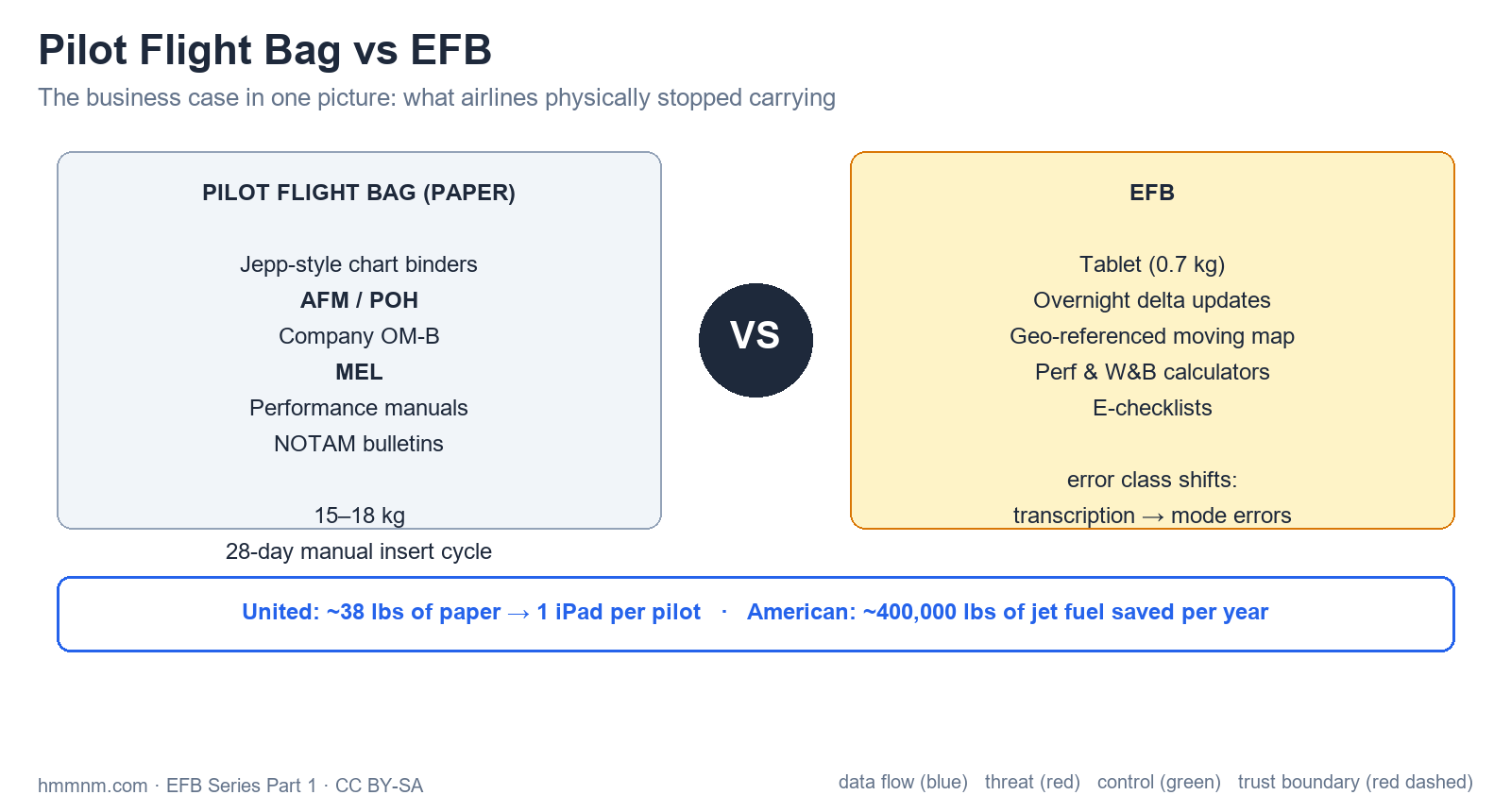
Somewhere in a closet at every legacy airline sits a museum piece: the pilot flight bag. A black leather (later nylon) case, roughly 18 × 14 × 8 inches, weighing — fully loaded — between 15 and 18 kilograms. It carried the entire documentary world a crew needed to fly an airliner: approach plates, enroute charts, the aircraft flight manual, the company operations manual, the minimum equipment list, performance tables, and a folder of weather and NOTAM printouts. United Airlines calculated that replacing it with a single iPad of under 1.5 pounds eliminated roughly 38 pounds of paper per pilot. American Airlines credited its EFB program with saving about 400,000 pounds of jet fuel per year just from the weight shed.
That is the business case. But the Electronic Flight Bag is not merely “paper, but on a screen.” It is a distributed computing system that stretches from state surveyors’ offices to a tablet glowing at 38,000 feet — and every link in that chain is now part of flight safety. This series explains the whole system: hardware, software, data, regulation, attack surface, defenses, and operational safety. This first post gives you the complete mental model.
The Problem EFBs Solved: The 18-Kilogram Flight Bag
Before EFBs, the flight bag was the cockpit’s only data storage — and it had three structural flaws that no amount of discipline could fix.
Flaw 1: The revision cycle. Aeronautical data changes on a fixed global rhythm — the 28-day AIRAC cycle we’ll dissect in Part 4. Under paper, every cycle meant a new stack of “revision strips” to be manually inserted into binders, page by page, at every airline base, for every fleet. A missed insert meant the chart in the binder quietly disagreed with reality. The revision room — with its clerks, its print queues, its library shelves — was a permanent cost center, and a permanent error source.
Flaw 2: The weight. Fuel is money. An extra 35–40 pounds carried on every leg of every aircraft, every day, compounds into the six-figure annual fuel bills that motivated the first airline programs. The operator-reported numbers range up to 80 pounds of documents per flight at some carriers.
Flaw 3: The error class. Paper invites transcription. Performance from tables meant interpolating by hand, writing V-speeds on a scratchpad, and keying them into the aircraft. Every hop was a chance to misread a digit. A safety-science study on electronic versus paper charts found measurably lower pilot response times with electronic charts — and the performance-calculator error class is exactly what Type B applications (Part 3) were designed to shrink.
Here is what all that paper actually became:
Table T1.1 — What the flight bag carried, and what replaced it
| Paper document | Contents | EFB replacement | Software class (Part 3) |
|---|---|---|---|
| Chart binders | Enroute, terminal, approach plates | Electronic chart app with geo-referenced moving map | Type B |
| AFM / POH | Aircraft operating limitations & procedures | Document viewer | Type A |
| Company OM-B | Operations manual | Document management (searchable, revision-controlled) | Type A |
| MEL | Minimum equipment list | Document management with search | Type A |
| Performance manual | Runway-limited weights, V-speed tables | Performance calculator app | Type B |
| NOTAM bulletins | Pre-flight notices | Weather & briefing app (digital NOTAM) | Type A/B |
| Flight folder | Release, weather, fuel plan, dispatch papers | Admin/routing “flight folder” module | Type A/B |
EFB Definition and Core Functions
An EFB, formally, is an electronic display system intended primarily for flight-crew use, capable of storing and computing flight information, and running software that is classified by the worst-case effect of its failure. That definition — synthesized from FAA Advisory Circular 120-76E and EASA’s AMC 20-25 vocabulary — carries three load-bearing ideas:
- It is a display system, not just a device. The tablet, its mount, its power source, its data feed and the applications together form the EFB system. Regulators approve systems, not gadgets.
- It computes. Unlike paper, an EFB can calculate takeoff performance, weight-and-balance, and fuel — which is why software failure classification matters so much (Part 3).
- It is program-managed. No regulator certifies “an iPad.” An operator — airline, charter, or flight department — runs an EFB program: policy, training, backup procedures, revision control (Part 5) that wraps the technology in procedure.
Its four core functions can be remembered as display, compute, store, sync: display of charts and documents; computation of performance and weight; storage of the document library; and synchronization with ground systems that keep the whole fleet on the same data cycle. That last function — sync — is the one paper never had, and it is where most of the security story of Parts 6 and 7 lives.
A Short History of the EFB
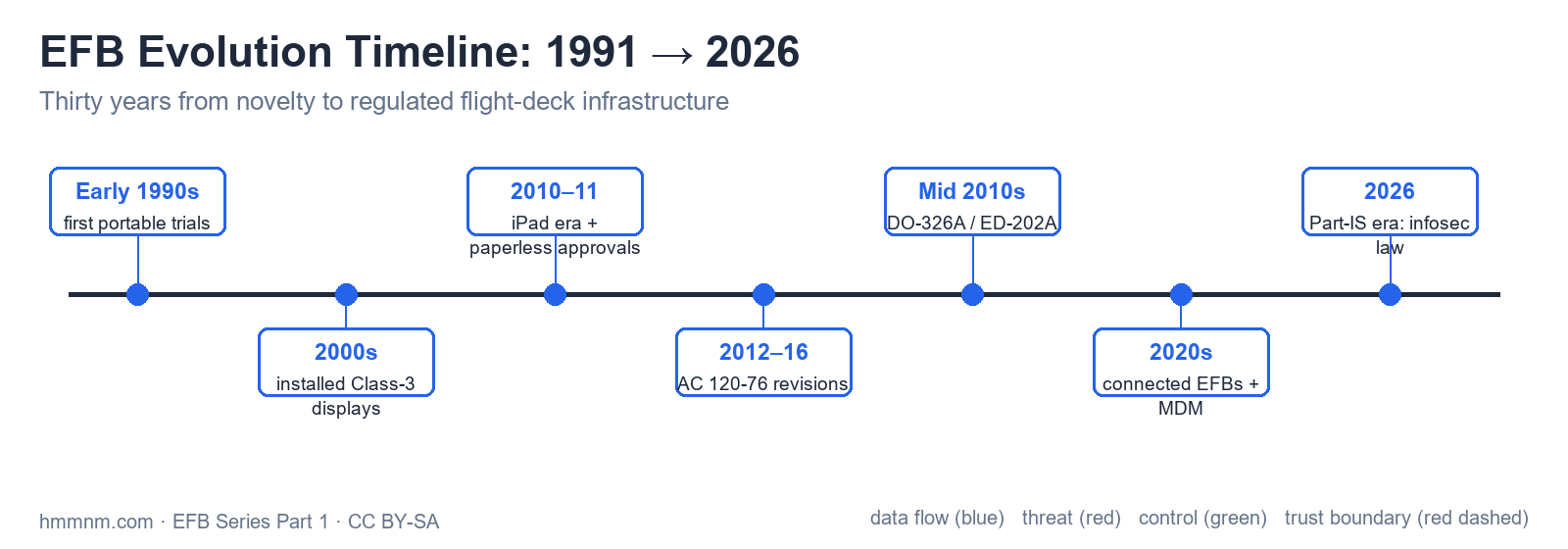
The EFB’s history is a story of consumer hardware repeatedly crashing into certification culture.
Early 1990s — the portables. Cargo operators — FedEx is commonly credited — began experimenting with laptop-class computers running performance software, an era before any real regulatory framework existed.
2000s — the installed era. Airframers integrated EFB displays into the cockpit itself (panel- or pedestal-mounted Class 3 screens), certified as part of the aircraft type design. These were capable but expensive, and adoption stayed limited to new-build widebodies and retrofit programs.
2010–2011 — the iPad discontinuity. The modern EFB era begins when the consumer tablet became good enough: sunlight-readable-enough screens, 10-hour batteries, and instant-on. The first regulatory framings for tablet EFBs (FAA AC 120-76’s early revisions) appeared, and within two to three years every major US airline had announced paperless flight decks.
2012–2016 — harmonization and connection. The regulatory vocabulary matured (hardware classes, software types — Parts 2 and 3), EASA aligned through AMC 20-25, and ICAO’s Doc 10020 gave states a common reference. Fleet-management backends and cellular distribution turned EFBs from stand-alone viewers into connected endpoints — the moment they became information-security objects.
Mid-2010s — security formalized. RTCA DO-326A / EUROCAE ED-202A established airworthiness security as a certification discipline, prompted by the e-enabled aircraft generation (Part 7).
2020s–2026 — the connected, security-regulated EFB. Ground backends manage fleets of thousands of tablets; data integrity is enforced cryptographically where it’s done well; and with EASA’s Part-IS information-security rules in force since October 2025 and February 2026, EFB security is no longer optional hygiene anywhere in Europe. That is the EFB this series covers.
The EFB Ecosystem at a Glance
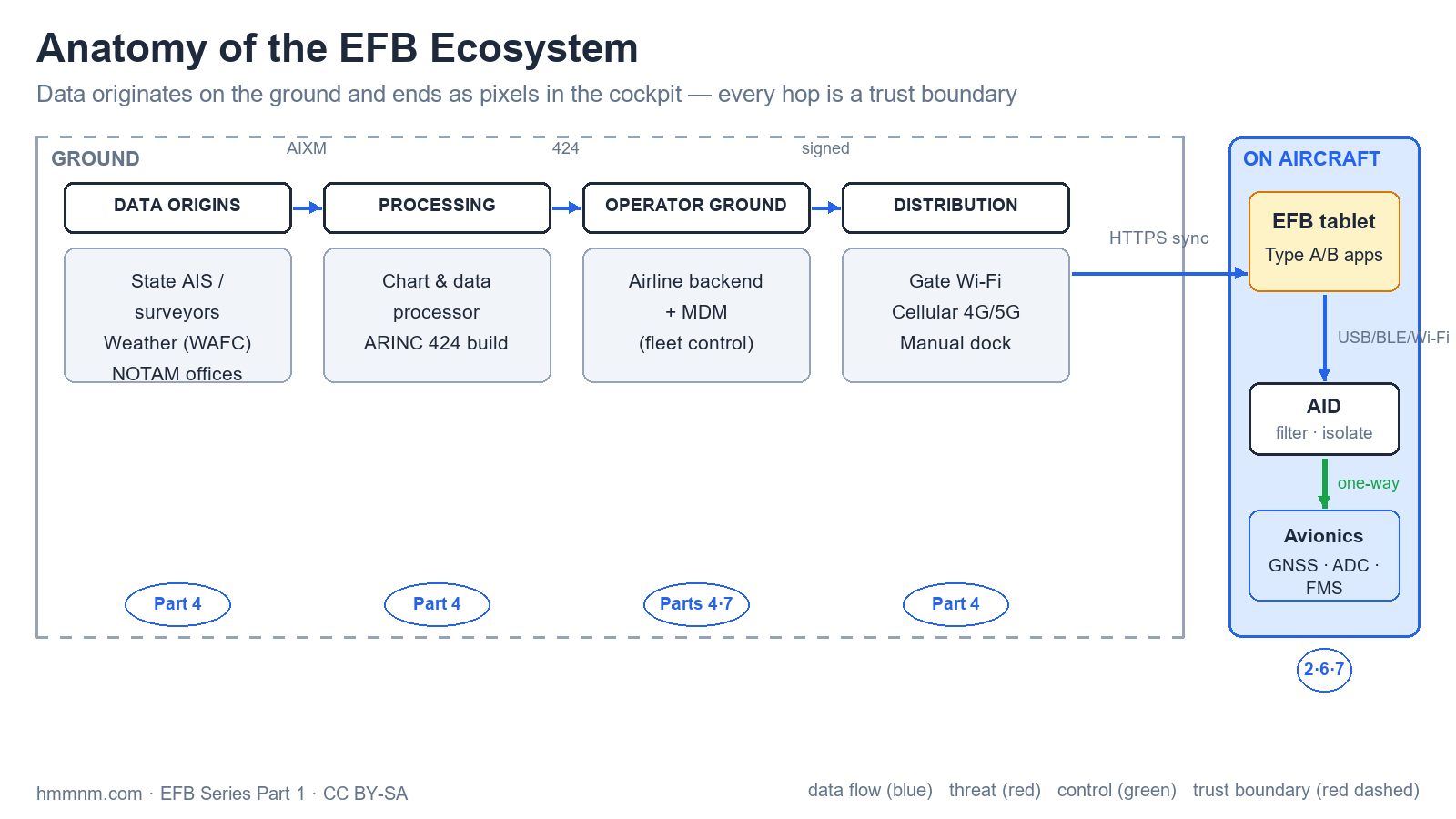
The best way to understand the EFB is to follow one chart’s journey through the ecosystem diagram above — which is also the map of this series.
- Data origination (left). Aeronautical data begins with states: national AIS offices publishing procedure changes per ICAO Annex 15, weather centers (the WAFCs), NOTAM offices. (Part 4)
- Processing. Commercial processors — Jeppesen, Lido, or the state’s own products — convert source data into coded navigation databases (ARINC 424) and rendered chart plates. (Part 4)
- Operator backend + MDM. The airline’s ground systems stage, sign, and distribute data packages; a mobile-device-management layer controls the fleet of tablets themselves. (Parts 4, 7)
- Distribution. Gate Wi-Fi, cellular fleets, or old-fashioned docking cabinets move the data to devices — hundreds of megabytes per cycle. (Part 4)
- The aircraft. Aboard, the tablet runs Type A/B applications; an Aircraft Interface Device (AID) — the small gateway box introduced properly in Part 2 — feeds filtered position and air data from the certified avionics to the non-certified tablet world.
- Everything red in later parts. Each arrow above is a trust boundary. Part 6 maps who can attack each one; Part 7 builds the defenses.
Benefits Beyond Weight
Weight paid for the EFB; these are the dividends:
- Currency by construction. An EFB’s data has an effective date and the device knows it. Paper’s revision discipline depended on a human inserting pages at 2 a.m.; the electronic cycle expires loudly and on schedule — if the integrity chain holds (Part 4’s “if,” Part 7’s job).
- Situational awareness. Geo-referenced approach plates with own-ship position — the moving map — turned the approach chart from a static document into a live display. It is the single most loved EFB feature in every human-factors survey.
- Error-class reduction. Computed performance replaces hand interpolation; searchable documents replace tab-flipping; both remove known error families while adding new ones (Part 8, human factors).
- Operational leverage. The EFB became the cockpit’s workstation: flight release acceptance, tech-log entries, weather updates in flight. What started as a chart viewer is now the interface between the crew and the operator’s entire ground IT.
The Trade-offs: Why EFBs Create New Risks
An honest 2026 guide cannot end on benefits, because every advantage above has a shadow.
- A lithium battery in the cockpit. A paper chart has never entered thermal runaway. Tablets can — and the procedure for it is drilled, not improvised (Part 8).
- Software fails in common. Two pilots carrying two paper bags never suffered the same simultaneous failure. Two tablets on one OS build, one app version, one data cycle can — the common-mode problem (Part 8).
- A data dependency. If the pipeline that feeds the EFB is late, poisoned, or bricked, the cockpit’s entire document world is affected at once (Part 4).
- An attack surface. A connected, programmable, ground-managed device in the cockpit is an IT endpoint. Published security research — including a demonstrated hardware attack feeding manipulated data to real Boeing 737 avionics on a test bench — means we can no longer discuss EFB safety without EFB security (Parts 6 and 7).
That last point is the thesis of this entire series, and it deserves to be stated plainly:
When you replace paper with software, data integrity becomes a flight-safety property. Security and safety converge on the EFB.
Everything that follows — the classes, the types, the cycles, the standards, the attack trees, the checklists — is that one sentence, unfolded.
Key Takeaways
- An EFB is a system — display, compute, storage, sync — not just a tablet; regulators approve programs, not gadgets.
- The paper bag weighed 15–18 kg; United replaced ~38 lbs per pilot with one iPad; American saves ~400,000 lbs of fuel/year.
- Software is classified by failure effect (Type A/B/C); hardware by attachment to the aircraft (classes → portable/installed).
- The EFB is only as current as its data pipeline: 28-day AIRAC cycles, effective-dated, distribution-managed.
- Connectivity turned the EFB into an IT endpoint — with a real, researched attack surface.
- Security and safety converge on the EFB: data integrity is now a flight-safety property.
- The whole system, block by block: Parts 2–8 of this series.
FAQ
What does EFB stand for in aviation?
EFB stands for Electronic Flight Bag. It names the electronic system — device, software, data feed and mounting — that replaces the pilot’s traditional paper flight bag of charts, manuals and performance documents.
Is an iPad an EFB?
An iPad becomes an EFB only inside an operator’s approved EFB program: authorized applications, an approved mount or stowage, a power and battery policy, revision control and training. The hardware alone is just a consumer tablet.
How much weight do EFBs save airlines?
United replaced roughly 38 pounds of paper per pilot with a sub-1.5-pound iPad; American Airlines credits EFBs with about 400,000 pounds of jet fuel saved annually. Operator-reported document weights reach 80 pounds per flight.
Can an EFB replace all paper in the cockpit?
Approved EFB programs can replace paper charts, manuals and performance data for most operations, but only with documented backup and reversion procedures — dual independent devices or retained paper quick-reference items — validated in the operator’s authorization.
Are EFBs secure?
EFBs are securable, not inherently secure. They are connected IT endpoints with a documented attack surface; defenses exist (cryptographic data signing, device management, network isolation — Parts 6–7) and regulation increasingly requires them.
When did airlines start using EFBs?
Early laptop experiments date to the 1990s; installed Class 3 screens spread through the 2000s; the tablet era began around 2010–2011, and within a few years major airlines were flying fully paperless flight decks.
What is the difference between an EFB and ForeFlight?
ForeFlight is an application (a Type A/B software product); an EFB is the whole certified-in-context system. Running ForeFlight on a managed tablet inside an operator’s EFB program makes it part of an EFB.
References
- FAA, Advisory Circular 120-76E — Electronic Flight Bag (faa.gov PDF, June 2024)
- SKYbrary, “Electronic Flight Bag (EFB)”
- United Airlines newsroom — iPad / paperless flight deck rollout (united.mediaroom.com)
- Aviation Today, “EFBs: More Than Paper Replacers” — American Airlines fuel-savings figure (interactive.aviationtoday.com)
- Safety-science study on electronic vs. paper chart response times (sciencedirect.com)
- EASA, AMC 20-25A — Airworthiness Considerations for Electronic Flight Bags (ED Decision 2019/008/R)
- ICAO, Doc 10020 — Manual of Electronic Flight Bags (2nd edition, 2018)
[← Series Hub] · Part 2: EFB Hardware — Class 1/2/3 and the AID →
The complete 8-part series is published — bookmark the series hub for the full set.
Current as of September 2026 · standards verified against the latest revisions.
Educational reference only — always follow your operator’s approved EFB program and your NAA’s current guidance.
Author: hmmnm.com editorial team · hmmnm.com