EFB SERIES · PART 6 OF 8 — Technology, Security & Safety · Series Hub · ← Part 5 · Part 7 → (publishes Sep 10)
TL;DR — Can an EFB be hacked? Yes — as a connected, programmable, ground-managed IT endpoint, the EFB has a mappable attack surface: the device itself, the update pipeline, the aircraft interface, and the supply chain. Published research has already demonstrated the key classes, including a coin-sized hardware implant that manipulated data flowing through real Boeing 737 avionics on a test bench. No real-world EFB-caused accident is known — which is exactly why the defense window is open now.
This is the post this series was built around. Parts 1–5 assembled the machine: the system concept, the hardware boundary, the software classes, the data pipeline, the rulebook. Now we do what this site does — put on the attacker’s glasses and ask hard questions about every trust boundary we drew.
Ground rules before the fun starts. First, everything in the “hypothetical” sections below is analysis, not instruction — we describe attack classes and cite published research, we don’t hand anyone an operational playbook. Second, the honest risk posture: there is no known real-world accident caused by a compromised EFB. What exists is demonstrated feasibility on test benches, published tampering research, and a structural argument. That combination — proven possible, not yet exploited — is precisely the window in which rational defenders build their walls. Part 7 builds them; today we earn them.
Threat Modeling the EFB Properly
A 1.5-lb tablet is an IT endpoint at 38,000 feet — and its crown-jewel property is the integrity of navigation and performance data.
Start by re-weighting the classic CIA triad for this target. In enterprise security, confidentiality usually leads. On a flight deck, integrity dominates: an attacker who reads your charts has embarrassed you; an attacker who changes a procedure altitude, an obstacle, a minimum, or a runway-length parameter is writing new physics into the cockpit. Availability follows — a bricked EFB fleet is a ground-stop weapon, not a crash weapon. Confidentiality matters mostly to the operator’s business (schedules, crews, ops data), which still gets you ransomware economics.
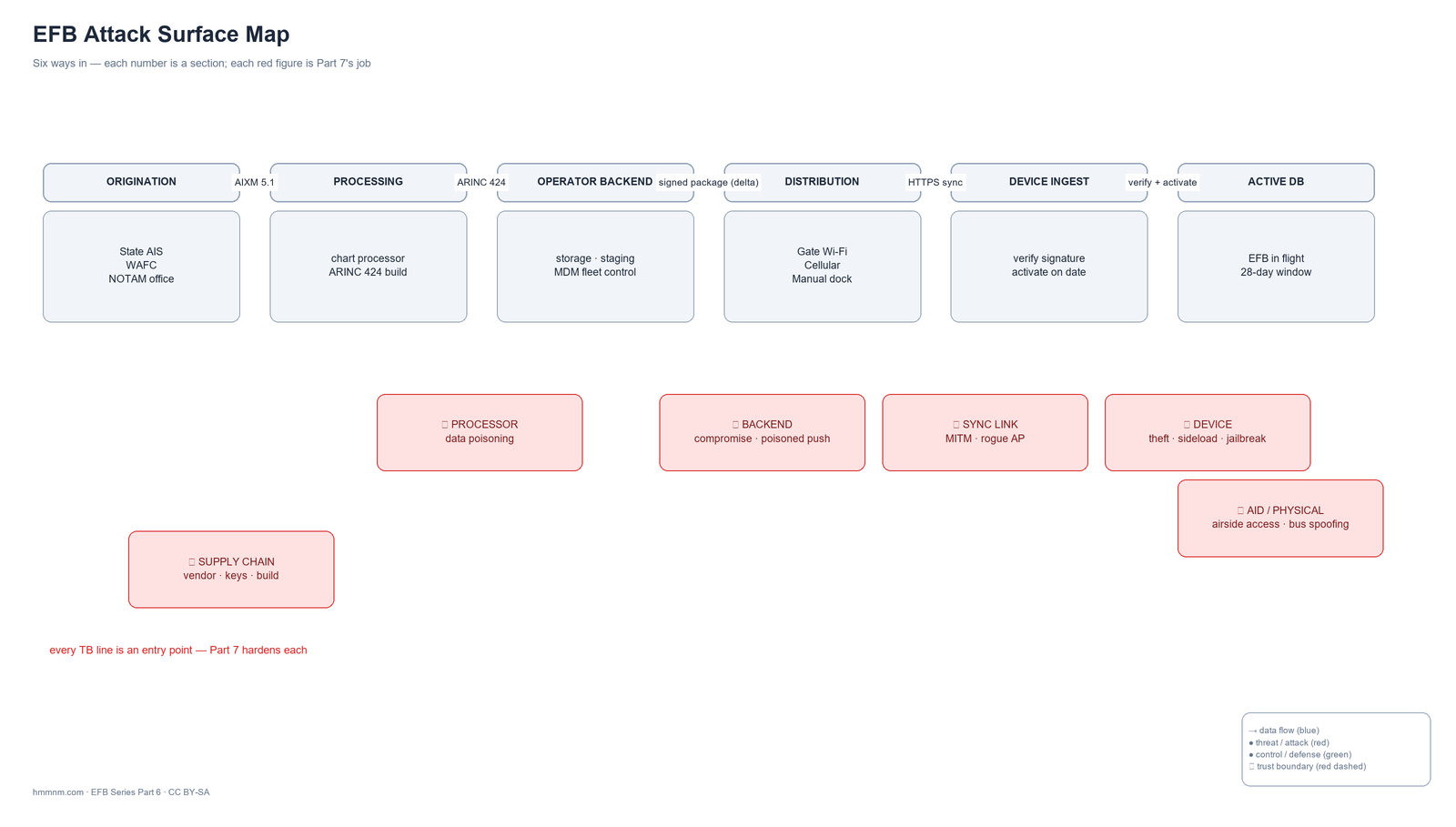
Table T6.1 — STRIDE across the EFB estate
| STRIDE | Component | Concrete scenario | Safety impact | Detectability |
|---|---|---|---|---|
| Spoofing | AID/position feed | Forged ARINC 429 labels feed wrong own-ship position | Wrong moving-map SA | Medium |
| Tampering | Chart/perf data | Poisoned procedure values, minima, obstacles | High — integrity is the crown jewel | Low |
| Repudiation | Update logs | Push denied; no signed audit trail of who shipped what | Forensic loss | High (absence noticed late) |
| Information disclosure | Device, backend | Ops data, crew credentials, DRM keys extracted | Business harm | Medium |
| Denial of service | Update path, devices | Fleet-wide bricked rollout; ransomware on distribution | Ground-stop class | High (loudly obvious) |
| Elevation of privilege | MDM, platform services | Compromised fleet manager pivots to every device | High | Low |
Table T6.2 — Who would attack an EFB, and why
| Actor | Capability | Favorite vectors | Motivation |
|---|---|---|---|
| Insider (ramp, maintenance, dispatch) | Physical access, process knowledge | AID/hatch access, dock tampering | Grievance, coercion, curiosity |
| Organized crime | Software, patience | Backend ransomware, data theft | Money |
| State actors | Everything, long timelines | Supply-chain prepositioning, key theft | Strategic access |
| Hacktivists/researchers | Variable | Public-facing surfaces, device attacks | Attention, disclosure |
Attack Vector 1: The Device
The easiest EFB to attack is the one you’re holding.
The unglamorous vectors first: loss and theft, with a wipe-race between the operator’s MDM remote-wipe and the thief’s faraday bag. Then lock bypass — PIN/biometric defeats on fleet tablets are a well-trodden consumer-security landscape. Then the configuration cancers: jailbroken or rooted fleet devices (which strip the OS guarantees every downstream control assumes), sideloaded or repackaged applications, and malicious configuration profiles/MDM abuse — the fleet-management layer itself becoming the attack (more in the supply-chain section).
Physical exposure is underrated: shared charging kiosks and cables in crew rooms are the classic juice-jacking / malicious-cable (O.MG-class) territory [attack-class reference, not aviation incident]. None of this is exotic. The important observation for EFB threat modeling: a compromised device is not just a lost secret — it is a synchronization peer. It talks to the backend, it can hold credentials, and in badly designed sync schemes it can push state upward. One device is not one device; it’s a foothold.
Attack Vector 2: The Data Pipeline — Chart Data Poisoning
The scariest EFB attack doesn’t delete anything. It edits.
Return to Part 4’s pipeline and think like an integrity attacker. Deleting charts gets noticed — screens go empty, alarms fire. The winning move is subtle falsification: nudge a procedure altitude, add a fictional obstacle, shift a waypoint, shorten a runway-length parameter, or bend a minimum. The data still looks like data. It passes every currency check, renders on every plate, and — if the crew has no independent cross-source comparison — silently becomes the version of the world the cockpit acts on, ideally timed to high workload where cross-checks decay.
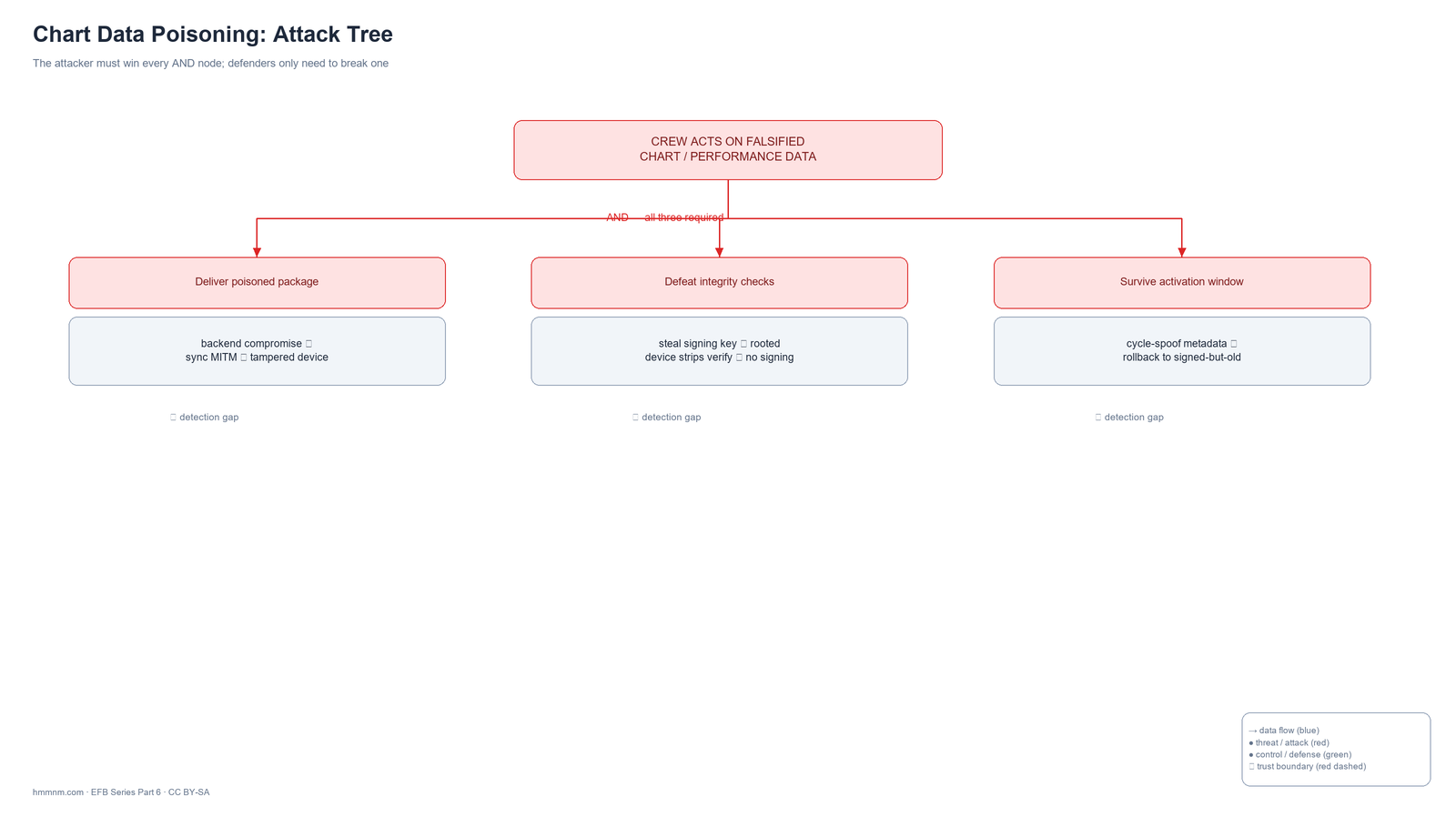
The attack tree above formalizes it. The root — crew acts on falsified data — requires three AND-branches, each with OR-alternatives underneath:
- Deliver a poisoned package: compromise the processor backend ∪ intercept/modify a sync ∪ tamper with a rooted device’s stored data;
- Defeat integrity checks: steal the signing key ∪ run on a rooted device that strips verification ∪ exploit absent/weak signing (Part 4 noted deployment maturity is uneven);
- Survive the activation window: spoof cycle metadata so stale looks current ∪ roll back to an old-but-validly-signed cycle (which is why Part 7 insists on anti-rollback counters).
Adjacent pipeline attacks share DNA: MITM on ground sync (rogue access point / evil-portal-class during gate Wi-Fi — plausible wherever crew tablets opportunistically join networks), and cycle-spoofing standalone — leave the data intact, falsify only the metadata that says this is current, and you’ve re-created the stale-data cardinal sin from Part 4, deliberately.
Attack Vector 3: The Aircraft Interface — the 737 Research
The most concrete EFB-adjacent attack ever published fits in a coin-sized package and takes about 60 seconds to install.
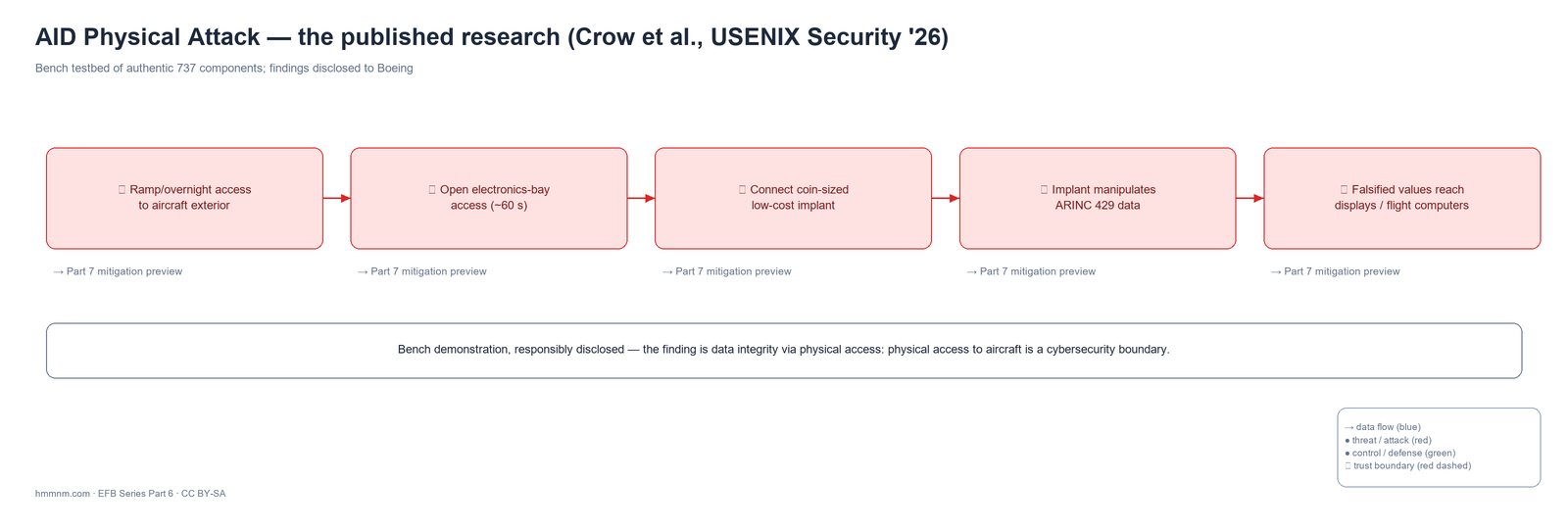
At the USENIX Security Symposium in August 2026, a UC San Diego–led team presented “Design and Implementation of a Physical Implant Attack on the Boeing 737” — Sam Crow, Stephen Checkoway, Patrick Mercier, Pat Pannuto, Stefan Savage, and Aaron Schulman. The essential facts: on a laboratory testbed built from authentic 737 components and software, the team showed that a coin-sized, low-cost hardware implant can be installed with roughly 60 seconds of physical access to the aircraft’s electronics bay — and once inline on the ARINC 429 bus, it can manipulate flight data, with the researchers’ analysis extending to data exchanged between flight computers and, potentially, displayed guidance. The exploit’s enabler is the one Part 2 flagged in its ARINC 429 table: the bus has no authentication. It was designed in an era when being on the wire was the credential.
Two honest clarifications keep this finding its proper size. First, bench ≠ airplane: this was a testbed demonstration, responsibly disclosed to Boeing — not an in-service compromise. Second, the attack operates on data integrity — falsifying what avionics and displays consume — within a controlled threat analysis. But the structural lesson is unshrinking: physical access to aircraft data paths is a cybersecurity boundary, and the industry’s perimeter assumptions (hatches, ports, ramp discipline) were never threat-modeled as such. The AID from Part 2 — that border checkpoint between certified and non-certified worlds — sits exactly where this class of attack operates, which is why Part 7 hardens it as a security gateway rather than a mere format converter.
Attack Vector 4: Ground Infrastructure and Supply Chain
Compromise the backend once, own the fleet’s documents forever.
The operator backend and its MDM are force multipliers: a single compromise pushes to every device. The classes here are the classics this site has covered for years: poisoned MDM — the fleet’s brain issuing malicious configuration or application pushes (the SolarWinds pattern applied to tablets); stolen developer or signing keys — the direct route to defeating vector 2’s integrity checks; build-chain compromise of the EFB vendor’s pipeline (the xz-backdoor lesson: the artifact is fine, the factory is rotten); and the enabling absence of SBOMs — without a software bill of materials, nobody can even answer “are we running the poisoned build?” These are enterprise supply-chain problems wearing aviation jackets, and they’re why Part 7’s Layer 4 reads like an extension of this site’s existing supply-chain coverage.
Case Files: What Security Researchers Have Already Shown
Table T6.3 — Published EFB/aviation-data security research index
| Research | Target | Technique | Lesson |
|---|---|---|---|
| Crow et al., USENIX Security ’26 | ARINC 429 data path | Coin-sized inline implant via electronics-bay access | Physical access = cyber boundary; unauthenticated buses |
| Pen Test Partners EFB tampering series | EFB device integrity | Chart-data modification on device | Device integrity assumptions need testing, not trusting |
| Wolf, “IT Security Threats to Modern e-Enabled Aircraft” (AIAA, 2014) | e-Enabled aircraft incl. EFB | Threat taxonomy incl. DoS/malware | The canonical academic framing of this entire post |
| GAO avionics-cybersecurity reports (2015, 2021) | Policy layer | Survey | Certification frameworks weren’t built for adversaries |
Ken Munro’s team at Pen Test Partners deserves specific credit in this story: their multi-part EFB work publicly demonstrated that tampering with chart data on the device was more feasible than the industry’s comfort level assumed, and their responsible-disclosure arc pushed vendors on exactly the device-integrity and signing issues Part 7 catalogs as controls.
Why Availability Attacks Still Matter
You don’t need to crash an airplane to cost an airline eight figures.
A ransomware event on the distribution backend, a “bricked” fleet-wide update pushed at 05:00, or even aggressive battery-drain malware on aging tablets — each converts the EFB estate from asset to liability within one departure bank. Availability attacks are the cheap, loud, monetizable end of this threat model: no subtle integrity engineering required, immediate operational leverage. Insurance and business-continuity people care about this class as much as safety engineers care about poisoning; a defensible program (Part 7) has to answer both.
Risk Posture Synthesis
Plot the six vectors on exploitability × safety impact and the defense priorities fall out.
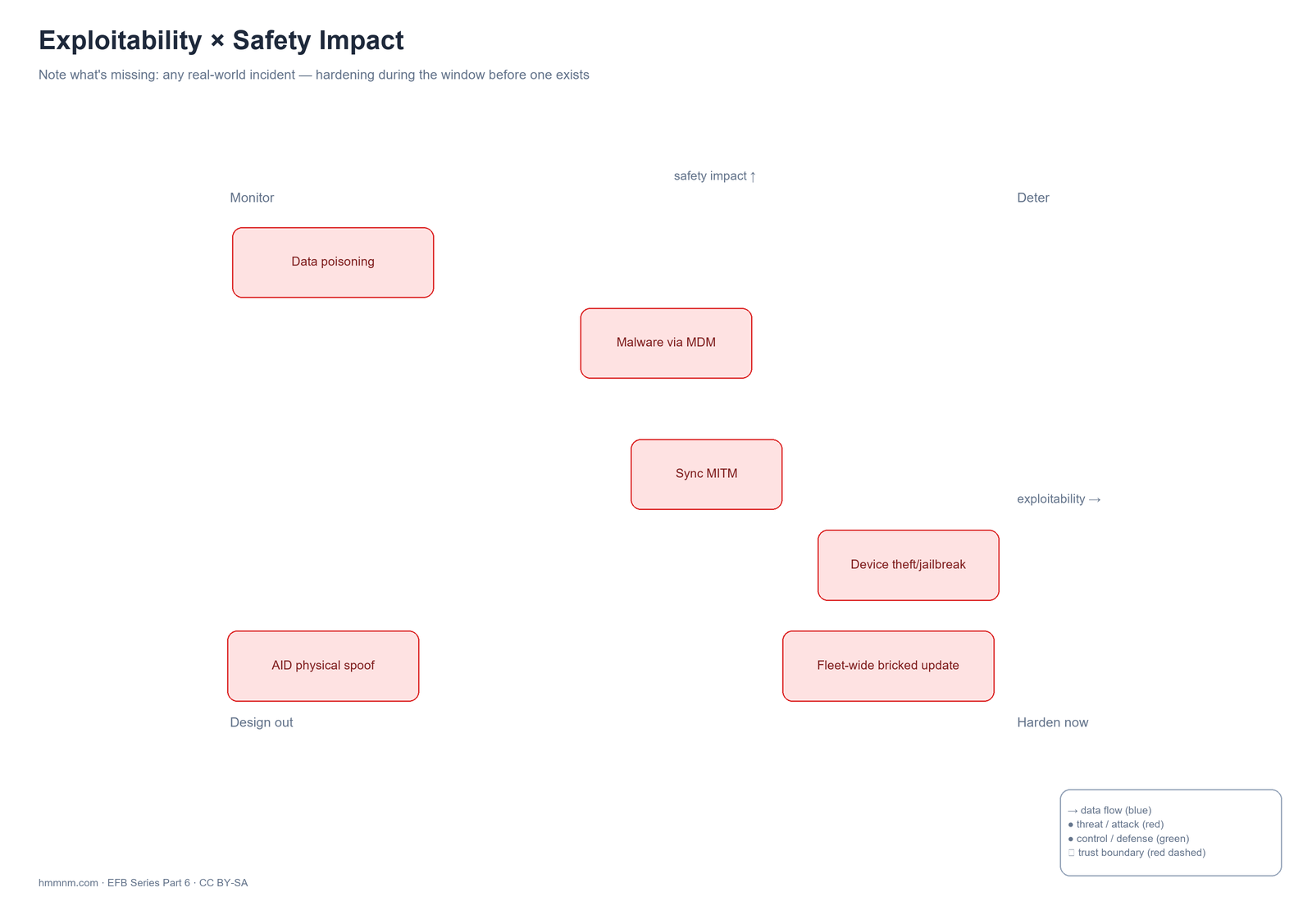
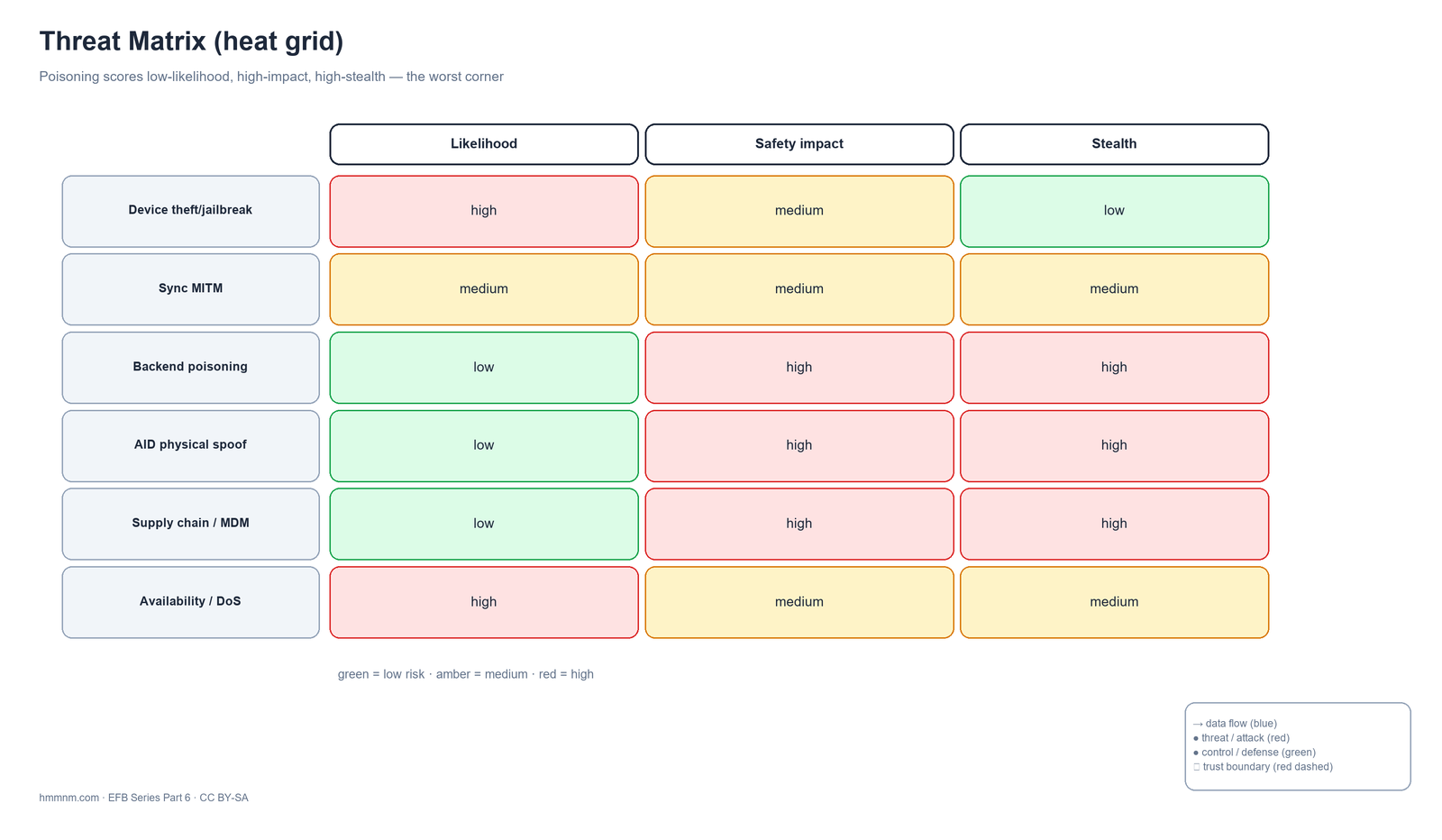
Device theft sits high-exploitability/mid-impact (money and data, mostly). Data poisoning sits lower-exploitability (needs real capability) but top-impact and top-stealth — the corner that justifies cryptographic infrastructure. The AID/physical class gates on the hardest prerequisite (airside access) which is also its containment: physical security is the control. Supply-chain/MDM compromise is the strategic threat — rare, devastating, and best-detected rather than best-prevented. Nothing here argues panic. Everything here argues architecture — which is tomorrow.
Tomorrow, Part 7 answers this post control-by-control: DO-326A/ED-202A airworthiness security, MDM hardening, signed chart data, the AID as a real security gateway, and a 20-item operator checklist that breaks every attack chain shown today.
Key Takeaways
- Re-weight CIA for the flight deck: integrity ≫ availability > confidentiality — the crown jewel is truth of navigation/performance data.
- Six mapped entry points: device, sync link, backend, processor, AID/physical access, supply chain.
- The scariest attack class is subtle data poisoning — wrong-but-plausible beats deleted-and-missing; it requires defeating signing and surviving activation checks.
- Published research already proves key classes: a coin-sized hardware implant manipulating 737 bench-avionics data via electronics-bay access (~60 s), enabled by ARINC 429’s absent authentication; PPT’s on-device tampering work.
- Compromised MDM/backend is the force multiplier — supply-chain classes (SolarWinds/xz lineage) apply directly.
- Availability attacks (ransomware, bricked rollouts) are the monetizable tier — no crash required.
- No known real-world EFB-caused accident: demonstrated-feasible, not-yet-exploited — the defense window is open now, and Part 7 walks through it.
FAQ
Can an EFB be hacked?
As a connected, programmable, ground-managed endpoint — yes, it has a mappable attack surface spanning device, data pipeline, aircraft interface and supply chain. Published research demonstrates the key attack classes, though no real-world compromise-driven accident is known.
Has an EFB ever been hacked in the real world?
No publicly known in-service EFB compromise has caused an aviation incident. What exists is research demonstration — including a bench attack on real 737 avionics — and responsible-disclosure findings on device tampering.
What is EFB data poisoning?
Tampering with chart or performance data so it remains plausible-looking while false — a shifted altitude, obstacle, minimum or runway parameter. It defeats currency checks by design and targets the cockpit’s trust in its own reference data.
Can a hacked EFB affect flight controls?
No demonstrated path exists from an EFB into flight-control systems; in compliant installations the AID enforces a one-way data flow to the EFB. The demonstrated risk is integrity of displayed and advisory data — still a serious safety concern.
Are iPads in cockpits secure?
They are securable: managed-enrollment MDM, no sideloading, encryption, and signed-data verification make a fleet tablet defensible. Consumer defaults — open configuration, app-store freedom, unmanaged sync — do not.
Is ARINC 429 encrypted?
No. ARINC 429 has no authentication or encryption; it predates threat modeling. Security comes from architecture — physical access control and gateway filtering — not from the protocol itself.
Who would attack an aircraft’s EFB?
Threat-actor analysis spans insiders with physical access (grievance/coercion), organized crime (ransomware on ops data), state actors (strategic prepositioning via supply chain), and researchers (disclosure). Different actors, different favorite vectors — all covered by the same defense layers.
References
- S. Crow, S. Checkoway, P. Mercier, P. Pannuto, S. Savage, A. Schulman, “Design and Implementation of a Physical Implant Attack on the Boeing 737,” USENIX Security Symposium 2026 (usenix.org/conference/usenixsecurity26/presentation/crow)
- UC San Diego Today, “Researchers Use a Physical Device to Take Over Electronics in a Boeing 737” (today.ucsd.edu); Wired and Aerospace Global News coverage
- GAO-15-370, Air Traffic Control: FAA Needs a More Comprehensive Approach to Address Cybersecurity as Agency Transitions to NextGen (2015); GAO-21-86, Aviation Cybersecurity (2021) (gao.gov)
- Pen Test Partners, EFB tampering series — device integrity (pentestpartners.com/security-blog/efb-tampering-2-device-integrity/)
- M. Wolf, “IT Security Threats to Modern e-Enabled Aircraft,” AIAA Journal of Aerospace Information Systems (arc.aiaa.org/doi/10.2514/1.I010156)
- SKYbrary, “Electronic Flight Bag (EFB)” — operational and safety context (skybrary.aero/articles/electronic-flight-bag-efb)
- AircraftIT, “EFB Data Security & Connectivity”; Aerospace Innovations, “EFBs: Cyber Safety”
- FAA AC 120-76E & EASA Part-IS context — Part 5 of this series
[← Part 5: Regulations] · [Series Hub] · Part 7: Securing the EFB — DO-326A & Defense-in-Depth → (publishes Sep 10)
Parts publish daily through September 11 — bookmark the series hub for the full run.
Current as of September 2026 · standards verified against the latest revisions.
Educational reference only — always follow your operator’s approved EFB program and your NAA’s current guidance. Attack scenarios are analytical and based on published research; no operational exploitation guidance is provided.
Author: hmmnm.com editorial team · hmmnm.com