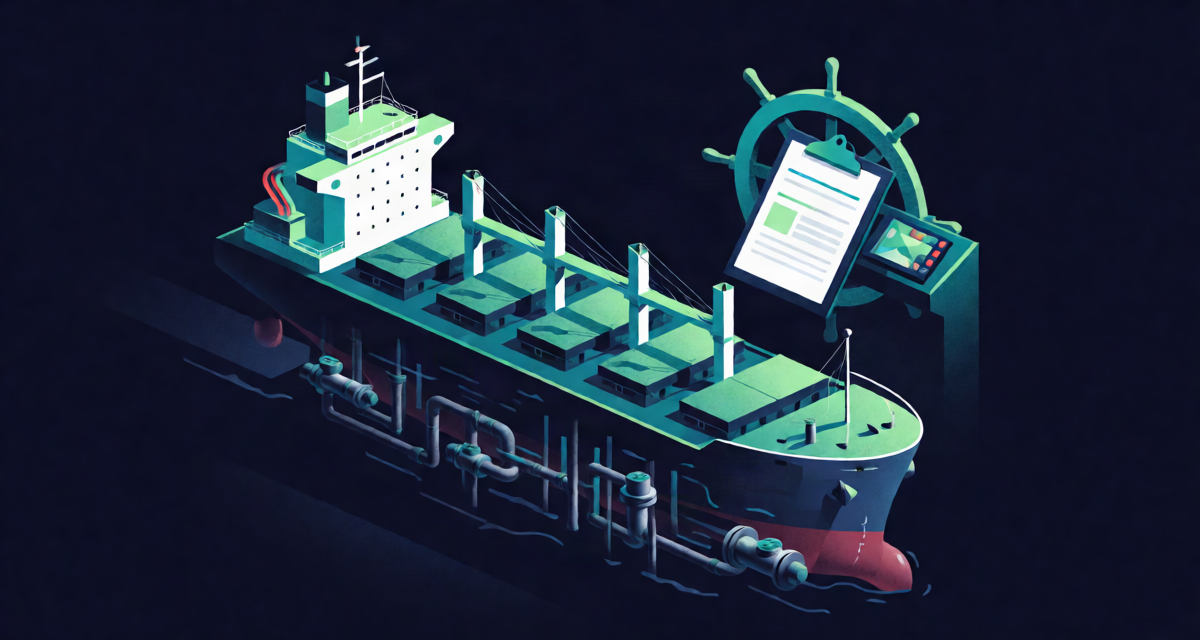
Maritime cyber regulation stopped being voluntary: since January 2024 ships and shipping companies must manage cyber risk under IMO resolution MSC.428(85)-derived requirements enforced through flag and port-state control, IACS UR E26 (systems integration/design assurance across the vessel lifecycle) and E27 (system-level security for onboard systems and equipment) give class societies the concrete assessment criteria, and the US Coast Guard now treats deficient cyber risk management on certain vessels as a detention-worthy deficiency. In practice a ship is a floating OT network — bridge, cargo, propulsion, SATCOM, and crew IT sharing hull space — where a compromised mailbox ashore has grounded fleets and ransomware has disabled hull systems. Getting compliant-and-actually-secure means treating the vessel as an OT estate: inventory and zone the floating systems, harden the SATCOM/IT/OT boundaries, maintain the shipboard-vs-ashore split for patching and incident response, and exercise it — because surveys and PSC inspections increasingly ask for evidence of the process, not a binder of policies.
A modern vessel is a data centre’s awkward cousin: propulsion controllers, bridge navigation, cargo management, satellite communications, and a crew Wi-Fi network, all packed into a steel box that spends months at sea with intermittent, expensive connectivity and a maintenance model built around dry docks. For twenty years the industry treated that estate’s cyber risk as an optional add-on — guidance documents and voluntary frameworks, rarely surveyed, never detained. That era ended. Ship cyber risk management is now mandatory under the IMO’s regime, it is classable through IACS’s E26 and E27 requirements, and in US waters the Coast Guard can — and does — hold vessels with deficient cyber programs.
The wake-up incidents are documented, not hypothetical: a container line’s ashore IT compromise cascaded into ships’ systems and halted a fleet for days; ransomware has taken hull and cargo systems offline mid-voyage; satellite-communication terminals with default credentials have been exposed en masse on the public internet. The bridge-to-engine-room attack surface is real, and the regulator’s patience for “it’s a floating office, IT handles it” ran out.
This guide walks what the rules actually demand (IMO/flag, IACS E26/E27, USCG), how a ship’s systems carve into security zones, what testing and surveys look like in practice, where checklist-driven compliance predictably fails, and how to build a maritime cyber program that survives both the port-state inspector and the actual attacker.
The Rulebook: From Voluntary to Detention-Ready
IMO and flag administrations
The IMO embedded cyber risk into the International Safety Management (ISM) Code through resolution MSC.428(85): cyber risk must be assessed and managed within the vessel’s Safety Management System — effectively “ISM now includes cyber.” Document what you have, assess what could go wrong, mitigate, drill, review. Flag administrations translate this into national requirements and audit it through DOC/SMC cycles, meaning your Document of Compliance audits and Safety Management Certificates now touch the cyber program whether or not the auditor says the word “firewall.”
IACS UR E26 and E27 — the “how”
The International Association of Classification Societies converted intent into engineering criteria, effective for contracted vessels from July 2024:
- UR E26 (Cyber Resilience of Ships) — whole-vessel, lifecycle: the design must partition onboard systems into security zones and conduits, control communication paths between them, and carry the resilience through build, commissioning, operations, and decommissioning. E26 is where “which systems may talk to which” becomes a classification-surveyed design artefact.
- UR E27 (Cyber Resilience of Onboard Systems and Equipment) — component/system level: equipment vendors must deliver hardened systems (secure configuration, authentication, logging, update capability, integrity protections) so that integrating them into E26 zones doesn’t import easy vulnerabilities. Think of E27 as the equipment security passport that E26’s naval-architectural security design depends on.
For newbuilds this is now part of class survey. For existing fleets it is the reference framework retrofit programs are measured against — and the vocabulary (zones, conduits, resilience) that flag and port-state conversations increasingly use.
US Coast Guard: enforcement with teeth
The USCG codified cyber into its marine-safety regime: certain U.S.-flagged vessels and outer-continental-shelf fleets must document and implement cyber risk management in their Vessel Security Plans, and port-state control inspectors worldwide (USCG prominent among them) can issue deficiencies — up to detention — for ships whose cyber risk management is demonstrably absent. The message from enforcement to date: the inspector won’t audit your firewall rules line-by-line, but will ask how you’d handle a compromised SATCOM, whether you’ve thought about cargo-system connectivity, and whether the answer exists anywhere outside a consultant’s slide deck.
The Ship as an OT Estate: Zones You Must Name
E26’s zone-and-conduit model matches how the ship actually fails. A practical decomposition:
| Zone | Representative systems | Key exposures |
|---|---|---|
| Bridge / navigation | ECDIS, radar, Voyage Data Recorder, GNSS/ais | Chart/format update chains, USB media, integration servers |
| Propulsion & machinery (engine control) | alarms and monitoring, PMS, PMU | Vendor remote support paths, machinery-space laptops |
| Cargo & ballast | loading computers, tank gauging, reefer monitoring | Shoreside cargo-data links, stevedore networks |
| Communications | VSAT/Fleet Broadband, antenna control, e-mail gateway, crew WAN | Public-internet exposure of terminals, default vendor creds |
| Crew & admin IT | office PCs, Wi-Fi, entertainment systems | Phishing, lateral movement toward technical networks |
| Shoreside/company | fleet ops, agent communications, technical dept mail | The proven kill-chain starting point — compromised ashore mailbox → fleet outage |
Two boundary truths dominate maritime incident history: the SATCOM boundary (a modem managing traffic for all zones is simultaneously a router, an attack surface, and a single point of failure) and the shoreside link (the most common initial-compromise vector isn’t on the ship at all — it’s the company network whose credentials then reach shipboard systems during port calls or remote-support sessions). Any program that hardens the vessel but ignores the office-to-ship conduit is decorating a drawbridge.
Building the Program: Inventory, Risk, Controls, Evidence
1. Inventory (the unglamorous foundation)
You cannot zone what you haven’t named. Inventory per vessel: systems, vendors, network connections (including the ones the vendor installed quietly during the last dock), remote-access endpoints, and every path data enters the hull (chart updates, cargo manifests, spare-part catalogues, crew media). Fleet-level, maintain it as a living asset list keyed to the ship — the artefact every downstream duty (risk assessment, incident response, surveys) references.
2. Risk assessment against real chains
Assess scenarios, not vulnerabilities-in-isolation: compromised shoreside mailbox reaching ECDIS update chains during a port call; ransomware on the crew network pivoting via a shared gateway into machinery monitoring; remote vendor support session into engine-control with reused credentials from the breach corpus; GNSS spoofing adjacent to a chart-corruption event (not “hacking” the IMO way, but a resilience scenario worth documenting). Score by consequence-to-vessel-safety, and drive mitigations that actually touch the chains: session-based brokered remote access, media hygiene on chart/updates, credentials that are per-vessel and rotated.
3. Controls: the maritime top ten
- Brokered, session-recorded remote vendor access (no always-on tunnels, no shared vendor creds)
- SATCOM gateway hardening — changed defaults, patched firmware, egress control at the antenna’s router
- Network segmentation between crew IT and technical systems (E26 zone logic, applied pragmatically to existing cable realities: VLANs plus enforced ACLs at the least, physical separation for machinery networks at best)
- Chart-update and software-media hygiene — signed sources, dedicated transfer laptops, no seaman’s-USB culture
- Per-vessel credential model: unique admin passwords, vaulted ashore, MFA where systems allow, offline break-glass procedure for bridge-critical systems
- Patch and configuration rhythm adapted to connectivity windows: a defined defer-policy with compensating controls when a dock is 3 weeks away
- Logging that survives the voyage: centralised collection when bandwidth permits, on-hull retention when not, time-synced for forensics
- Detection in depth: SATCOM-egress monitoring for C2 patterns, EDR on admin/crew endpoints, protocol-aware checks on machinery links where feasible
- Response capability split shipboard/ashore: the ship isolates and switches to degraded but safe manual operations; the shore handles forensics, vendor coordination, and flag/port notifications
- Exercises that include the master and chief engineer — including the “IT is the incident” case where email is down and notifications must flow via contractual backup channels
4. Evidence
Because surveys and PSC ask “show me”: link inventory → assessment → mitigations → drills → review records in one navigable trail per vessel. The trail is ship-specific; fleet templates get you 70% but the inspector’s questions land on the individual hull (what SATCOM is fitted, what remote support exists on this engine). The audit passes on cross-referenced evidence, not binder weight.
Where Checklists Fail (and Fleets Get Surprised)
- Paper-SMS syndrome: the cyber risk assessment exists as a PDF from a consultant, referenced in the Safety Management System, matching no system aboard. Inspectors increasingly cross-check the inventory against the actual bridge — the VDR/ECDIS vendor model question catches the template fleet instantly.
- The organisational seam: shipping companies split authority between technical (machinery), marine (bridge), and IT (crew/office) departments; the conduit nobody owns — the SATCOM router, the remote-support broker — is precisely where incidents start and checklists assume someone else has it. E26 design review catches this on newbuilds; existing fleets must catch it in governance: name an owner for every inter-zone conduit.
- ** update-chain amnesia**: chart and software update processes are contracted, routine, and invisible — until they’re the attack chain. Checklists that inventory “systems” but not “data flows entering the hull” miss the second-most-common vector entirely.
- Crew as afterthought: the phishing surface sails with the ship; a program that trains office staff ashore but not chief mates and ETOs at sea hasn’t covered its network. Include ship’s officers in exercises and training rosters explicitly.
- “Class compliance = secure”: E26/E27 certification of newbuilds establishes design baseline and build quality; it does not operate the ship. Misconfigurations, deferred patches, and social engineering eat certified vessels as happily as uncertified ones — the certificate, like the checklist, is where security management begins, not where it ends.
FAQ: Maritime Cyber Compliance
Is cyber risk management legally mandatory for ships now?
Yes. Through the IMO’s incorporation of cyber into the ISM Code (resolution MSC.428(85)), cyber risk must be managed within each vessel’s Safety Management System, verified in DOC/SMC audits; IACS UR E26/E27 give class societies concrete design and equipment criteria for newbuilds and retrofits; and the US Coast Guard enforces documented cyber risk management for certain vessels in US waters, with deficiency and detention powers through port-state control.
What are IACS UR E26 and E27 in plain terms?
E26 is the ship-level requirement: partition onboard systems into security zones, control the communication conduits between them, and maintain that resilience across the vessel lifecycle — design, build, commission, operate, retire. E27 is the equipment-level requirement: systems and equipment delivered for installation must arrive hardened (secure configuration, authentication, logging, update capability), so they can be integrated into E26’s zoned design without importing easy vulnerabilities.
Do these rules apply to existing ships or only newbuilds?
E26/E27 apply to vessels contracted for construction after their July 2024 effective date, so newbuilds carry them through class survey directly. Existing ships aren’t retro-mandated E26/E27 — but the IMO/ISM cyber-risk-management duty applies to the whole fleet now, and flag and port-state inspectors use the same zone-and-conduit vocabulary when assessing whether an older vessel’s program is credible, which makes E26 the de-facto retrofit benchmark.
Could a cyber attack actually endanger a vessel, or is this paperwork?
The documented incidents run from fleet-wide IT outages halting container operations, to ransomware affecting hull systems, to mass-exposed satellite terminals with default credentials. Propulsion and steering cannot be “hacked into a crash” from the bridge network in most designs — but cargo, loading-computer, and machinery-monitoring corruption, or loss of ECDIS and communications mid-passage, degrade safety margins meaningfully. The regulatory response matches that reality: safety-case management, not theatre.
Who inspects or enforces this — and what do they look for?
Class surveyors assess E26/E27 conformity on newbuilds (design documentation, zone/conduit implementation, equipment certifications); flag and port-state control inspectors — the USCG most visibly — verify that the vessel’s Safety Management System actually addresses cyber risk: inventory matching the fitted systems, crew awareness, remote-access control, incident-response arrangements including the shipboard side. The classic failure is a consultant PDF contradicted by the actual bridge fit-out.
What’s the highest-value first step for a fleet starting now?
Inventory and conduits: enumerate systems per vessel including the data flows that enter the hull (chart updates, cargo data, remote support), then close the two dominant attack paths — brokered session-based remote vendor access with per-vessel credentials, and hardened SATCOM gateways with patched firmware and controlled egress. Those two moves address the majority of real maritime incident chains and generate the evidence records every survey framework asks for next.
Key Takeaways
- Maritime cyber is mandatory and enforceable: IMO/ISM makes cyber risk management part of the vessel’s Safety Management System, IACS UR E26/E27 give class the design-and-equipment criteria (zones, conduits, hardened equipment), and the USCG uses port-state control to issue deficiencies — up to detention — for absent programs.
- Treat the ship as an OT estate with two killer boundaries: segment bridge, machinery, cargo, communications, and crew IT as zones with controlled conduits (E26 logic); the historically proven entry points are the SATCOM gateway and the shoreside office-to-ship link, not exotic hull hacking.
- Build the evidence trail per hull: inventory → scenario-based risk assessment → controls that touch real chains (brokered remote access, media hygiene, per-vessel credentials, segmentation) → drills including master and chief engineer → review records; surveys and inspections increasingly cross-check paper against the fitted bridge.
- Expect checklist compliance to fail at the seams: unowned conduits between departments, invisible update chains, untrained crew at sea, and “class-compliant = secure” complacency are the predictable gaps — governance (a named owner for every inter-zone path) beats binder weight.
- Start where incidents actually start: brokered vendor remote access and hardened SATCOM gateways address most documented maritime attack chains, fit the connectivity-poor operational reality, and produce exactly the audit artefacts E26/flag/PSC inspectors ask for next.
References
- IMO Resolution MSC.428(85) — Maritime Cyber Risk Management in IMO-instrumented Safety Management Systems
- IACS UR E26 (Cyber Resilience of Ships) & UR E27 (Cyber Resilience of Onboard Systems and Equipment) — effective July 2024 for contracted newbuilds
- US Coast Guard — cyber risk management requirements for certain U.S.-flagged vessels and Port State Control enforcement guidance (CG-NAV/CG-FAC policy series)
- Baltic and International Maritime Consultative Organisation (BIMCO) — The Guidelines on Cyber Risk Management Onboard Ships (practical industry workflow with E26/E27 alignment)
- Fleet incident documentation — container-line shoreside compromise cascading to vessel operations (2017 & follow-on reporting); mass-exposed maritime SATCOM terminal studies
- Internal: Don’t Crash the Factory — testing OT estates like the ones ships float on
{“@context”:”https://schema.org”,”@type”:”FAQPage”,”mainEntity”:[{“@type”:”Question”,”name”:”Is cyber risk management legally mandatory for ships now?”,”acceptedAnswer”:{“@type”:”Answer”,”text”:”Yes. Through the IMO’s incorporation of cyber into the ISM Code, cyber risk must be managed within each vessel’s Safety Management System and is verified in DOC/SMC audits; IACS UR E26 and E27 give class societies concrete design and equipment criteria for newbuilds and retrofits; and the US Coast Guard enforces documented cyber risk management for certain vessels in US waters, with deficiency and detention powers through port-state control.”}},{“@type”:”Question”,”name”:”What are IACS UR E26 and E27 in plain terms?”,”acceptedAnswer”:{“@type”:”Answer”,”text”:”E26 is the ship-level requirement: partition onboard systems into security zones, control the communication conduits between them, and maintain that resilience across the vessel lifecycle. E27 is the equipment-level requirement: systems delivered for installation must arrive hardened secure configuration, authentication, logging, and update capability so integrating them doesn’t import easy vulnerabilities.”}},{“@type”:”Question”,”name”:”Do these rules apply to existing ships or only newbuilds?”,”acceptedAnswer”:{“@type”:”Answer”,”text”:”E26 and E27 apply directly to vessels contracted for construction after July 2024. Existing ships are not retro-mandated E26/E27, but the IMO/ISM cyber-risk duty applies to the whole fleet now, and flag and port-state inspectors use the same zone-and-conduit vocabulary when judging whether an older vessel’s program is credible making E26 the de-facto retrofit benchmark.”}},{“@type”:”Question”,”name”:”Could a cyber attack actually endanger a vessel, or is this paperwork?”,”acceptedAnswer”:{“@type”:”Answer”,”text”:”Documented incidents include fleet-wide IT outages halting container operations, ransomware affecting hull systems, and mass-exposed satellite terminals with default credentials. Propulsion and steering are not remotely crashable from the bridge network in most designs, but corruption of cargo, loading-computer, or machinery-monitoring data, or loss of ECDIS and communications mid-passage, degrades safety margins meaningfully which is why regulators treat it as a safety case.”}},{“@type”:”Question”,”name”:”Who inspects or enforces maritime cyber rules?”,”acceptedAnswer”:{“@type”:”Answer”,”text”:”Class surveyors assess E26/E27 conformity during newbuild design and construction; flag and port-state control inspectors, the US Coast Guard most visibly, verify the vessel’s Safety Management System actually addresses cyber risk: inventory matching fitted systems, crew awareness, remote-access controls, and incident-response arrangements including the shipboard side. The classic failure is a consultant PDF contradicted by the actual bridge fit-out.”}},{“@type”:”Question”,”name”:”What is the highest-value first step for a fleet starting now?”,”acceptedAnswer”:{“@type”:”Answer”,”text”:”Inventory systems and data flows per vessel including everything that enters the hull (chart updates, cargo data, remote support), then close the two dominant attack paths: brokered session-based remote vendor access with per-vessel credentials, and hardened SATCOM gateways with patched firmware and controlled egress. Together these address most documented maritime incident chains and generate the evidence every survey framework asks for next.”}}]}
- Uber’s 2022 Hack: A Bought Password, a Flood of Pushes, and vSph
- The Cyber Resilience Act: Security Is the Product Now
- Snowflake-Related Arrests: UNC5537’s Kitchener Pinch