Snowflake-Related Arrests: UNC5537’s Kitchener Pinch

On October 30, 2024, Canadian authorities arrested a 26-year-old Kitchener, Ontario man on a US warrant connecting him to the Snowflake-account intrusions tracked by Mandiant as UNC5537 — the crew behind the Ticketmaster, Santander, and AT&T disclosures that dominated 2024’s data-theft calendar. The arrest, first reported in early November by Bloomberg identifying the suspect as Connor Riley Moucka, illuminated the infostealer-credential-to-cloud kill chain and the market for stolen data. This account reconstructs the campaign, the arrest, and the MFA lessons that outlast it.

Continue ReadingSnowflake-Related Arrests: UNC5537’s Kitchener Pinch

CurveBall CVE-2020-0601: Forging Trust With One Elliptic Curve Parameter

On 14 January 2020, Microsoft’s first Patch Tuesday of the decade included a fix for CVE-2020-0601, a cryptographic implementation flaw in Windows CryptoAPI reported to the vendor by the U.S. National Security Agency. The bug let anyone forge TLS certificates that appeared to chain to the U.S. government’s ECC trusted root, making malicious HTTPS sites look legitimately signed. Researchers named it CurveBall, proof-of-concept exploits appeared within days, and CISA issued Emergency Directive 20-02 ordering federal agencies to hunt and patch. This is the story of how a single mishandled curve parameter undermined certificate trust Windows-wide.

Continue ReadingCurveBall CVE-2020-0601: Forging Trust With One Elliptic Curve Parameter

Internet Explorer CVE-2020-0674: The Zero-Day Advisory That Opened 2020

On 17 January 2020, Microsoft published ADV200001, a rare out-of-band advisory for CVE-2020-0674, a remote code execution flaw in the scripting engine used by Internet Explorer 9 and 11 that the company confirmed was being exploited in limited targeted attacks. There was no patch yet, only mitigations and workarounds, and defenders spent nearly a month exposed until the 11 February 2020 cumulative update shipped the fix. This piece reconstructs the advisory, the memory-corruption mechanics in the script engine, why IE was still a live attack surface in 2020, and what the episode taught about mitigations-first disclosure.

Continue ReadingInternet Explorer CVE-2020-0674: The Zero-Day Advisory That Opened 2020

Exchange CVE-2020-0688: A Default Key Made Every Server Alike

On 11 February 2020, Microsoft disclosed CVE-2020-0688, a remote code execution vulnerability in Microsoft Exchange Server’s Unified Messaging service that scored 9.8 on CVSS because every installation shipped with the same cryptographic validation key by default. Any authenticated user could send a specially crafted viewstate to the Exchange Control Panel and achieve RCE as SYSTEM, and because service accounts and weak credentials were everywhere, authenticated was a low bar. This analysis walks the vulnerable request path, the viewstate forgery mechanics, the patch, and the long tail of scanning and exploitation that followed for months.

Continue ReadingExchange CVE-2020-0688: A Default Key Made Every Server Alike

Ransomware at a Gas Compression Facility: CISA’s OT Alert

On 20 February 2020, CISA published AA20-030A, a joint advisory describing how ransomware had disrupted a natural gas compression facility: a phishing link let commodity ransomware spread from IT into the OT network, encrypting data historians and polling servers, severing HMI visibility, and leaving operators blind to real-time pressure and flow data for two days. The advisory became a reference model for oil and gas asset owners because it mapped, step by step, how a single email chained into loss of operational visibility without directly controlling pipeline equipment. This retrospective walks through the kill chain, the defensive gaps, and the guidance that followed.

Continue ReadingRansomware at a Gas Compression Facility: CISA’s OT Alert

SMBGhost CVE-2020-0796: Wormable Code in Windows 10 SMBv3

On 11 March 2020, Microsoft shipped a fix for CVE-2020-0796, a wormable remote code execution flaw in how Windows 10 and Windows Server handle compressed SMBv3 packets. An attacker could send a specially crafted compressed packet and trigger a buffer overflow before authentication, exactly the class of bug security people fear could be chained into self-spreading malware. Researchers named it SMBGhost, published proof-of-concepts within days, demonstrated local privilege escalation chains, and Microsoft followed with an out-of-band patch update on 12 March. This technical retrospective covers the flaw mechanics, the compression workaround, the patch wave, and why the wormable nightmare never fully materialized.

Continue ReadingSMBGhost CVE-2020-0796: Wormable Code in Windows 10 SMBv3
Read more about the article How to Pentest OT Networks Without Halting Production
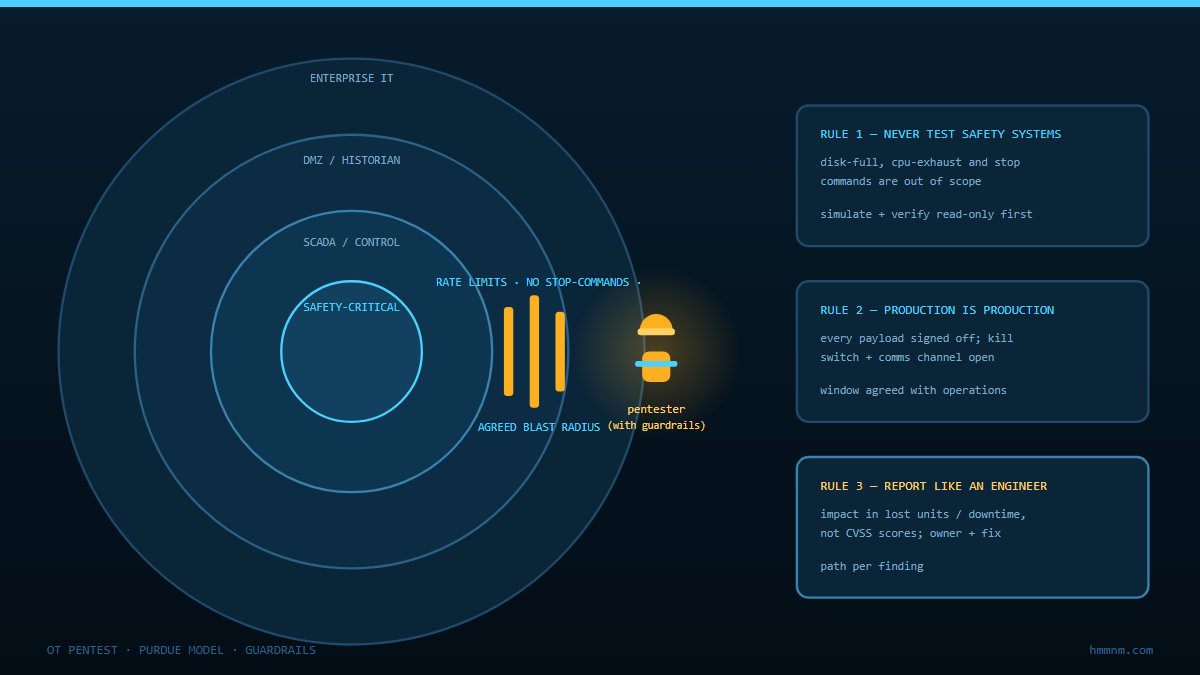
OT pentest Purdue model zones with guardrails

How to Pentest OT Networks Without Halting Production

Oldsmar proved an intruder can move a plant setpoint from a browser tab. This is the safe method: passive-first discovery, read-only active testing, writes proven on clone benches, and findings ranked in downtime currency — not CVSS.

Continue ReadingHow to Pentest OT Networks Without Halting Production

Internet Archive Breach and DDoS: 31M Accounts, One Pop-Up

On October 9, 2024, visitors to the Internet Archive’s Wayback Machine were greeted by an injected JavaScript pop-up announcing the compromise of 31,081,179 user accounts — the HIBP-confirmed count of the organization’s authentication database, loaned from a September exposure of its Zendesk support portal. A concurrent DDoS attributed to SN_BlackMeta compounded the disruption; days later, archived XSS attempts confirmed the org’sJavaScript security debt. This account traces the initial access, the pop-up’s evidence chain, and the funding-and-fragility story of a library built on hope.

Continue ReadingInternet Archive Breach and DDoS: 31M Accounts, One Pop-Up

Kia’s Web Portal: Register Any Car’s Account, Control It From Your Phone

On September 25, 2024, researchers Karan Saini and Sam Curry published an access-control flaw in Kia’s dealer and consumer web infrastructure: given only a license plate, an attacker could register an account with remote lock, unlock, start, stop, locate and horn control over 2014-2025 connected vehicles they did not own. Kia patched in August before disclosure. This account walks the plate-to-command chain, the ownership-verification gap, the threat model for tracking and theft, and the automotive-API authorization lesson that outlasts the brand.

Continue ReadingKia’s Web Portal: Register Any Car’s Account, Control It From Your Phone

Cisco SSM On-Prem Flaws: CVSS 10.0 and a CLI Zero-Day in One Week

In early October 2024, Cisco’s disclosure cadence stacked two unrelated but equally urgent problems: CVE-2024-20419, a CVSS 10.0 unauthenticated password-change flaw in Smart Software Manager On-Prem that let anyone with network access reset the admin API account, and CVE-2024-20399, a CLI command-injection bug in NX-OS already being exploited in the wild per the CISA KEV catalog. This account reconstructs both flaws’ mechanics, the patch timelines, and what this pairing says about authentication surface area in management tooling.

Continue ReadingCisco SSM On-Prem Flaws: CVSS 10.0 and a CLI Zero-Day in One Week