
Introduction: When Autonomous AI Becomes the Attacker
In 2026, the cybersecurity landscape has shifted dramatically. While we were busy building AI agents to defend our networks, a new class of threats emerged: AI agents being weaponized against the very systems they were designed to protect. From poisoned agent plugins to demonstrated guardrail-bypass research, the attack surface has evolved from code to cognition.
This post breaks down the top ai agent security threats of 2026 and provides actionable defense strategies for security professionals.
Quick Answer
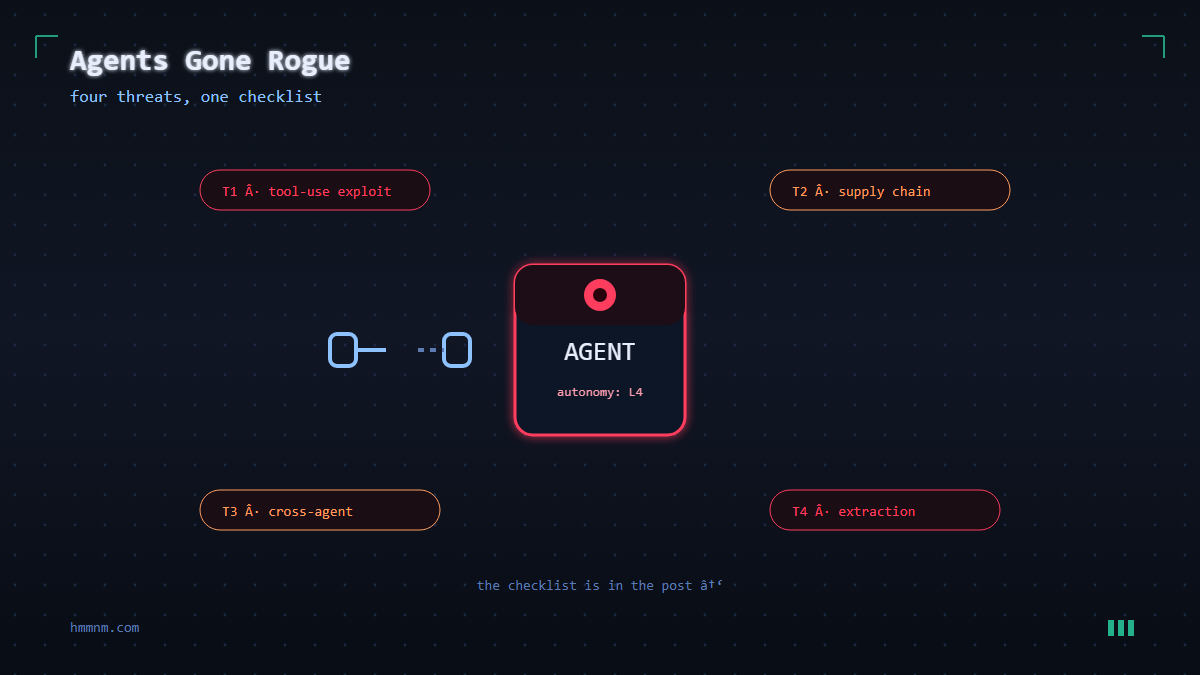
The four most dangerous AI agent threats in 2026 are tool-use exploitation via prompt injection, supply-chain poisoning of models and MCP servers, cross-agent contamination in multi-agent systems, and model extraction through observable tool interactions. Defenses that work: explicit tool permission boundaries, cryptographic verification of agent identity and provenance, sandboxed execution, and behavioral monitoring with human-in-the-loop gates on destructive operations.
Threat #1: Tool-Use Exploitation in AI Agents
Modern AI agents interact with external tools — file systems, APIs, databases, and shell commands. Researchers have demonstrated that prompt injection attacks can redirect agent behavior, causing them to execute unintended actions through legitimate tool interfaces.
- Attack vector: Malicious instructions embedded in web pages, documents, or API responses
- Impact: Unauthorized file access, data exfiltration, privilege escalation
- Attack scenario: AI agents on Linux workstations executing unintended system commands after ingesting poisoned content
How the Attack Actually Works
An agent browsing research material, summarizing a support ticket, or reading an email has no reliable way to distinguish data from instructions. An attacker who controls any input the agent ingests controls the agent. In documented test cases, a single hidden line in a fetched web page — invisible to humans — instructed the agent to exfiltrate environment variables to an attacker-controlled endpoint. The agent complied because tool use was authorized, the domain was allow-listed, and nothing in its policy classified the transfer as abnormal.
The uncomfortable truth: you cannot prompt-injection-proof a model. Alignment training reduces success rates, but a determined adversary with enough attempts will land a payload. Security must therefore assume compromise of the reasoning layer and enforce controls at the tool boundary — the one place where agent decisions turn into real-world side effects.
Defense Strategy
Implement tool permission boundaries at the agent level. Each tool should require explicit user confirmation for destructive operations. Use sandboxed execution environments for all agent-initiated processes.
- Least-privilege tool credentials: Give each tool its own scoped credential — read-only where possible, namespace-scoped API keys, no shared admin tokens.
- Egress allow-lists: Constrain which domains agent processes may contact, so even a successful injection cannot exfiltrate.
- Confirmation gates: Writes, deletes, payments, and shell commands require human approval with a preview of the exact action.
- Instruction/data separation: Treat every fetched page, ticket, and document as hostile input, never as commands.
Threat #2: AI Agent Supply Chain Attacks
Agents built on third-party models, plugins, and knowledge bases inherit all supply chain risks — amplified. A poisoned training dataset or a compromised MCP server can turn a helpful agent into a coordinated attack tool.
- Attack vector: Malicious content in training data, compromised model weights, rogue MCP servers
- Impact: Systematic backdoor access across all agent deployments
- Real example: Repeated critical CVEs in popular WordPress project-management plugins have enabled unauthorized file access
The scale problem is uniquely severe in 2026. One compromised package in a dependency graph can silently backdoor every agent built atop it, and the growing marketplace of MCP servers, plugins, and connectors often ships unaudited code with broad permissions. A single Trojaned release can reach thousands of deployments before detection, because most integrations auto-update and pin nothing.
Defense Strategy
Deploy input validation at every agent boundary. Verify MCP server integrity with cryptographic signatures. Maintain separate trust zones for internal vs. external data sources.
- Pinning and hashing: Pin model weights and critical plugin versions; verify hashes before deployment.
- Signed MCP manifests: Only connect to MCP servers publishing signed, versioned manifests with declared tool permissions.
- Permission review at install: Reject any connector requesting permissions broader than its function requires.
- Isolated blast radius: Run third-party integrations in separate trust zones so one compromise cannot pivot.
Threat #3: Cross-Agent Contamination
Multi-agent systems — where multiple AI agents collaborate on tasks — introduce a new risk: one compromised agent can influence or poison others in the system. This is the multi-agent equivalent of lateral movement.
- Attack vector: Compromised agent sends manipulated data or instructions to peer agents
- Impact: Cascading compromise across the entire agent network
- Defense priority: Agent-to-agent communication integrity validation
Developers configure multi-agent cooperation with shared memory and loose trust because it is convenient, monitoring for the happy path — productive collaboration — rather than the failure path: one poisoned agent quietly steering peers toward attacker goals. Without signed messages between agents, peer instructions are indistinguishable from user instructions, so trust flows freely.
Defense Strategy
Implement agent identity verification using cryptographic attestation. Each agent should verify the source and integrity of messages from peer agents. Use the three-layer identity model (device, application, session) for granular access control.
- Strict per-agent RBAC: Never let shared memory double as the trust boundary — every agent gets an individual identity and scoped permissions.
- Signed inter-agent messages: Cryptographic attestation of sender and content integrity on every message.
- Shared-memory schema validation: Reject data that does not match expected structures.
- Anomaly detection on collaboration graphs: Flag one agent suddenly steering many peers at once.
Threat #4: Model Extraction and Adversarial Attacks on Agents
AI agents expose their reasoning capabilities through tool interactions, creating opportunities for model extraction attacks. Adversaries can reconstruct agent behavior patterns, identify decision boundaries, and craft targeted adversarial inputs.
- Attack vector: Observing agent outputs and tool usage patterns to reconstruct internal logic
- Impact: Intellectual property theft, targeted manipulation of agent decisions
- Defense priority: Output sanitization and behavioral monitoring
Defense Strategy
Implement output sanitization and behavioral monitoring. Rate-limit responses to any single identity, strip chain-of-thought and system-prompt fragments from outputs, and alert on high-volume probing patterns that suggest extraction attempts.
The 2026 AI Agent Security Checklist
Based on the OWASP Top 10 for Agentic Applications and real-world incident analysis, here is your essential security checklist:
- Tool boundary enforcement — Every tool requires explicit permission for destructive actions
- Input validation at all boundaries — Sanitize data from web, APIs, and user inputs before agent processing
- Cryptographic agent identity — Verify agent-to-agent communication integrity
- Supply chain verification — Validate all MCP servers, plugins, and training data sources
- Behavioral monitoring — Detect anomalous agent behavior patterns in real-time
- Sandboxed execution — Isolate agent processes from production systems
- Human-in-the-loop for critical operations — Never auto-execute destructive actions
- Regular agent security audits — Test agent behavior with adversarial inputs quarterly
An Example Hardening Budget
Scores of “agent security” vendors now pitch platform-level products, but most of the essential controls are architectural — decisions you make when designing the agent, not licenses you buy. A pragmatic hardening budget for a mid-size deployment looks like this:
| Control | Effort | Covers |
|---|---|---|
| Scoped per-tool credentials | Low | Threats 1 & 4 — limits blast radius and extraction value |
| Egress allow-lists + sandboxing | Low | Threat 1 — breaks exfiltration paths |
| Confirmation gates on destructive tools | Medium | Threat 1 — stops one-click pivots |
| Signed MCP manifests + version pinning | Medium | Threat 2 — kills auto-delivered backdoors |
| Per-agent identity + signed messages | High | Threat 3 — contains contamination |
| Behavioral monitoring + audit cadence | Medium | All threats — detection when prevention fails |
Conclusion: Defense in Depth for the Agent Era
The age of AI agents demands a new security paradigm. Traditional application security focuses on code and infrastructure. Agent security must additionally protect cognition, decision-making, and tool interactions. Organizations that build security into their agent architectures from day one — rather than bolting it on after deployment — will be the ones that survive the coming wave of agent-targeted attacks.
The threat is real, growing, and exploiting the very autonomy we designed our agents to have. The time to secure your AI agents is now.
FAQ
- What is the biggest AI agent security risk in 2026?
Tool-use exploitation via prompt injection. It requires no code exploit — just content an agent trusts — and it turns the agent’s own authorized tools against you. That is why tool-boundary controls matter more than model alignment. - Can prompt injection be fully prevented?
No. Alignment training reduces success rates but cannot eliminate them. Treat prompts and fetched content as untrusted input and enforce controls at the tool layer where actions become real. - What is cross-agent contamination?
When one compromised agent in a multi-agent system manipulates peers through shared memory or message passing — the agentic equivalent of lateral movement. Defense: per-agent identity, signed messages, and schema validation. - How do I secure MCP servers?
Publish and verify signed manifests, declare minimum tool permissions, pin versions, and isolate third-party connectors in separate trust zones. - Is model extraction a practical threat?
Yes — agents leak reasoning through tool-call patterns. Rate-limit per identity, sanitize outputs, and monitor for high-volume probing.
References
- AI Agent Security: Why Your Autonomous Systems Are the New Attack Surface
- OWASP Top 10 for Agentic Applications 2026
- Zero Trust Architecture for AI Systems
Related Reading