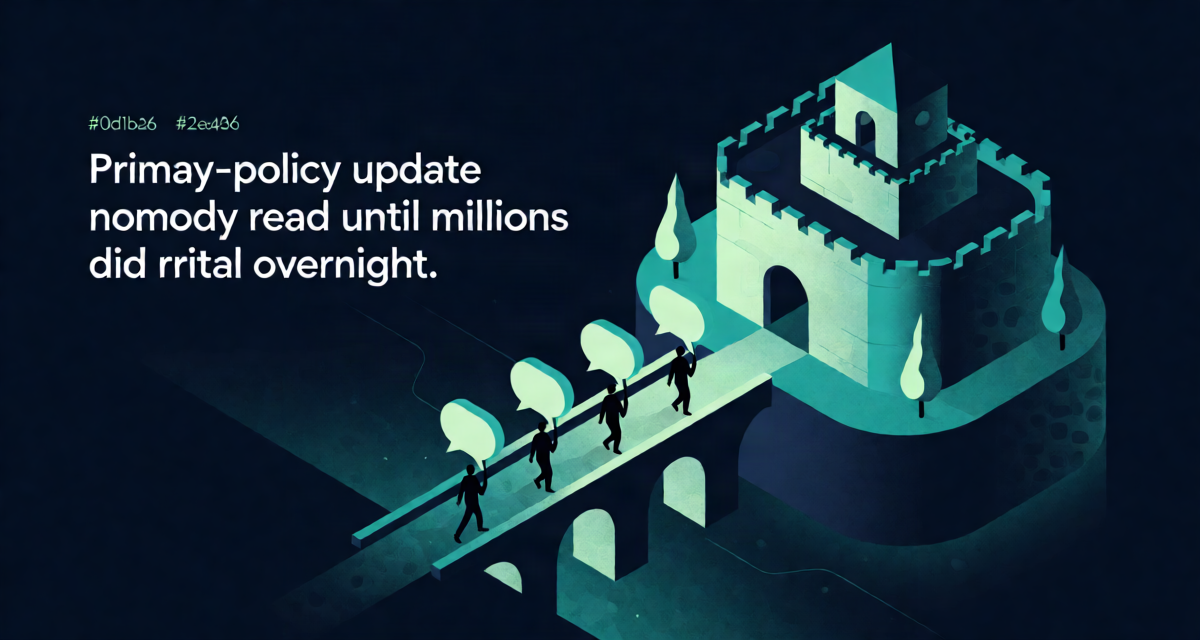
In January 2021, a privacy-policy change nobody had read triggered one of the largest consumer migrations in internet history: millions of users moved from WhatsApp to Signal and Telegram in days. For security teams, the episode was a live demonstration that trust in a messaging platform is a security control — and that it can evaporate overnight.
Passwordless in 2026: Why Passkeys Are Finally Killing the Password (and How Attackers Are Adapting)
What Studying 33 Historic Cyberattacks Taught Me About Defending Systems Today
On 4 January 2021, WhatsApp announced a privacy-policy update requiring data sharing with parent Facebook, with an accept-by-date of 8 February 2021. A viral misreading — that personal messages would be shared (they were not; the policy concerned business messaging and metadata) — triggered a migration wave that installed Signal on millions of devices within a week, briefly making it the top app across dozens of national App Store charts. WhatsApp delayed enforcement to 15 May 2021 and clarified the policy. The durable lesson: encrypted transport is not the whole security story — metadata policy, ownership, and crisis communications determine whether users (and employees) stay on a platform, and shadow-IT migrations happen faster than any corporate approval cycle.
What happened
WhatsApp’s 4 January notification told users they must agree to expanded data sharing with Facebook “to continue using WhatsApp,” with an effective date of 8 February. The wording, landing months after Facebook’s broader 2020 ad-targeting integration announcements, ignited a viral backlash: forwarded messages claimed WhatsApp would hand private chats to Facebook for advertising. The claim was wrong in the specific — chats remained end-to-end encrypted and were not part of the policy — but the underlying direction was real: WhatsApp had shared phone numbers, transaction data and usage metadata with Facebook since 2016, and the new policy made agreement mandatory.
The exodus was immediate and measurable. Signal, endorsed publicly by Elon Musk on 7 January (“Use Signal”) — and had been championed for years by WhatsApp co-founder Brian Acton, who had left the company over its monetisation direction — Signal then told the record registrations that strained its verification servers for days. Telegram added an estimated 25 million new users in 72 hours. and published explainer pages; by June it said the policy would apply only to users who interacted with business accounts.
The 15 May deadline, when it arrived, was enforced with a slow nag rather than deactivation — users who declined saw persistent reminders, and WhatsApp quietly extended grace for months. The story then faded from headlines but not from enterprise reality: migration to Signal and Telegram had already happened inside organisations, and security teams spent 2021–2022 discovering that shadow messaging apps were now part of the corporate attack surface.
How it worked
Technically, nothing was broken — which is the point. WhatsApp’s end-to-end encryption (Signal Protocol) performed exactly as designed through the entire episode; no message contents were exposed by the policy change. What changed was the metadata and integration layer.
WhatsApp policy 2021 (the actual scope)
   user account data: phone number, contacts graph, device/usage info
   business messaging: merchants on Facebook infrastructure
   payments (selected regions): transaction metadata
        |
NOT in scope: message contents (E2EE for 1:1 + most groups)

viral reading (wrong but directionally resonant)
   "WhatsApp shares your private chats with Facebook"
        -> trust collapse -> coordinated switch campaigns
        -> Signal/Telegram onboarding at record scale
        -> enterprise shadow-IT echo: employees migrate work chats too
Two structural lessons outlive the episode. First, security communication happens in a trust market: the same population that ignored years of privacy policies moved in 96 hours when framing flipped to betrayal — defenders should assume security-relevant behaviour (app choice, tool adoption) follows narrative, not documentation. Second, metadata is the product: the technical distinction between “we read messages” and “we share metadata” was accurate and irrelevant to users, and attackers later exploited precisely this metadata layer (contact-graph discovery, SMS redirect, SIM-swap onboarding flows) rather than breaking encryption.
Impact and numbers
| Metric | Value | Source |
|---|---|---|
| Policy announce / original deadline | 2021-01-04 / 2021-02-08 | WhatsApp in-app notice |
| Signal installs, first week of January | ~17.8M (top free app, dozens of countries) | app-store figures / Signal Foundation |
| Telegram adds, 72 hours | ~25M new users | Telegram statement, Jan 2021 |
| Deadline delay to 15 May | announced 2021-01-15 | WhatsApp statement |
| Regulatory responses | Turkey RTB investigation; India MeitY summons; global DPAs | regulator filings, Jan 2021 |
| Message contents shared with Facebook | None (E2EE maintained throughout) | WhatsApp policy text + independent audits |
Timeline
| Date | Event |
|---|---|
| 2021-01-04 | Policy notification goes out: agree to Facebook data sharing or stop using WhatsApp |
| 2021-01-07/08 | Viral migration peaks; Elon Musk “Use Signal” tweet; Signal tops charts |
| 2021-01-15 | WhatsApp delays enforcement from 8 Feb to 15 May; explainer campaign |
| 2021-01 (late) | Turkey opens investigation; India summons WhatsApp; users petition |
| 2021-05-15 | Deadline lands as a slow nag, not deactivation; grace period extends |
| 2021-06 onward | Business-account scoping clarifications; exodus headlines fade |
Why it still matters in 2026
The episode remains the benchmark case for trust-drift in consumer security platforms — and for how fast unofficial migration becomes enterprise reality. Security teams now assume messaging apps turn over on narrative velocity: an AI-toy breach, a policy change, or a celebrity endorsement can move employee behaviour before a policy committee meets. The lived 2026 version of this story plays out inside phishing’s evolution (attackers follow users onto whatever platform they flee to) and inside data-governance programs wrestling with modern MFA-bypass lures that abuse the same onboarding flows.
Detection and hardening takeaways
- Treat messaging-platform trust as a monitorable risk. Watch policy changes and ownership events for tools in enterprise use; pre-draft communications for when employees ask “should we leave?”
- Sanctioned-alternative playbooks. Have an approved, MFA-capable messaging option ready before the next trust event; shadow migrations otherwise choose for you.
- Train on metadata, not just encryption. Users who understand what E2EE does not protect (contact graphs, presence, transaction metadata) make better platform choices.
- Monitor onboarding abuse. Migration waves are cover for account-takeover: alert on new-device registrations, SMS-redirect patterns, and SIM-swap complaints during any platform event.
- Keep crisis comms faster than virality. WhatsApp lost the narrative for ten days; an enterprise equivalent is a single Slack screenshot away.
FAQ
Did WhatsApp actually share private chats with Facebook?
No. Message contents stayed end-to-end encrypted; the 2021 policy concerned business messaging, payments metadata, and account/device metadata sharing that had largely existed since 2016. The viral claim overstated the change — but the metadata sharing itself was real, which is why “technically wrong, directionally resonant” became the episode’s memorable shape.
Why is this in a security timeline rather than a tech-news one?
Because it demonstrated that platform trust is a security control with failure modes. Overnight migration changed the apps on millions of devices, including employee devices used for work — expanding exposure to new phishing surfaces, onboarding abuse, and data-governance gaps — all without any CVE. Security is what happens when incentives, narrative, and infrastructure meet.
What should enterprises do when the next messaging trust-collapse happens?
Move in days, not quarters: issue clear guidance on the sanctioned tool, enable its enterprise controls (SSO, DLP, retention), monitor for unmanaged-app adoption spikes, and fold the event into access reviews. The January 2021 window proved employee behaviour re-platforms in under a week — governance has to be pre-positioned to meet it.
The migration event as a security case study
The Signal migration of January 2021 — millions of users moving after the WhatsApp privacy-policy change — is the largest documented identity-ecosystem shift driven by privacy preference, and it carries security lessons beyond the moment. The verification bottleneck: the migration ran through identity verification at scale, and every onboarding surge is an attacker opportunity — social-engineered account takeovers ride the noise, verification processes degrade under load, and the influx population is primed by urgency to accept process shortcuts. Platforms absorbing migration waves learned to scale verification integrity with onboarding capacity, or absorb the fraud that fills the gap.
The measurement lesson for the industry: privacy preference is a real adoption driver, quantifiable, and durable — the migration cohort did not fully return when the news cycle moved, demonstrating that trust, once visibly priced by users, stays priced. For security programs the analog is talent-and-vendor migration: organizations that mishandle trust events (breaches disclosed poorly, terms changed adversarially) lose users, staff, and partners on timelines the news cycle does not capture, and the loss compounds quietly. Trust migrations are one-way streets in both directions.
The consolidation for practitioners: end-to-end encryption became a competitive feature rather than a compliance burden because users demonstrated they would move for it — a rare case where the security property won a mass-market decision on its own terms. Every subsequent messaging-platform security investment inherited that proof point, and every argument for strong defaults in consumer products since has cited January 2021 as its exhibit A.
The migration also left operational guidance for platforms expecting trust-event surges: server capacity planned for identity-verification spikes, fraud-team staffing aligned to onboarding noise, and communication cadence that keeps verification instructions ahead of attacker impersonations of the migration itself — phishing rode the Signal wave exactly as it rides every mass migration, impersonating onboarding help to harvest the very accounts users were moving to protect. Trust events concentrate exactly the anxiety that social engineering monetizes; the platforms that pre-positioned guidance against impersonation absorbed the wave, and the ones that treated it purely as a capacity event absorbed the fraud statistics too.
Capacity plus fraud posture plus impersonation-aware guidance — the complete platform playbook for trust-event surges, written by a migration that proved users will move for privacy and attackers will move with them.
- NIST’s PQC Standards: FIPS 203-205 and the Migration Clock
- Biden’s Zero Trust Executive Order: The Procurement Pivot
- Marriott’s FTC Settlement: 20 Years of Audits for Starwood’