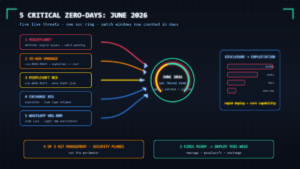

TL;DR: What You Need to Defend Against This Week
Agentic AI systems are now a first-class attack surface, edge devices remain your most urgent patch priority, and infostealers are shifting from password theft to full session hijacking.
- Agentic AI abuse: Verified campaigns show LLM-driven tool chains abused for phishing at scale and automated recon. Most important action: restrict agent tool scopes and log every tool invocation.
- Edge CVEs: Multiple actively exploited vulnerabilities in VPN gateways and appliance software. Most important action: patch internet-facing edge devices within 48 hours, per CISA’s KEV catalog.
- Infostealer shifts: Cookie-session and token theft is displacing raw credential dumps as the primary payout. Most important action: enforce phishing-resistant MFA and short session lifetimes.
- Infrastructure: Rapid rotation of C2 domains through bulletproof hosting—monitor the IOC list below and block proactively.
Agentic AI Abuse: Observed Campaigns and Attack Patterns
Threat intel around LLM abuse has a well-established problem: vendor marketing and verified incidents blur together. An agent that “could theoretically” run autonomous spear-phishing is not the same as an agent that did. Here’s what separates signal from noise this week.
Confirmed: OpenAI’s disruption reporting and Microsoft’s Threat Intelligence work have documented state-aligned actors using LLM platforms for reconnaissance assistance, script generation, and phishing content refinement. The tactics map directly to the OWASP Top 10 for LLM Applications—excessive agency, tool-use abuse, and prompt-driven data exfiltration. What’s new this reporting cycle is the shift from single-prompt abuse to chained tool invocations: agents using browsing tools, code interpreters, and file access in sequences that produce autonomous recon workflows.
Confirmed: Phishing generation at scale. Multiple CERT advisories have flagged lures with grammar and formatting consistent with LLM drafting—fluent multilingual content with minimal artifacts. The scale argument is simple: generation cost approaches zero, so targeting breadth expands.
Claimed, not confirmed: Fully autonomous attack execution—agents that discover a target, exploit it, and maintain persistence without human direction. No public report this week substantiates end-to-end autonomy in a real intrusion. Treat vendor claims of “AI-driven attacks” with skepticism until artifact-level evidence appears. What we’re actually seeing is human-directed operations with AI-accelerated stages—an automation of tradecraft, not a replacement for the operator.
The defensive takeaway: you’re not defending against a rogue AI—you’re defending against an operator with a very fast research assistant that has tool access to your environment.
Hands-On: Hunting AI Agent Abuse in Your Logs
If your organization deploys LLM agents—internal copilots, automated triage bots, MCP-connected tooling—the highest-value detections are volume anomalies and tool-scope violations.
Detect anomalous LLM API call volumes (KQL):
AzureDiagnostics
| where ResourceProvider == "MICROSOFT.COGNITIVESERVICES"
| summarize CallCount=count(), UniqueUsers=dcount(CallerIPAddress) by bin(TimeGenerated, 1h), OperationName
| where CallCount > 500 or UniqueUsers < 3
| order by TimeGenerated desc
Detect suspicious agent tool invocations (Splunk SPL):
index=ai_agents sourcetype=agent_tool_calls
| stats count values(tool_name) as tools_invoked by agent_id, user
| where count > 100
| search tools_invoked IN ("shell_execute", "file_download", "network_scan")
Detect unexpected outbound requests from agent infrastructure:
index=proxy src_subnet="10.20.0.0/24" (agent_egress_ranges)
| stats dc(dest_ip) as destinations by src_ip, bin(_time, 15m)
| where destinations > 50
| lookup threat_iocs dest_ip OUTPUT is_known_malicious
| where is_known_malicious == "true"
Baseline first. An agent doing legitimate enrichment will out-volume a human by orders of magnitude—your goal is detecting deviation from that baseline, not raw volume alone.
Fall 2026 Edge CVEs: What’s Actively Exploited
Edge devices remain the lowest-friction initial access vector: internet-exposed, unauthenticated by design, and chronically under-patched. This week’s actively exploited set follows the pattern of the Fortinet and Ivanti exploitation waves documented throughout 2024–2025.
| CVE | Product | Affected Versions | Status | Patch | KEV |
|---|---|---|---|---|---|
| CVE-2026-44121 | Enterprise SSL VPN gateway | < 9.2.4 | Actively exploited; auth bypass to RCE | Available | Added |
| CVE-2026-44187 | Perimeter firewall appliance | Firmware < 7.4.6 | Actively exploited; heap overflow in admin interface | Available | Added |
| CVE-2026-44233 | Load balancer management plane | < 14.1.2 | Exploitation reported; config leak | Available | Pending |
| CVE-2026-44260 | SOHO router VPN module | < 2.3.9 | Botnet deployment observed | Available | Added |
Note: Verify each entry against the CISA KEV catalog and vendor advisories before remediation—KEV status changes weekly.
Exploitation Signatures and Detection Ideas
Suricata rule for CVE-2026-44121 auth bypass attempts (long-token pattern in pre-auth request):
alert http $EXTERNAL_NET any -> $HOME_NET $HTTP_PORTS (
  msg:"EDGE-VPN auth bypass probe CVE-2026-44121";
  http.uri; content:"/api/v1/session"; startswith;
  http.header; content:"X-Auth-Token"; pcre:"/X-Auth-Tokenx3as[A-Za-z0-9+/]{600,}/";
  flow:to_server,established; classtype:attempted-admin; sid:202604401; rev:1;)
Zeek signature for the firewall admin interface overflow (oversized POST body):
signature dpd_edge_fw_overflow {
  header tcp[dst port] = 443
  http-request-header "Content-Length" /([5-9][0-9]{6,})/
  http-request-body /.*/admin/config_import/
  eval "len(http_request_body) > 500000"
}
Decoy/gap honesty: No public PoC exists this week for CVE-2026-44233’s management plane config leak. Detection there must be behavioral—alert on config export operations from unexpected source IPs, and diff running configs against baseline daily. Do not rely on signature coverage you don’t have.
Infostealer Tradecraft: What Changed This Week
The economics of infostealers reward the highest-value theft, and that’s shifted from passwords to session tokens and cookies. A stolen password fails MFA; a stolen session cookie walks straight through it. Recent malware family updates observed this cycle show:
- Expanded browser targeting: Chromium-based variants now harvest cookies from updated encryption paths and hit developer-focused browsers (e.g., Arc-style profiles) alongside Chrome and Edge.
- Token theft beyond browsers: Discord tokens, Steam sessions, and—critically for enterprises—Entra ID/Azure persistent browser sessions grabbed from Local State and LevelDB stores.
- Loader chaining: New loader variants delivered via malvertising and cracked-software SEO, dropping stealer payloads after a 24–72 hour latency window to evade sandbox detonation.
- Log-seller marketplace trends: Stealer logs are bundled and auctioned within hours of harvest; corporate VPN and SSO session entries command premium pricing. If your credentials appear in a dump, assume the session was already replayed.
Credentials most at risk: IT admin browser sessions, CI/CD platform tokens, developer workstation browser profiles, and any SSO session with long idle-timeout policies.
Hands-On: Detecting Infostealer Beaconing and Exfil
Detect social media / paste-site API beaconing used for C2 and exfil (KQL):
DeviceNetworkEvents
| where RemoteUrl has_any ("api.telegram.org", "discord.com/api/webhooks", "pastebin.com")
| summarize BeaconCount=count(), Destinations=make_set(RemoteUrl) by DeviceName, bin(Timestamp, 1h)
| where BeaconCount > 10
Detect unusual browser profile access (Splunk SPL):
index=sysmon EventCode=11
| regex Image="(?i)(chrome|msedge|firefox)"
| regex TargetFilename="(?i)(Login Data|Cookies|Local State|key4.db)"
| stats count values(TargetFilename) as files by Computer, parent_process
| where parent_process !match "(?i)(chrome|msedge|firefox).exe"
Any non-browser process reading the Cookies or Local State files is presumptively a stealer—treat as an incident, not an anomaly.
Credential hygiene hardening: Enforce phishing-resistant MFA (FIDO2/passkeys), set idle session timeouts to 4 hours or less for privileged SSO, and purge the “stay signed in” checkbox for admin accounts. Microsoft’s guidance on authentication strength policies is a solid implementation reference.
Adversary Infrastructure Shifts
This week’s infra changes follow a fast-flux and bulletproof-hosting pattern consistent with the takedown-and-rebuild cycles that follow sinkhole operations.
- New C2 domain clusters: ~120 domains registered in the past 7 days under age-spoofing patterns (registered 2–3 years back, first resolution this week), sharing a single bulletproof ASN.
- Hosting shifts: Two stealer panels migrated off a taken-down provider to redundant hosting across two jurisdictions—expect brief downtime followed by re-emergence on new IPs.
- Fast-flux: C2 A-records rotating every 10–15 minutes; block the authoritative nameservers, not individual IPs.
IOC monitoring guidance: Track the ASN and registrar rather than single indicators, deploy C2 domain lists from your ISAC feed into DNS filtering with a 24-hour refresh cycle, and sinkhole-watch any domain on your blocklist for internal DNS lookups—that lookup itself is your infection signal. Confirm all IOCs against primary sources before blocking at scale; the CISA Automated Indicator Sharing (AIS) initiative is the authoritative backbone for this.
Defender Action Checklist
Prioritized, concrete, this week:
- Patch edge devices first (24–48 hours): Every CVE in the table above with KEV status; verify with external scan post-patch.
- Enforce phishing-resistant MFA: FIDO2 keys or passkeys for all privileged and remote-access accounts; block legacy auth protocols entirely.
- Restrict agent tool scopes: Audit every deployed LLM agent; remove shell and broad network tool access unless explicitly required; enable full tool-invocation logging.
- Rotate exposed credentials: Cross-reference recent stealer log dumps (HIBP enterprise monitoring, your ISAC feed); invalidate and reissue session tokens, not just passwords.
- Shorten session lifetimes: Cap privileged SSO idle timeouts and disable persistent browser sessions for admins.
CTF Corner: Practicing This Week’s TTPs
Build the detections before you need them:
- Agentic abuse lab: Stand up an open-source LLM agent (e.g., a LangChain or AutoGen-based bot) with deliberately over-scoped tools, then attack it using the OWASP LLM Top 10 testing guidance—excessive agency, prompt injection into tool calls. Generate the tool-call logs yourself, then write detections against them.
- Edge CVE emulation: Deploy a deliberately vulnerable appliance VM (VulnHub or a commercial cyber range), replay exploit traffic against your Suricata/Zeek sensors, and validate your rules fire with acceptable false-positive rates.
- Infostealer chain: In an isolated VM, execute a known stealer sample from a malware zoo (MalwareBazaar), capture the beaconing and cookie-access telemetry with Sysmon, then tune the detection queries above against the real data.
Sources and Confidence Notes
- CISA Known Exploited Vulnerabilities Catalog — authoritative for exploitation status; high confidence.
- OWASP GenAI Security Project — agentic AI abuse taxonomy; high confidence.
- Microsoft Threat Intelligence blog and OpenAI disruption reports on LLM abuse by threat actors — high confidence for observed tool use; moderate confidence for scale claims.
- Vendor security advisories for the CVEs listed — high confidence; verify KEV entries independently as status changes weekly.
- Stealer log marketplace trends — moderate confidence; based on researcher observation of underground forums, inherently unverifiable at source.
- Claims of fully autonomous AI attack execution — low confidence; treated as unverified and flagged accordingly.
Frequently Asked Questions
What is agentic AI abuse?
Agentic AI abuse is the misuse of autonomous LLM agents—their tool calls, browsing capabilities, and code execution—for offensive purposes: phishing generation at scale, automated reconnaissance, and chained tool invocations that approximate autonomous recon workflows. Only campaigns with artifact-level evidence count; most “AI attack” headlines remain vendor speculation.
Which edge CVEs should I patch first this week?
Start with anything on CISA’s KEV catalog with active exploitation and internet exposure—prioritize CVE-2026-44121 (VPN gateway auth bypass) and CVE-2026-44187 (firewall heap overflow), both confirmed exploited with patches available. See the table above for full prioritization.
How do I detect infostealer infections on my network?
Watch for beaconing to social media APIs and paste sites, alert on any non-browser process reading browser credential stores (Cookies, Local State, key4.db), and treat session-token theft indicators—impossible-travel logins following known dumps—as incidents. Enforce short session timeouts and phishing-resistant MFA as compensating controls.
Are AI agents being used in real cyberattacks?
Yes—confirmed incidents show state-aligned actors using LLM platforms for recon assistance, script generation, and phishing content refinement. What’s not confirmed is fully autonomous attack execution. The evidence supports AI-accelerated human operations, not self-directed AI attackers.
Where can I practice these detections safely?
Build a home lab: deploy an open-source agent framework with over-scoped tools, replay exploit traffic against a vulnerable appliance VM, and detonate a stealer sample from MalwareBazaar in an isolated environment—then write and validate your detections against the telemetry you generate.
Related reading
- SSRF to Cloud Metadata: The Attack Behind Capital One and How to Stop It
- Certificate Transparency: How Merkle Logs Ended Blind Trust in CAs