TL;DR — UEFI Secure Boot makes firmware the root of everything: each boot stage verifies the next component’s signature against keys anchored in the motherboard itself, so unsigned bootloaders and kernels shouldn’t run. BlackLotus broke that assumption in practice — a UEFI bootkit, sold on underground forums, that ran with Secure Boot enabled by exploiting a patched-but-not-revoked vulnerability (CVE-2022-21894). The incident exposed the uncomfortable mechanics of trust revocation in firmware: signing keys can’t just be changed, so Microsoft spent 2023–2025 phasing in boot-manager revocations through Windows Update. Understanding that timeline is understanding how hardware trust actually gets repaired — slowly, in stages, with a rollback risk at every step.
Every trust chain we’ve covered on this site — DNSSEC’s root anchors, CT’s logged certificates — shares one property with Secure Boot: the anchor is only as good as the process for retiring compromised keys. Firmware is the hardest case. The anchors live in the platform (the PK, KEK and signature databases stored in NVRAM), OEMs ship them baked in, and “rotate the key” can literally mean bricking motherboards. BlackLotus is the case study of what happens when that rigidity meets a real attacker.
How the Boot Chain of Trust Works
Secure Boot (specified by UEFI Forum) is a boot-time verification chain: platform firmware verifies each next stage against signature databases before executing it. The cast:
| Component | Role | Failure mode |
|---|---|---|
| PK (Platform Key) | The root — controls who can update KEKs | Compromise = the whole chain is attacker-controlled |
| KEK (Key Exchange Keys) | Authorize updates to the signature databases | Compromise = attacker db/dbx writes |
| db (signature database) | Allowed certificates/hashes (e.g., Microsoft Windows Production PCA) | Bad entry = malicious code boots as trusted |
| dbx (revocation database) | Explicitly revoked certificates/hashes | Missing entry = known-bad code still boots |
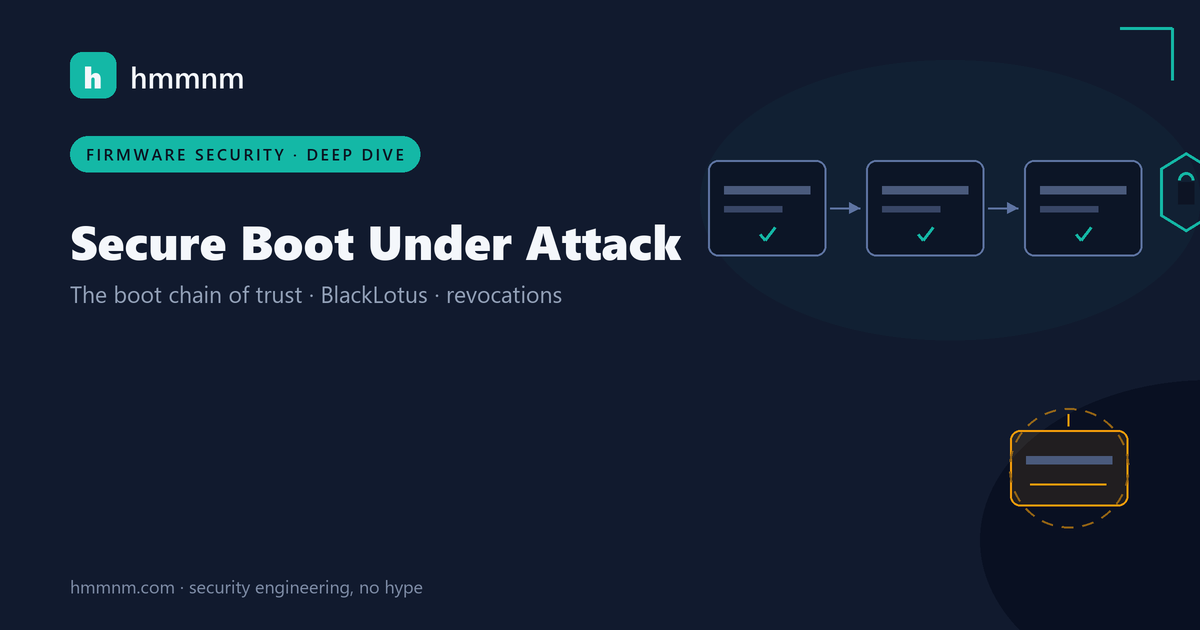
The chain runs firmware → bootloader (bootmgfw.efi on Windows) → kernel, each link checked against db and not present in dbx. The design goal is exactly the one from our defense-in-depth discussions: even with disk-level admin compromise, the attacker cannot install code that survives a reboot at the earliest, most privileged stage.
BlackLotus: The Breach of the Assumption
Reported publicly in early 2023 (ESET’s analysis drew the outline; Binarly and Microsoft documented the mechanics), BlackLotus was the first widely observed UEFI bootkit that ran successfully on systems with Secure Boot enabled. Its trick was not breaking cryptography but exploiting revocation lag:
- The vulnerability. CVE-2022-21894 (“Baton Drop”) — a bypass patched by Microsoft in January 2022. The patch stopped the bug; it did not revoke the already-signed vulnerable boot managers still trusted by every deployed system.
- The persistence. BlackLotus used the bypass to strip Secure Boot’s policy enforcement during boot, then established bootkit persistence — controlling the kernel from its first instruction, before EDR agents load.
- The operational lesson. A signed-but-vulnerable component is still trusted until revoked, and revocation in firmware requires updating dbx + boot policy on hundreds of millions of heterogeneous machines — via an OS that must itself keep booting throughout.
Microsoft’s April 2023 guidance for investigating CVE-2022-21894 exploitation reads like the incident-response field manual this scenario demanded: how to look for the bootkit’s artifacts (dropped binaries, hibernation-file abuse, policy-stripping remnants) on fleets that were, by design, not supposed to be able to host such a thing.
The Longest Patch: KB5025885 and Staged Revocation
The repair is a masterclass in fleet-scale trust migration:
- May 2023. KB5025885 ships the mechanism: revocation of vulnerable Windows boot managers (addressing CVE-2023-24932’s attack path) — but manual, opt-in, and explicitly warned: applying it incorrectly could render systems unbootable, especially those re-imaged from older media.
- 2024. Prerequisites and staged readiness (SKUSiPolicy and boot-manager revocation prerequisites); fleet owners inventoried boot WIMs and dual-boot setups because post-revocation, old media fails validation by design.
- July 9, 2024. Enforcement begins via Windows Update: vulnerable boot managers added to the disallow list (dbx) and Code Integrity policy on capable systems.
- 2025. The revocation flow is folded into normal monthly servicing — Microsoft’s guidance simply says to be on the July 8, 2025 security update or later, with revocations enforced on capable hardware.
Two-plus years from patch to full enforcement — not negligence, but the physics of hardware-anchored trust: every step had to be safe for machines whose recovery path is “reflash the motherboard.”
Why This Matters Beyond Windows
- Revocation is the hard part of every PKI. CT catches bad certificates because logging is cheap; firmware revocation is expensive because the anchor is physical. Design any trust system around your revocation budget, not your issuance story.
- Bootkits defeat endpoint tooling by construction. Code that runs before the OS loads sits below every agent — detection has to include measured-boot attestation (TPM-extended boot measurements compared against expected values) rather than runtime processes alone.
- Supply-chain signing discipline compounds. The same verify-before-trust mindset as SBOMs and Sigstore-style artifact signing applies at boot: know exactly which signed components your fleet trusts, and treat any surprise as an incident.
- Linux is exposed differently. shim’s Microsoft-signed bootloader chain gives Linux Secure Boot compatibility — and inherited the same class of revocation headaches (shim updates have required dbx coordination too). Firmware trust is an ecosystem problem, not an OS feature.
Operating Secure Boot Like You Mean It
A note on scope before the checklist: everything above is about platform Secure Boot, but the same verification-chain idea now extends further down and further up — measured boot extends it into attestation (the TPM records what actually ran), and the Linux world’s shim extends it sideways into distributions Microsoft never signed directly. Each extension adds another link that must be inventoried, monitored and eventually revoked. The checklist below assumes you know which links exist in your fleet; if you don’t, step zero is building that inventory, because every later step depends on it.
- Verify it’s actually on. Audit Secure Boot mode fleet-wide (not “shipped enabled” — currently in enforcement mode); setups drift, especially after imaging workflows that toggle it.
- Inventory your trust anchors. Enumerate db/KEK contents on your OEM mix; unexpected certificates in db are a finding, not a curiosity.
- Stay current on revocations. The BlackLotus-era revocations are enforced only on updated systems with modern boot managers — old images in deployment pipelines re-introduce revoked trust with every reimage.
- Use measured boot. TPM boot measurements compared against known-good baselines detect boot-chain tampering even when nothing else has loaded yet — the one sensor that outranks the bootkit.
- Plan key updates before you need them. Whether it’s KEK rotation or custom db entries (e.g., for signed internal tooling), rehearse with recovery media at hand — the failure mode of every firmware-key operation is “machine won’t boot.”
Key Takeaways
- Secure Boot chains verification from firmware-anchored keys (PK → KEK → db/dbx) through bootloader to kernel — strong persistence resistance, anchored in hardware.
- BlackLotus (CVE-2022-21894, “Baton Drop”) proved a signed-but-vulnerable boot manager stays trusted until revoked: the first public UEFI bootkit running with Secure Boot enabled.
- Repair took years by design: KB5025885 manual revocation (May 2023) → WU enforcement (July 9, 2024) → routine by the July 8, 2025 updates — revocation physics, not vendor delay.
- Below-OS persistence outranks endpoint agents: measured-boot attestation is the structural counter-detection.
- Every trust system’s real design constraint is its revocation budget — firmware is just the extreme case that makes it visible.
FAQ
What is UEFI Secure Boot?
A boot-time verification chain: firmware checks each next boot component’s signature against databases (db) of trusted certificates, with revoked entries in dbx — anchored by platform keys stored in the machine itself.
What was BlackLotus?
A UEFI bootkit sold on underground forums, first widely analyzed in 2023, that achieved persistent boot-level compromise on systems with Secure Boot enabled by exploiting CVE-2022-21894 to strip policy enforcement.
Why did patching not fix it immediately?
The January 2022 patch fixed the bug but not the trust: already-signed vulnerable boot managers remained in db. Removing them required revoking signatures fleet-wide without bricking machines — a staged 2023–2025 process (KB5025885).
What is dbx?
The revocation database — explicitly banned signatures/hashes. Updating it is how the ecosystem retires compromised-but-signed components; BlackLotus is the canonical reason dbx updates became routine.
How do I detect bootkit persistence?
Measured boot: TPM-extended measurements of each boot stage compared against known-good baselines — it detects tampering that precedes every OS-level agent.
Should enterprises use custom Secure Boot keys?
Only with a rehearsed rotation and recovery process. Custom PK/KEK ownership buys control and costs operational responsibility — the failure mode of every mistake is an unbootable fleet.
References
- Microsoft — Guidance for investigating attacks using CVE-2022-21894 (BlackLotus)
- Microsoft Security Response Center — CVE-2023-24932 (Secure Boot bypass / KB5025885)
- ESET WeLiveSecurity — BlackLotus UEFI bootkit: myth confirmed
- Binarly — BlackLotus UEFI bootkit analysis
- NIST NVD — CVE-2022-21894
- UEFI and Secure Boot — overview and specification context
- Microsoft — How Windows uses the TPM (measured boot)
- MITRE ATT&CK — T1542.003 Bootkit
- CISA — advisories and mitigation guidance
Current as of September 2026. Educational reference — firmware operations carry brick risk; follow vendor guidance and rehearse recovery before changing trust anchors on any fleet.