
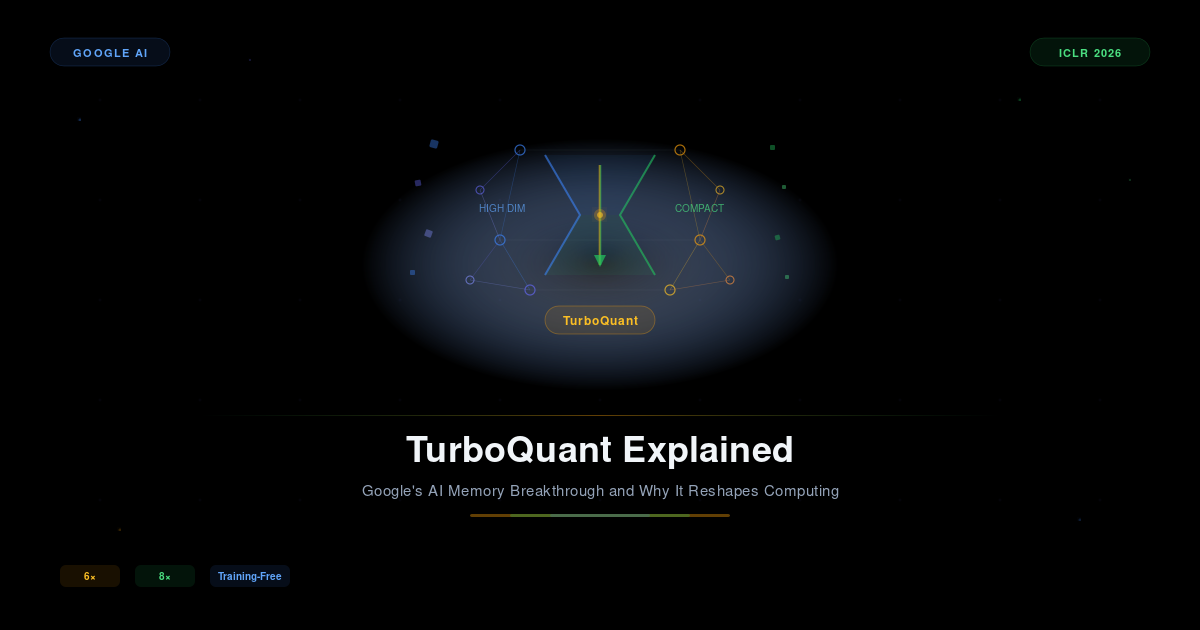
Artificial intelligence has spent the past few years chasing scale. Bigger models, longer context windows, more users, more data, more multimodal capability. For a while, the central story of AI progress sounded simple: if you want more intelligence, you buy more compute. But that story is starting to look incomplete. One of the biggest constraints on modern AI systems is not just raw processing power. It is memory. Specifically, it is the cost, speed, and physical burden of storing the information models need while they generate outputs in real time.
That is why TurboQuant has become such a closely watched development. Publicly introduced by Google Research on March 24, 2026, TurboQuant is a compression method designed for high-dimensional vectors, with two especially important applications: reducing the memory footprint of large language models’ key-value (KV) caches and improving the efficiency of vector search systems. Google says the method can reduce KV-cache memory by at least 6x on long-context tasks and, in one reported benchmark, deliver up to an 8x speedup in attention-logit computation on Nvidia H100 GPUs. The work is also listed as an ICLR 2026 poster, which signals that it has moved beyond a blog-post teaser into the formal research spotlight.
What makes TurboQuant especially intriguing is that Google presents it as training-free for these use cases. In other words, the promise is not “train a whole new model from scratch,” but “compress existing workloads much more efficiently using better mathematics.” That sounds technical, but the practical implication is easy to understand: if the method works broadly, AI systems could become faster, cheaper, and less memory-hungry without sacrificing much or any quality in many of the tested settings.
And that matters because memory is not a small implementation detail. It shapes product design, cloud costs, latency, concurrency, and even the economics of the semiconductor industry. In fact, after Google’s announcement, memory-related stocks such as Micron, SK hynix, Samsung Electronics, Sandisk, Western Digital, and others came under pressure as investors worried that more efficient AI inference might reduce demand for memory hardware. At the same time, several analysts argued that the sell-off was likely overdone, because efficiency gains often increase usage rather than destroy it.
TurboQuant, then, is not just another obscure optimization with a flashy name. It sits at the intersection of research, infrastructure, product design, and markets. To understand why so many people are paying attention, we need to start with the bottleneck it is trying to solve.
The Memory Bottleneck Behind Modern AI
When people think about AI, they usually imagine models “thinking” in some vague digital sense. But the reality is more mechanical. Large language models generate output token by token, and as they do so, they keep track of earlier information through a structure called the key-value cache, or KV cache. Google describes this cache as a high-speed store of frequently used information that lets the model retrieve what it needs quickly instead of recomputing everything from scratch. That is extremely useful for long prompts and conversations, but it also consumes a great deal of memory.
As context windows get longer, the KV cache grows. As more users interact with a model simultaneously, memory requirements rise again. And as companies try to serve advanced models quickly at scale, that memory demand becomes one of the major determinants of cost and performance. This is why TurboQuant has landed at such a sensitive moment. AI systems are not only getting more capable; they are also becoming more memory-hungry, and memory is expensive both in hardware terms and in system-design terms.
Traditional quantization methods have tried to deal with this by storing data in fewer bits. The basic idea is simple enough: represent values more compactly so they take up less space. But traditional approaches often introduce hidden overhead. Google notes that many vector quantization methods require storing quantization constants or scaling data in full precision for small blocks of vectors, and that this overhead can add one or two extra bits per number. In other words, the advertised compression is not always the true compression. TurboQuant is attractive because it is designed not merely to shrink vectors, but to do so while avoiding much of that side-information baggage.
What TurboQuant Actually Is
At its core, TurboQuant is a form of online vector quantization. Vector quantization is a classical compression idea: you take high-dimensional numerical data and represent it with fewer bits while trying to preserve the relationships that matter. In AI, those relationships are crucial because models rely on geometry. Distances, angles, and inner products between vectors are not decorative mathematics; they are part of the machinery that makes attention and retrieval work.
The ICLR paper frames TurboQuant as a method that addresses both mean-squared error (MSE) and inner-product distortion, which is important because some compression methods may preserve one aspect of the data while damaging another. The authors argue that TurboQuant achieves near-optimal distortion rates, within a small constant factor of the theoretical lower bounds, across bit widths and dimensions. That is a bold claim because it suggests the method is not just empirically good, but theoretically well-founded.
Google also positions TurboQuant as useful for vector search, not just language-model inference. That broadens its significance. Vector search is central to semantic retrieval, recommendation engines, retrieval-augmented generation, and search systems that rely on embeddings rather than exact keyword matching. So while the public conversation has focused heavily on chatbots and long context windows, TurboQuant is relevant to a much wider slice of modern AI infrastructure.
That dual use case is part of what makes the work compelling. If a single compression approach can improve both LLM inference and large-scale retrieval, then it is not merely a niche optimization. It becomes an infrastructure technology.
How TurboQuant Works: A Two-Stage Compression Pipeline
Despite the name, TurboQuant is not magic. It is a carefully designed two-stage pipeline.
The first stage uses what Google calls PolarQuant. In the Google Research explanation, TurboQuant begins by randomly rotating the data vectors. This changes the geometry of the input in a way that makes the coordinates easier to quantize individually. The paper describes this more formally by saying the random rotation induces a concentrated Beta distribution over coordinates and allows simple scalar quantizers to work effectively in high dimensions. In practical terms, the first stage does most of the compression work by transforming the data into a structure that is easier to encode compactly.
Google’s public explanation uses a helpful intuition: instead of working with ordinary Cartesian coordinates, PolarQuant effectively re-expresses the vector in a more compressible form, capturing the “strength” and “direction” of the underlying information more efficiently. The point is not that the system literally thinks in circles like a confused trigonometry student. The point is that the transformed representation behaves in a way that reduces overhead and makes low-bit quantization more practical.
Then comes the second stage, which is arguably the more elegant trick. After the first quantization stage, there is still residual error left over. TurboQuant addresses this by applying a 1-bit Quantized Johnson-Lindenstrauss transform (QJL) to the residual. According to the paper, this second stage removes the bias that MSE-optimal quantizers can introduce into inner-product estimation. That matters because attention mechanisms depend on inner products. If you distort them carelessly, the model may still be compressed, but it may also become less accurate in the places that matter most.
Google describes QJL as a lightweight mathematical error-checker. It uses only a tiny amount of extra compression power — just 1 bit — to preserve attention accuracy far better than a naïve quantization scheme would. So the full TurboQuant pipeline is not simply “compress the numbers aggressively and hope for the best.” It is “compress the main structure efficiently, then correct the residual in a way that preserves the computations the model cares about most.”
That design is a big reason the method has generated excitement. It suggests that AI efficiency is not just about more hardware or brute-force optimization. Sometimes the breakthrough comes from representing the same information more intelligently.
Why the Reported Results Turned Heads
If TurboQuant had been introduced with vague claims about “some improvement,” the reaction would have been modest. It was the magnitude of the reported gains that made people pay attention.
Google says TurboQuant achieved perfect downstream results across its reported long-context benchmarks while reducing KV memory size by at least 6x. It also says the method can quantize the KV cache to 3 bits without training or fine-tuning and still maintain model accuracy in those experiments. In a separate performance figure, Google reports that 4-bit TurboQuant produced up to an 8x speedup over 32-bit unquantized keys for attention-logit computation on H100 GPUs.
The ICLR paper states the results in more academic language, but they are still impressive. It reports absolute quality neutrality for KV-cache quantization at 3.5 bits per channel and only marginal degradation at 2.5 bits per channel. For nearest-neighbor search, it says TurboQuant outperforms existing product quantization methods in recall while reducing indexing time to virtually zero in the reported setup.
The nuance is important. These are reported experimental results, not a guarantee that every model, every workload, and every production environment will see identical gains. But even with that caution, the numbers are strong enough to justify the current attention.
Why Wall Street Got Nervous
One of the most fascinating parts of the TurboQuant story is that it did not stay inside the AI research bubble. It spilled into financial markets.
Following Google’s announcement, the stocks of several memory-related companies fell as investors worried that dramatically more efficient AI systems might reduce demand for memory hardware. The Wall Street Journal reported sharp declines in Micron and other memory and storage names after Google unveiled the technology, and noted that the pressure extended internationally to firms such as SK hynix, Samsung Electronics, and Kioxia.
That reaction makes intuitive sense. If a new algorithm claims to cut memory requirements by a factor of six, investors may reasonably wonder whether hyperscalers will need fewer memory chips. But the market’s first reaction is not always its best reaction. MarketWatch and Investopedia both reported that several analysts viewed the sell-off as overdone, arguing that efficiency gains often increase adoption rather than reduce it.
In other words, if memory becomes less of a bottleneck, companies may use that efficiency to serve more users, run longer contexts, or deploy bigger systems on the same hardware budget. That distinction matters. An efficiency improvement does not automatically destroy demand. Sometimes it does the opposite. It lowers cost enough to expand usage. This is one reason some analysts compared the market panic to earlier moments in tech when investors briefly mistook optimization for contraction.
TurboQuant may reduce memory needed per task in some settings, but that can still be bullish for total AI activity if it makes more ambitious deployments economically viable. So the market shock tells us something important: TurboQuant is not being treated as a mere academic curiosity. It is being treated as a potentially meaningful infrastructure technology.
Why This Matters for the Future of AI
The most immediate importance of TurboQuant is obvious: if it works broadly, it can help make long-context language models more practical. One of the biggest pain points in modern AI is keeping models fast and affordable when they need to remember a lot of prior information. By shrinking the KV cache, TurboQuant directly targets that constraint.
Implications for Local and Edge AI
A second implication is for local and edge AI. Many powerful models struggle on smaller devices because memory runs out before compute does. A strong, training-free compression technique could widen the range of hardware that can support advanced inference workloads. That does not mean every laptop will suddenly become a supercomputer, but it does mean the boundary between cloud-only AI and more local deployment could shift.
Implications for Vector Databases and Retrieval
A third implication is for vector databases and retrieval systems. Modern AI products increasingly depend on embedding search, not only for semantic search engines but also for recommendation systems and retrieval-augmented generation pipelines. Google says TurboQuant dramatically speeds index building and improves retrieval performance relative to existing methods. If that holds up in wider deployment, TurboQuant could matter as much for the retrieval layer of AI as for the generation layer.
In short, TurboQuant matters not because it shaves a few milliseconds off a benchmark, but because it targets a bottleneck that sits near the center of modern AI economics.
What TurboQuant Does Not Mean
Whenever a research breakthrough lands with this much excitement, it is worth resisting the temptation to turn it into mythology.
TurboQuant does not mean memory no longer matters. AI systems still depend on compute, bandwidth, storage, networking, and hardware architecture. Compression can relieve one bottleneck while leaving others intact. Google’s own framing is narrower: TurboQuant is a vector quantization advance for KV-cache compression and vector search, not a universal cure for every infrastructure constraint.
It also does not mean every production system will immediately enjoy the exact headline numbers. Real-world deployment depends on hardware integration, software stacks, model architectures, inference frameworks, workload patterns, and engineering trade-offs that do not always show up cleanly in benchmark summaries. Strong research results are important, but adoption usually unfolds in stages.
And finally, TurboQuant does not mean the industry is done with scaling. What it does mean is that the next era of AI progress may depend as much on efficiency breakthroughs as on sheer model size. Bigger still matters. But smarter representation matters too.
The Bigger Story: AI Is Entering Its Efficiency Era
For the past few years, the dominant philosophy in AI has been scale-first. Train larger models, buy more chips, increase context windows, and let hardware spending do the talking. That logic is not disappearing, but it is being supplemented by something just as important: efficiency.
TurboQuant is exciting because it embodies that shift. It suggests that you do not always need a brand-new model or a bigger accelerator cluster to get a major performance improvement. Sometimes the right compression method can unlock better economics, faster inference, larger effective contexts, and more scalable retrieval using the same underlying systems.
That is why the story spread so quickly from researchers to developers to investors. It speaks to a broader truth about the direction of AI. As models become more capable, the question is no longer only “How do we make them smarter?” It is also “How do we make them practical?” Practical AI is not just an algorithmic problem or a chip problem. It is a systems problem. TurboQuant matters because it attacks one of the most expensive pieces of that systems problem with an unusually elegant mathematical solution.
In that sense, TurboQuant may end up being remembered as more than a clever compression paper. It may become part of a broader reorientation in AI, one where representation, memory efficiency, and deployment economics become just as strategically important as raw model scale.
Conclusion: A Smaller Memory Footprint, a Bigger Strategic Impact
TurboQuant is easy to misunderstand if you view it only as a technical footnote. Yes, it is “just” a compression method. But in modern AI, compression is power. Memory is one of the core resources that determines how long a model can think, how many users it can serve, how fast it can respond, and how much it costs to operate. A method that meaningfully reduces that burden without heavy retraining is not a side quest. It is central to the future of scalable AI.
Google’s reported results are strong enough to justify the excitement: major KV-cache reduction, strong benchmark quality, faster attention-logit computation, and promising vector-search performance. The ICLR paper strengthens that story by giving the method a theoretical foundation and formal performance framing. Meanwhile, the brief market panic around memory-chip stocks shows that the implications are already being taken seriously outside research circles.
The fairest conclusion is neither hype nor dismissal. TurboQuant does not abolish memory constraints overnight, and it does not guarantee identical gains in every real-world system. But it does appear to be a significant advance in a part of AI infrastructure that has become increasingly important. If the method proves robust in broader deployment, it could help make long-context models more affordable, retrieval systems more efficient, and AI infrastructure more scalable overall.
And that is the real story. TurboQuant is not exciting because it makes AI smaller. It is exciting because it may make advanced AI more usable, more economical, and more deployable at scale. In a field obsessed with bigness, that is a reminder that sometimes the smartest breakthrough is learning how to do more with less.
Key Takeaways
- TurboQuant is a two-stage vector quantization method from Google Research, introduced March 24, 2026, with an ICLR 2026 poster. It combines PolarQuant (random rotation + scalar quantization) with a 1-bit QJL correction stage.
- Training-free compression. Unlike many optimization approaches, TurboQuant does not require retraining or fine-tuning models. It compresses existing workloads using better mathematics.
- 6x KV-cache memory reduction with perfect downstream quality on long-context benchmarks, and up to 8x speedup in attention-logit computation on H100 GPUs at 4-bit quantization.
- Dual impact: inference and retrieval. TurboQuant works for both LLM KV-cache compression and vector search, making it an infrastructure technology rather than a niche optimization.
- Wall Street reacted. Memory stocks (Micron, SK hynix, Samsung) fell after the announcement, though many analysts argued the sell-off was overdone — efficiency often increases adoption rather than destroying demand.
- Broader implications. If proven robust, TurboQuant could enable longer context windows, more local/edge AI deployment, faster vector databases, and lower cloud inference costs.
- Not a universal cure. Memory still matters. Real-world gains depend on hardware, software stacks, and workload specifics. Adoption will unfold in stages, not overnight.
- AI is entering an efficiency era. The next wave of progress will depend as much on smarter representation and compression as on raw model scale.
Frequently Asked Questions
What is TurboQuant?
TurboQuant is a vector quantization method developed by Google Research that compresses high-dimensional vectors with near-optimal distortion rates. It has two primary applications: reducing the memory footprint of LLM key-value caches and improving the efficiency of vector search systems.
How does TurboQuant differ from existing quantization methods?
TurboQuant uses a two-stage pipeline: PolarQuant (random rotation + scalar quantization) followed by a 1-bit Quantized Johnson-Lindenstrauss (QJL) transform that corrects residual bias in inner-product estimation. This approach avoids the hidden overhead of traditional methods that store quantization constants in full precision.
Do I need to retrain my model to use TurboQuant?
Google presents TurboQuant as training-free for KV-cache quantization and vector search. The compression is applied to existing workloads without requiring fine-tuning or retraining, though real-world performance may vary depending on model architecture and deployment conditions.
What does the 6x memory reduction actually mean in practice?
In Google’s reported benchmarks, TurboQuant reduced the KV-cache memory required for long-context tasks by at least 6x while maintaining perfect downstream task quality. This means models could handle much longer contexts or serve more concurrent users with the same memory hardware.
Why did memory stocks drop after the TurboQuant announcement?
Investors worried that if AI systems need significantly less memory per task, demand for memory chips could decline. However, many analysts argued the sell-off was overdone, noting that efficiency improvements historically increase total adoption by making technology more accessible and affordable.