
Removed 19 empty tags
Blood Donation: Lifesaving Benefits, Risks, and Evidence
Blood transfusion is not a niche medical service; it is a core part of modern healthcare. Safe blood is needed for trauma, major surgery, childbirth complications, severe anemia, cancer care, and chronic conditions such as sickle cell disease and thalassemia. The World Health Organization notes that many patients who need transfusion still do not have timely access to safe blood, which is why blood availability remains a public-health priority.
See also: WHO Blood Donor Safety
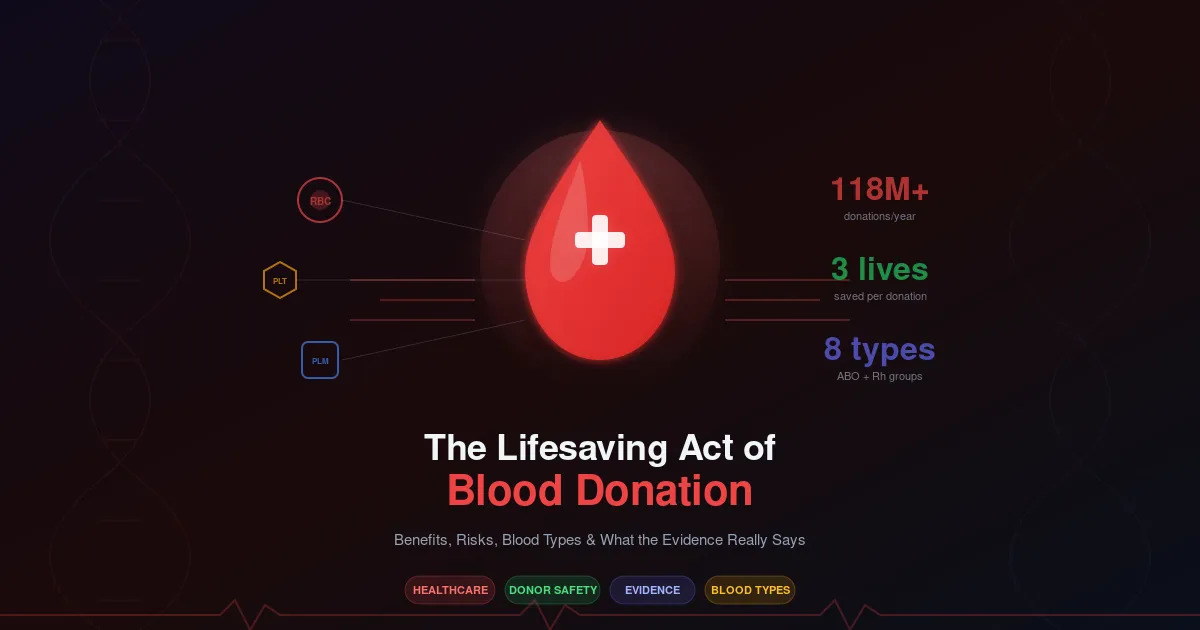
Globally, about 118.54 million blood donations are collected each year, but the supply is unevenly distributed: around 40% of all donations are collected in high-income countries, which are home to only 16% of the world’s population. That gap matters because blood has a limited shelf life, demand is continuous, and shortages can occur quickly when donor turnout falls.
The social impact of each donation is substantial. WHO states that one unit of safe blood can help save up to three lives because whole blood is commonly separated into red cells, platelets, and plasma for different clinical needs. In the United States, the National Heart, Lung, and Blood Institute says someone needs blood about every two seconds.
What Actually Happens to Donated Blood
A standard whole-blood donation usually collects about one pint of blood. After collection, the unit is labeled, tested, processed, and most often separated into red cells, platelets, and plasma. That component-based approach makes blood donation remarkably efficient: a single visit can support several different patients with different medical problems.
Table 1. What one whole-blood donation can become in routine processing.
Blood Types, Compatibility & Why Matching Matters
Your ABO group and Rh status are central to transfusion safety. The four major ABO groups are A, B, AB, and O, and each can be Rh positive or Rh negative. Red-cell transfusions must be matched carefully because incompatible blood can trigger destructive immune reactions.
For red-cell transfusions, O negative is the universal donor type used when the recipient’s blood type is unknown, especially in emergencies. AB positive is the universal red-cell recipient. Plasma works differently: AB plasma is the universal plasma donor.
Can give red cells to any ABO/Rh type. Critical for emergency trauma when typing isn’t possible.
Can give plasma to any ABO type. Contains no anti-A or anti-B antibodies, making it universally compatible.
Compatibility matters for another reason too: some patients need repeated transfusions over time, and good matching can reduce complications and make future transfusions safer. This is one reason blood systems emphasize both safety and donor diversity.
The Real Benefits of Blood Donation
The benefit to patients and the healthcare system. The most important benefit is still the clearest one: donated blood saves lives. Hospitals cannot manufacture blood, and many forms of care are impossible without a safe and stable supply. For trauma centers, maternity services, operating rooms, oncology units, and hematology clinics, blood donation is not optional support — it is core infrastructure.
The benefit to donors: meaningful, but often misunderstood. Many public articles list long menus of donor benefits — better heart health, detoxification, skin improvements, and more. The evidence is more nuanced. The strongest donor-side benefits are psychological and practical: many donors report a sense of purpose, generosity, belonging, and what researchers often call a “warm glow” after donation.
Table 2. Evidence summary of commonly discussed donor benefits.
High-quality donor education should never oversell blood donation as a wellness hack. A Canadian Blood Services clinical review notes that many widely reported health benefits are not supported by strong published data, particularly claims about lasting cardiovascular protection in healthy donors. A 2022 review similarly warns that observed benefits may reflect the “healthy donor effect” — blood donors are usually healthier than the general population to begin with.
In a randomized clinical trial involving firefighters with elevated PFAS exposure, both blood donation and plasma donation lowered PFAS levels over 12 months, with plasma donation producing the larger reduction. This finding is scientifically important, but it should be presented carefully: it does not mean routine blood donation is a general detox treatment for everyone.
Demerits & Real Risks Donors Should Know
Blood donation is widely regarded as safe, and most complications are uncommon and minor. But it is still a medical procedure, which means good education should discuss risks honestly rather than pretend they do not exist.
The main short-term problems are dizziness, nausea, vasovagal symptoms, fainting, bruising, localized pain, or re-bleeding at the needle site. The American Society of Hematology notes that fainting is typically the most significant complication encountered, while bruising is usually minor. A Canadian clinical review reports that moderate-to-severe adverse events in whole-blood donors occur in about 0.49% of donations, and that reaction rates are higher in first-time, younger, and female donors.
The most important long-term medical downside is iron depletion. The NIH notes that frequent donors may develop low iron levels, leading to anemia or low hemoglobin. A major review of donor iron status states that iron deficiency with or without anemia is a common consequence of regular blood donation, particularly in younger people, females, and high-intensity donors.
Table 3. The most clinically relevant donor-side risks and who is most affected.
The good news is that donor safety can usually be improved. Iron deficiency can be mitigated through longer intervals between donations, ferritin monitoring in higher-risk donors, and iron supplementation when recommended. Likewise, short-term reactions can often be reduced with hydration, food intake, calm coaching, and a brief supervised recovery period after donation.
Recovery After Donation
A whole-blood donation typically takes around 8 to 10 minutes for the blood draw itself, followed by rest and refreshments. Most people can resume normal daily activity afterward, but strenuous lifting and vigorous exercise are usually avoided for the rest of the day.
Body fluid replacement is relatively fast, but full biological recovery takes longer than many people realize. Plasma volume is replaced within roughly 24 to 48 hours, while red-cell replacement takes several weeks and iron replacement can take longer — especially in frequent donors.
Myths That Deserve Retirement
“Donating blood is dangerous for healthy adults.”
Fact: Donation is considered a safe and simple procedure for most healthy adults. Serious complications are uncommon.
“Donating blood makes people permanently weak.”
Fact: A donor may feel briefly tired or lightheaded, but most reactions are mild and self-limited. Long-term weakness is not expected in healthy donors unless issues like iron deficiency develop.
“Donating blood is the same as getting a medical check-up.”
Fact: Donor screening is valuable, but it is not a substitute for clinical care, diagnosis, or preventive health evaluation.
“Blood donation automatically improves heart health.”
Fact: Current evidence is mixed, and stronger reviews do not support promoting blood donation as a proven cardiovascular intervention for healthy donors.
The Professional Bottom Line
Blood donation is one of the clearest examples of a high-value public-health action with manageable individual risk. Its greatest benefit is external rather than personal: it keeps trauma care, surgery, maternal care, cancer treatment, and chronic transfusion support functioning.
Donors often gain a real emotional benefit, and some may incidentally learn useful health information through screening, but blood donation should not be marketed as a guaranteed personal health boost.
The main medical caution is iron loss, especially for frequent donors and other higher-risk groups. Once that point is understood — and managed through appropriate intervals, hydration, nutrition, ferritin monitoring when indicated, and iron replacement when advised — the case for blood donation remains very strong.
“Blood donation is best understood not as a miracle cure for donors, but as a safe, evidence-based act of solidarity that keeps modern healthcare alive.”
Reference: Red Cross Blood Donation
Who Can Donate: Eligibility Requirements
Blood donation criteria exist to protect both the donor and the recipient. Standards vary slightly by country and organization, but the following requirements are widely accepted across major blood services including the Red Cross, NHS Blood and Transplant, and WHO-aligned programs.
Basic Eligibility Criteria
- Age: Typically 17–65 years, though some jurisdictions accept donors from 16 (with parental consent) or have no upper age limit for regular donors with medical clearance.
- Weight: Minimum of 50 kg (110 lbs). Lower body weight increases the risk of vasovagal reactions.
- Health status: Generally good health on the day of donation. No active infections, fever, or acute illness.
- Hemoglobin level: Must meet minimum thresholds (usually 12.5 g/dL for women, 13.5 g/dL for men) tested via finger-prick before donation.
- Identification: Valid government-issued ID is required at most centers.
Common Deferral Reasons
Temporary deferrals are far more common than permanent ones. Understanding these helps avoid wasted trips and unnecessary disappointment.
- Recent travel: Travel to malaria-endemic regions typically results in a 3–12 month deferral depending on the specific area and duration of stay.
- Recent tattoos or piercings: Many jurisdictions require a 3–6 month waiting period if the procedure was performed at an unregulated facility.
- Pregnancy: Deferred during pregnancy and for 6 months postpartum.
- Recent illness: Cold, flu, or infection requires full recovery before donating. Antibiotic use for active infection also triggers deferral.
- Medications: Most medications do not disqualify donors, but certain drugs — particularly those affecting blood clotting or representing underlying conditions — may require a waiting period or permanent deferral.
- Low iron stores: The most common reason eligible donors are turned away at the clinic. This is correctable but underappreciated.
The Step-by-Step Donation Process
Understanding what happens during a donation appointment reduces anxiety and helps first-time donors prepare appropriately. The entire process typically takes 45–60 minutes, though the actual blood draw occupies only 8–10 minutes of that window.
Step 1: Registration and Informed Consent
Upon arrival, donors complete a registration form and provide identification. Staff then walk through an informed consent document explaining the procedure, potential risks, and how the donated blood will be used. This is not a formality — it is a legal and ethical requirement designed to ensure voluntary, understood participation.
Step 2: Health History and Mini-Physical
A confidential health history questionnaire covers travel, medications, sexual history, and potential exposure to bloodborne pathogens. This interview is conducted privately. Following the questionnaire, a brief physical assessment checks pulse, blood pressure, temperature, and hemoglobin level.
Step 3: The Donation
The donor sits in a reclined chair. A phlebotomist cleans the antecubital fossa (inner elbow) and inserts a sterile, single-use needle. Approximately 450–500 mL (about one pint) of whole blood is collected over 8–10 minutes. The donor is asked to squeeze a soft ball or similar object intermittently to maintain blood flow.
Step 4: Post-Donation Recovery
The needle is removed, pressure is applied, and a bandage is placed. Donors rest for 10–15 minutes in a designated recovery area while consuming fluids and light refreshments. Staff observe for any immediate adverse reactions before the donor is cleared to leave.
Step 5: Processing and Testing
After donation, the blood is labeled, refrigerated, and transported to a processing facility where it is separated into components (red cells, plasma, platelets). Each unit undergoes mandatory screening for HIV, hepatitis B and C, syphilis, and in many regions, hepatitis E, HTLV, and West Nile virus. Only units that pass all screening are released for patient use.
Understanding the Risks: An Honest Assessment
Transparency about risks is essential to informed consent and to maintaining public trust in blood services. While serious adverse events are rare, they do occur and deserve clear acknowledgment.
Common and Minor Reactions
- Vasovagal reactions: Lightheadedness, dizziness, or brief fainting. Occurs in roughly 2–5% of donations, more frequently in first-time donors, younger donors, and those with lower body weight.
- Hematoma: Bruising at the needle site. Usually mild and resolves within days to weeks.
- Arm soreness: Localized discomfort that typically subsides within 24–48 hours.
Less Common but Significant Risks
- Iron depletion: Each whole blood donation removes approximately 200–250 mg of iron. For frequent donors, premenopausal women, and individuals with marginal dietary iron intake, this can progress to iron deficiency anemia if not monitored and managed.
- Arterial puncture: Rare complication where the needle inadvertently enters an artery rather than a vein. Requires prolonged pressure and monitoring.
- Nerve injury: Uncommon but documented cases of transient or persistent nerve irritation near the puncture site.
- Severe vasovagal response: Prolonged syncope with potential for secondary injury (e.g., fall-related trauma). Estimated at fewer than 1 in 5,000 donations.
Extremely Rare Risks
- Bacterial contamination: Can occur during collection or processing. Modern aseptic techniques have made this exceedingly rare in developed blood systems.
- Transmission of infectious agents: Window-period infections (where a pathogen is present but not yet detectable by screening) represent a residual risk. Nucleic acid testing has dramatically reduced this window, making the current per-unit risk for HIV in the United States estimated at approximately 1 in 2 million.
Evidence-Based Outcomes: What the Data Actually Shows
The clinical impact of blood transfusion is well-documented across multiple medical domains. While individual transfusion decisions are always made case-by-case, population-level data provides a clear picture of where donated blood makes the most measurable difference.
Trauma and Emergency Care
Massive transfusion protocols in trauma settings have been associated with significant reductions in mortality. Studies from military and civilian trauma systems demonstrate that early blood product administration — particularly balanced ratios of red cells, plasma, and platelets — improves survival in hemorrhagic shock. The availability of typed and screened blood is a prerequisite for these protocols to function.
Oncology and Hematology
Patients undergoing chemotherapy for leukemia, lymphoma, and solid tumors frequently develop treatment-related cytopenias. Transfusion support is often the difference between continuing treatment at effective doses and requiring dose reductions that compromise outcomes. In some hematologic malignancies, transfusion dependency is a defining feature of disease management for months or years.
Maternal Health
Obstetric hemorrhage remains a leading cause of maternal mortality worldwide, particularly in low-resource settings. The WHO identifies timely access to safe blood as a critical intervention for reducing pregnancy-related deaths. In high-income countries, blood product availability for postpartum hemorrhage has contributed to maternal mortality ratios that are a fraction of those in settings without reliable transfusion infrastructure.
Chronic Transfusion Dependence
Conditions such as sickle cell disease, thalassemia major, and myelodysplastic syndromes require regular, often monthly, transfusions to maintain quality of life and prevent severe complications. For these patients, blood donation is not a one-time intervention — it is an ongoing lifeline that directly determines their trajectory of health or progressive organ damage.
Conclusion: From Awareness to Action
The case for blood donation does not rely on exaggerated claims about personal health benefits or emotional manipulation. It rests on a straightforward, evidence-supported reality: donated blood is a medical resource with no synthetic substitute, and patients need it every day — not just during widely publicized disasters or emergencies.
Blood services in most countries operate on narrow margins. A single severe weather event, holiday period, or surge in demand can strain supply to critical levels. The sustainability of the system depends on a consistent base of donors who give regularly, not just once.
If you are eligible, the most impactful thing you can do is schedule your next donation — and then the one after that. If you are temporarily or permanently ineligible, you can still contribute by organizing drives, spreading accurate information, or supporting blood service organizations in other ways.
The need is not abstract. Every unit collected has a documented path to a specific patient in a specific clinical situation. That is what makes blood donation unusual among health-related behaviors: the benefit is not probabilistic or long-term. It is immediate, concrete, and non-negotiable for the person receiving it.
Find your nearest blood donation center or mobile drive today. Register online, bring valid identification, and expect to spend about an hour. The procedure is safe, the need is real, and the impact is direct.