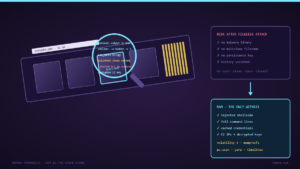

August 2021 was the month Exchange admins aged a decade. ProxyShell — a chain of three authentication-bypass-to-RCE bugs (CVE-2021-34473 SSRF, CVE-2021-34523 elevation, CVE-2021-31207 post-auth bypass) published by Vietnamese researcher Nguyễn Jang — turned unpatched on-prem Exchange Servers into webshell planters at population scale. The name said it: chained like its March cousin ProxyLogon, minus the auth requirement in the final path. Within two weeks of public chaining, mass scanners had hit virtually every exposed Exchange org, Exchange and Outlook Web Access pipelines lit up with China Chopper-style droppers, and ransomware crews (Conti, Black Kingdom, Hive-era opportunists) queued behind initial-access brokers. By early September, Microsoft counted 10+ APT/actor clusters riding the same rail. For defenders, ProxyShell was the second punch of a one-two that started with Hafnium in March — proof that one buggy codebase could feed an entire year of carnage.
ProxyShell (August 2021 exploitation wave) is an attack chain on Microsoft Exchange Server combining three vulnerabilities: CVE-2021-34473 (path confusion/SSRF in Exchange’s Front End HttpProxy — lets an unauthenticated attacker reach the Exchange Back End as SYSTEM), CVE-2021-34523 (Exchange Back End treats malicious request as authority, elevation of privilege — the “trusted as SYSTEM” trick), and CVE-2021-31207 (post-auth filter bypass via mail-export path enabling writing files, commonly a webshell, into web-accessible paths). Chained: unauthenticated RCE as SYSTEM on unpatched Exchange. Exploitation tooling was public within days (Vietnamese researcher Nguyễn Jang’s write-up and public PoC chained the trio after April–July individual disclosures/patches), leading to August mass-campaign: opportunistic webshell drops (China Chopper, ASAPoet-style), credential theft, mailbox exfil (reportedly exploited in iPhones-of-journalists style targeting later attributed via related tooling), BEC mailbox-rules planting, and ransomware follow-on (Conti, BlackKingdom, Hive). Microsoft’s July 2021 cumulative patches fixed all three CVEs, so the wave hit only unpatched/lagging servers — but Exchange’s attack surface (legacy architecture, sprawling autodiscover/MAPI endpoints) kept it on CISA’s top-exploited list through 2023+. Defender priorities: patch (July CU or later), hunt webshells (authentication anomaly detection, common paths like aspx in inetpub, or via Exchange logging HTTP 400/POST anomalies), rotate credentials (mailbox + local admin + service accounts), audit mailbox rules and transport rules, and treat any pre-patch exposure window as presumed-compromised with IR support. ProxyShell’s lasting lesson: chained “medium” bugs equal critical — CVSS-sum fallacy — and perimeter Exchange must die in favour of hardened architectures, per the hardening-mindset guidance we outline in infrastructure resilience coverage.
What happened
Disclosure runway: the three CVEs patched individually across April–July 2021 (April CU fixed SSRF-adjacent pieces; July CU closed the chain). In-triage bug-bounty/pentation noises were low — until researcher chaining made exploitation trivial. Late July–early August 2021: public PoC + write-up (Nguyễn Jang’s blog, plus Orange Tsai’s earlier ProxyLogon lineage context) — within days, Shodan-visible mass-scanning for /autodiscover/ and /mapi/ patterns; by mid-August, the wave peaked: tens of thousands of servers touched across education, government, healthcare, and SME sectors globally. Post-access: webshell gardens (China Chopper variants, one-letter aspx in default directories), exfil of mailbox content, domain recon from SYSTEM, and ransomware drops — Conti observed riding ProxyShell access within weeks; later, LockBit 2.0 and Hive-affiliated initial access brokers trafficked the same holes.
Origin note: as with ProxyLogon, Microsoft attributed most early ProxyShell exploitation to China-based actor clusters (Hafnium-adjacent and copycat), but by autumn the actor list had sprawled — including FIN-style espionage crews, cryptominers, and pure-criminal ransomware outfits — because the bug class was actor-agnostic commodity. Attribution mattered less than the operational reality: any unpatched server was a public paintball target, and defenders’ incident-triage queues filled through Q4.
How it worked
The chain in one diagram:
attacker (unauthenticated, internet) -> Exchange Front End

  1. CVE-2021-34473 (SSRF / path confusion):
     crafted Autodiscover URL targeting Back End
     endpoint as an internal spool -> Front End proxies
     request to Back End (attacker now "origin")
  2. CVE-2021-34523 (elevation):
     Back End's Exchange Web Services FbaAuth /
     default authorization treats proxied request as
     authenticated SYSTEM-level internal call
  3. CVE-2021-31207 (post-auth filter bypass):
     use ExportRequest/.NET serialization-XOP mail
     export path to write attacker content to disk -
     classically a webshell .aspx into a web-servable
     directory (e.g. FrontEndHttpProxyowaauth)
  4. interact with webshell -> arbitrary commands as
     IIS/ApplicationPool/SYSTEM context
  5. post-exploitation: credential/vault theft,
     mailbox exfil via EWS/MAPI, persistence via
     transport rules + additional shells, ransomware

patch reference: July 2021 CU (and later) closes all 3;
any pre-patch server with 443 exposure = presumed hit
The composite lesson — chained authentication-confusion bugs in a perimeter-legacy architecture — is why Exchange Online migration, attack-surface reduction on CAS roles, and “no unauthenticated internet-facing admin planes” became board-level tolerances. The wave also cemented webshell-hunting as a permanent blue-team discipline, the same detection muscle we prescribe in hardening guidance.
Impact and numbers
| Metric | Value | Source |
|---|---|---|
| CVEs chained | CVE-2021-34473 / 34523 / 31207 | Microsoft advisories |
| Patch that closed chain | July 2021 cumulative update | Microsoft |
| Exploitation peak | Aug 2021 mass wave post-PoC | vendor telemetry |
| Actor clusters observed | 10+ (espionage + criminal) | Microsoft/FBI/CISA 2021 |
| Follow-on effects | Webshells, mailbox exfil, ransomware (Conti et al.) | IR reports |
| Legacy | CISA top-exploited list through 2023+ | CISA KEV |
Timeline
| Date | Event |
|---|---|
| 2021-04/07 | Individual CVEs patched in April & July CUs |
| 2021-08 (early) | Public chain write-up + PoC (Nguyễn Jang) |
| 2021-08 (mid) | Mass scanning + webshell planting wave peaks |
| 2021-09 | Microsoft counts 10+ actor clusters exploiting |
| 2021 Q4–2022 | Ransomware follow-on (Conti, LockBit, Hive lineage) |
| 2023+ | Residual unpatched servers keep CVEs on KEV |
Why it still matters in 2026
ProxyShell’s permanence comes from what it exemplifies, not the specific trio (patched for years): chained low-single bugs into SYSTEM RCE on internet-facing middleware; the economics of copycat waves post-PoC; and the reality that patch latency of even a few weeks on perimeter email infrastructure equals incident. In 2026 guidance, ProxyShell is the canonical case for: (1) attack-surface elimination — get Exchange off the internet or into regulated SaaS; (2) chained-CVSS threat modelling — rate combos, not singles; (3) “presumed compromised” playbooks — any exposure window before patch triggers full hunt, not just patch-and-pray; (4) mailbox-grade detection — transport-rule anomalies, EWS/MAPI bulk-export patterns, new aspx-in-webroots alerts. CISA’s KEV still lists the ProxyShell trio as actively observed — a standing reminder that legacy on-prem email remains the gift that keeps giving to initial-access markets, and that the org-level lesson lives in our resilience-mindset coverage.
Detection and hardening takeaways
- Patch to current CU floor, then verify. ProxyShell’s chain closed at July 2021 CU — but half-wave victims were orgs that patched March (ProxyLogon) and stopped. Treat every Exchange CU as mandatory-within-days, and verify version + exposure (no pre-CU server on 443).
- Hunt webshells as a standing patrol. Alert on anomalous .aspx writes in web roots, one-request POST anomalies to owa/auth paths, and living-off-IIS processes — the drops were commodity and, once planted, persisted for months undiscovered in many orgs.
- Rotate everything after exposure windows. Mailbox credentials, machine accounts, service-account and krbtgt-adjacent secrets — SYSTEM-context access assumed vault reads; patch-without-rotate was the dominant re-compromise path.
- Watch mailbox & transport rules. BEC persistence via forwarding rules and hidden inbox manipulation were signature follow-ons; detection content on rule creation/modification by unusual principals pays for itself weekly.
- Plan the exit from perimeter middleware. The structural fix accelerated in every post-ProxyShell architecture review: consolidate to managed SaaS or strictly-tunnelled on-prem with WAF/admin-plane segmentation — eliminate unauth internet-facing request-processing entirely.
FAQ
How was ProxyShell different from ProxyLogon?
Same codebase, same prefix-name, different chain mechanics: ProxyLogon (March 2021, Hafnium) chained SSRF + deserialization after token forging; ProxyShell chained a different trio (SSRF + Back End elevation + filter bypass) achieving unauthenticated RCE without needing the same token mechanics. Practically: both meant SYSTEM on unpatched Exchange; ProxyShell hit servers that had skipped ProxyLogon-era patching plus newly-chained paths, and its PoC quality made copycat exploitation even broader.
Were only unpatched servers hit?
Yes — every wave victim lacked the July 2021 CU (or partial patches leaving one CVE open). Microsoft had fixed all three before the public chain. The scandal was timing-lag and CU complexity: delayed patch cycles, fragile DAGs, and fear of update breakage left thousands exposed weeks after fixes shipped — the eternal operational excuse ProxyShell made indefensible.
What should orgs do if they still run on-prem Exchange in 2026?
Assume interest and shrink surface: current-CU-plus-rapid cadence, no direct internet exposure (tunnel/proxy/WAF with strict auth pre-proxy), EDR on Exchange boxes with webshell detections, honeytoken mailboxes, full audit-rule monitoring, credential-rotation playbooks — and a migration plan on the roadmap, because the ecosystem answer (and Microsoft’s push) is clear: perimeter email middleware is legacy liability.
The second wave doctrine
ProxyShell — the August 2021 Exchange exploitation wave — taught the second-wave lesson: after HAFNIUM forced mass patching in March, the machines that remained unpatched faced a different, broader attacker population, because every researcher and criminal crew had spent the interim weaponizing the same vulnerability class. The August campaigns were noisier, more indiscriminate, and more ransomware-oriented than the targeted spring intrusions — the economics of unpatched populations attract different predators as they age.
The doctrine formalized: patch-or-isolate has a compounding deadline — the gap between first and second wave is measured in months, and the second wave is worse for laggards because the tooling matured in the interim. The operational programs that tracked estate-wide patch completion as a percentage against days (rather than ticket closure) consistently emptied the second-wave exposure window; the ticket-based programs discovered, each wave, that closed tickets and deployed patches are overlapping but non-identical sets.
The consolidation with the genre: Exchange 2021 was the era clearest demonstration that mass-exploitation events are estate-management events wearing exploitation costumes — the HAFNIUM record — and ProxyShell added the temporal dimension: exposure does not merely persist for the unpatched, it worsens on a schedule that weaponization research sets. The exam has two sittings; the second is graded harder; and the same homework passes both.
Related Reading
- What Studying 33 Historic Cyberattacks Taught Me About Defending Systems Today
- Passwordless in 2026: Why Passkeys Are Finally Killing the Password (and How Attackers Are Adapting)
- 2022–2024: Lapsus$, Change Healthcare & the XZ Backdoor
- Authoritative reference: CISA Known Exploited Vulnerabilities
- HAFNIUM and Exchange Zero-Days: The 30,000-Server Compromise
- Apache httpd CVE-2021-44790: The RCE After Log4Shell
- Exchange CVE-2020-0688: A Default Key Made Every Server Alike