
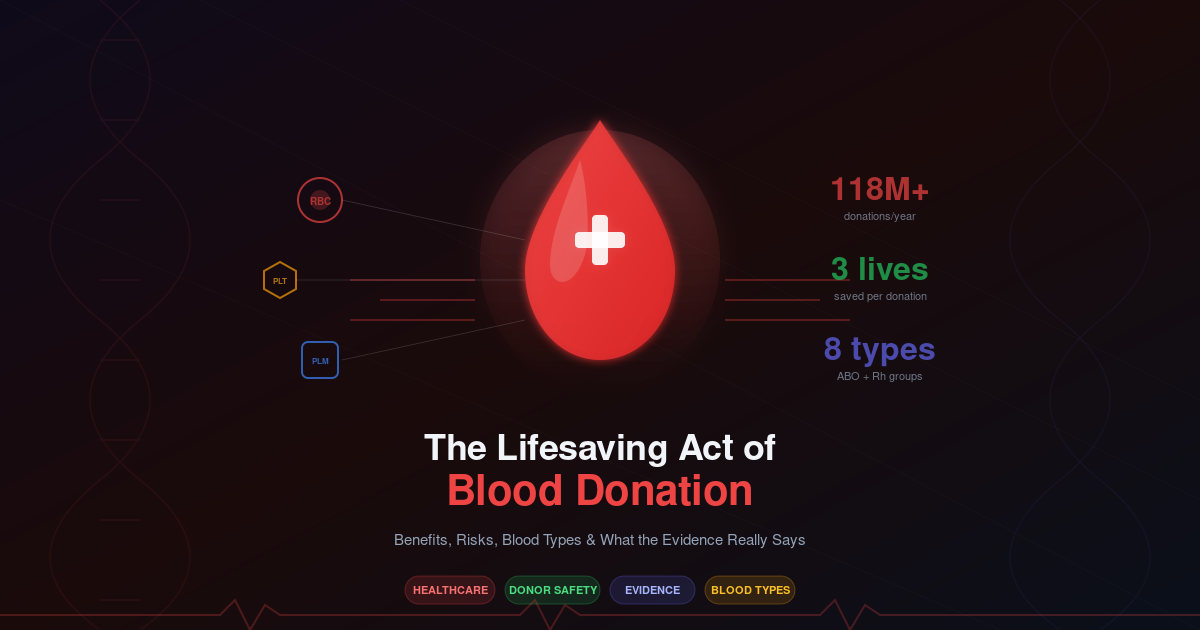
Blood transfusion is not a niche medical service; it is a core part of modern healthcare. Safe blood is needed for trauma, major surgery, childbirth complications, severe anemia, cancer care, and chronic conditions such as sickle cell disease and thalassemia. The World Health Organization notes that many patients who need transfusion still do not have timely access to safe blood, which is why blood availability remains a public-health priority.
Globally, about 118.54 million blood donations are collected each year, but the supply is unevenly distributed: around 40% of all donations are collected in high-income countries, which are home to only 16% of the world’s population. That gap matters because blood has a limited shelf life, demand is continuous, and shortages can occur quickly when donor turnout falls.
The social impact of each donation is substantial. WHO states that one unit of safe blood can help save up to three lives because whole blood is commonly separated into red cells, platelets, and plasma for different clinical needs. In the United States, the National Heart, Lung, and Blood Institute says someone needs blood about every two seconds.
What Actually Happens to Donated Blood
A standard whole-blood donation usually collects about one pint of blood. After collection, the unit is labeled, tested, processed, and most often separated into red cells, platelets, and plasma. That component-based approach makes blood donation remarkably efficient: a single visit can support several different patients with different medical problems.
Table 1. What one whole-blood donation can become in routine processing.
Blood Types, Compatibility & Why Matching Matters
Your ABO group and Rh status are central to transfusion safety. The four major ABO groups are A, B, AB, and O, and each can be Rh positive or Rh negative. Red-cell transfusions must be matched carefully because incompatible blood can trigger destructive immune reactions.
For red-cell transfusions, O negative is the universal donor type used when the recipient’s blood type is unknown, especially in emergencies. AB positive is the universal red-cell recipient. Plasma works differently: AB plasma is the universal plasma donor.
Can give red cells to any ABO/Rh type. Critical for emergency trauma when typing isn’t possible.
Can give plasma to any ABO type. Contains no anti-A or anti-B antibodies, making it universally compatible.
Compatibility matters for another reason too: some patients need repeated transfusions over time, and good matching can reduce complications and make future transfusions safer. This is one reason blood systems emphasize both safety and donor diversity.
The Real Benefits of Blood Donation
The benefit to patients and the healthcare system. The most important benefit is still the clearest one: donated blood saves lives. Hospitals cannot manufacture blood, and many forms of care are impossible without a safe and stable supply. For trauma centers, maternity services, operating rooms, oncology units, and hematology clinics, blood donation is not optional support — it is core infrastructure.
The benefit to donors: meaningful, but often misunderstood. Many public articles list long menus of donor benefits — better heart health, detoxification, skin improvements, and more. The evidence is more nuanced. The strongest donor-side benefits are psychological and practical: many donors report a sense of purpose, generosity, belonging, and what researchers often call a “warm glow” after donation.
Table 2. Evidence summary of commonly discussed donor benefits.
High-quality donor education should never oversell blood donation as a wellness hack. A Canadian Blood Services clinical review notes that many widely reported health benefits are not supported by strong published data, particularly claims about lasting cardiovascular protection in healthy donors. A 2022 review similarly warns that observed benefits may reflect the “healthy donor effect” — blood donors are usually healthier than the general population to begin with.
In a randomized clinical trial involving firefighters with elevated PFAS exposure, both blood donation and plasma donation lowered PFAS levels over 12 months, with plasma donation producing the larger reduction. This finding is scientifically important, but it should be presented carefully: it does not mean routine blood donation is a general detox treatment for everyone.
Demerits & Real Risks Donors Should Know
Blood donation is widely regarded as safe, and most complications are uncommon and minor. But it is still a medical procedure, which means good education should discuss risks honestly rather than pretend they do not exist.
The main short-term problems are dizziness, nausea, vasovagal symptoms, fainting, bruising, localized pain, or re-bleeding at the needle site. The American Society of Hematology notes that fainting is typically the most significant complication encountered, while bruising is usually minor. A Canadian clinical review reports that moderate-to-severe adverse events in whole-blood donors occur in about 0.49% of donations, and that reaction rates are higher in first-time, younger, and female donors.
The most important long-term medical downside is iron depletion. The NIH notes that frequent donors may develop low iron levels, leading to anemia or low hemoglobin. A major review of donor iron status states that iron deficiency with or without anemia is a common consequence of regular blood donation, particularly in younger people, females, and high-intensity donors.
Table 3. The most clinically relevant donor-side risks and who is most affected.
The good news is that donor safety can usually be improved. Iron deficiency can be mitigated through longer intervals between donations, ferritin monitoring in higher-risk donors, and iron supplementation when recommended. Likewise, short-term reactions can often be reduced with hydration, food intake, calm coaching, and a brief supervised recovery period after donation.
Recovery After Donation
A whole-blood donation typically takes around 8 to 10 minutes for the blood draw itself, followed by rest and refreshments. Most people can resume normal daily activity afterward, but strenuous lifting and vigorous exercise are usually avoided for the rest of the day.
Body fluid replacement is relatively fast, but full biological recovery takes longer than many people realize. Plasma volume is replaced within roughly 24 to 48 hours, while red-cell replacement takes several weeks and iron replacement can take longer — especially in frequent donors.
Myths That Deserve Retirement
“Donating blood is dangerous for healthy adults.”
Fact: Donation is considered a safe and simple procedure for most healthy adults. Serious complications are uncommon.
“Donating blood makes people permanently weak.”
Fact: A donor may feel briefly tired or lightheaded, but most reactions are mild and self-limited. Long-term weakness is not expected in healthy donors unless issues like iron deficiency develop.
“Donating blood is the same as getting a medical check-up.”
Fact: Donor screening is valuable, but it is not a substitute for clinical care, diagnosis, or preventive health evaluation.
“Blood donation automatically improves heart health.”
Fact: Current evidence is mixed, and stronger reviews do not support promoting blood donation as a proven cardiovascular intervention for healthy donors.
The Professional Bottom Line
Blood donation is one of the clearest examples of a high-value public-health action with manageable individual risk. Its greatest benefit is external rather than personal: it keeps trauma care, surgery, maternal care, cancer treatment, and chronic transfusion support functioning.
Donors often gain a real emotional benefit, and some may incidentally learn useful health information through screening, but blood donation should not be marketed as a guaranteed personal health boost.
The main medical caution is iron loss, especially for frequent donors and other higher-risk groups. Once that point is understood — and managed through appropriate intervals, hydration, nutrition, ferritin monitoring when indicated, and iron replacement when advised — the case for blood donation remains very strong.
“Blood donation is best understood not as a miracle cure for donors, but as a safe, evidence-based act of solidarity that keeps modern healthcare alive.”