Enterprise software has always had a last-mile problem: the product works in the demo, and then it meets the customer’s actual data. Palantir built its answer in the mid-2000s — put the engineer on a plane, sit them inside the customer’s environment, and have them build the missing mile in production code. The title was Forward Deployed Engineer, borrowed from military vocabulary, and for fifteen years it stayed a niche Palantir quirk.
Then LLMs arrived and replayed Palantir’s problem one-to-one. The models are powerful, but every enterprise deployment hits messy data, unique workflows, and integration work no account manager can do. In 2025-2026, Anthropic, OpenAI, Cursor, Sierra, Ramp, Scale AI and dozens of others began hiring FDEs aggressively — with pay bands to match. This guide covers the full picture: what the role is, where it came from, how the work actually flows, what it pays, why demand exploded, and where the hype deserves pushback.
A Forward Deployed Engineer (FDE) is a software engineer who embeds inside a customer’s organization — on-site or virtually — for months at a time, learns the domain from the inside, and writes production code in the customer’s environment while committing reusable improvements back to the core product. Unlike a consultant, an FDE ships code, not reports; unlike a sales engineer, they arrive after the signature and stay through deployment. The role was popularized at Palantir, where reporting around the 2020 direct listing put FDEs at roughly 10% of headcount. Demand exploded in the AI era because enterprises now buy outcomes, not access — and turning a powerful model into a working production system requires an engineer embedded in the customer’s reality. Typical AI-industry compensation runs $200-350K base plus equity, with senior frontier-lab roles above that.
What is forward deployed engineering?
The phrase comes from military operations, where “forward-deployed” describes forces positioned inside the theater where they’ll fight, not waiting at home base. Applied to software, it means the same thing: an engineer positioned inside the customer’s environment rather than parked behind a product roadmap.
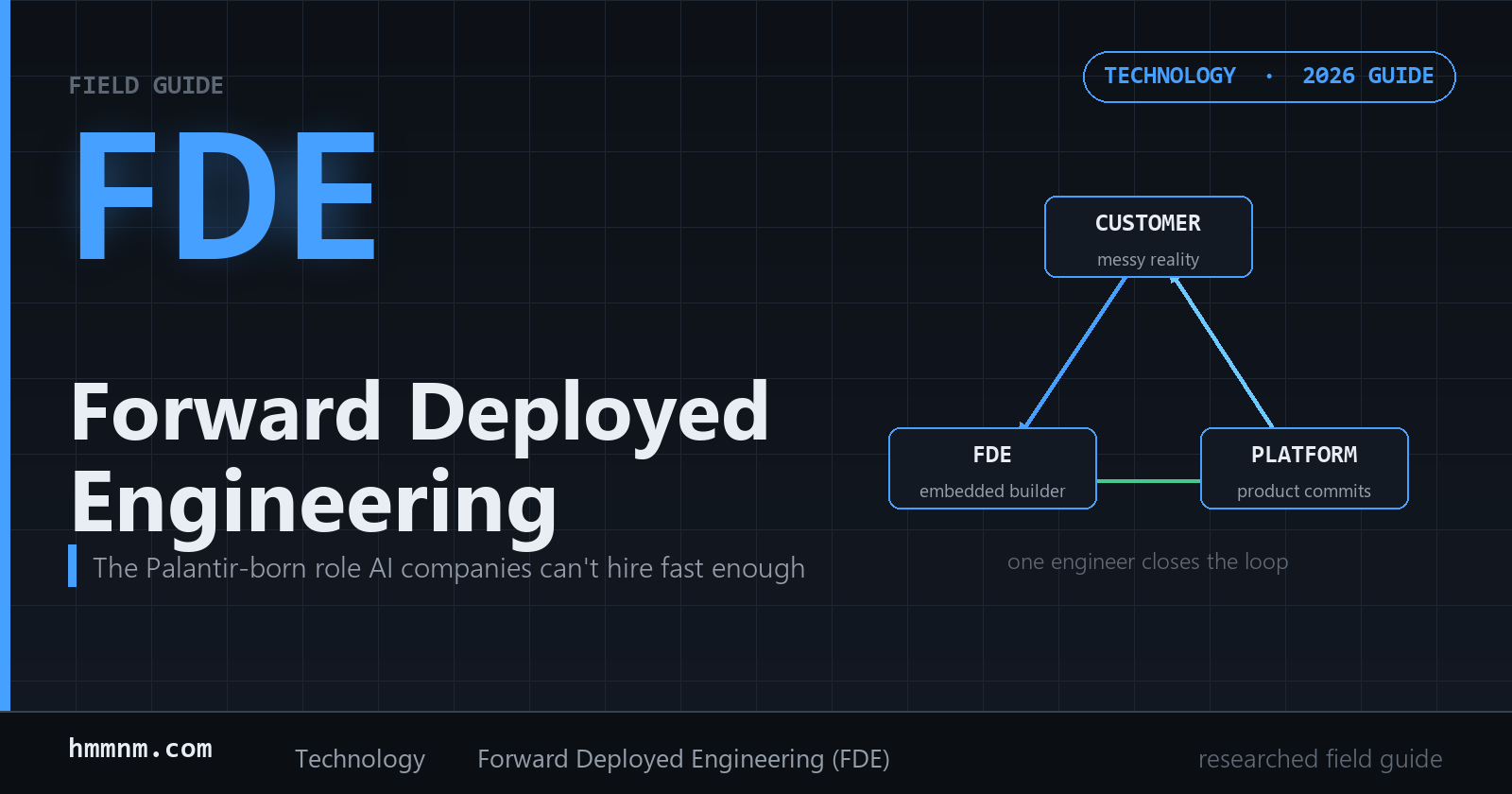
In practice, a forward deployed engineer is a software engineer organized around a customer’s operational problem instead of a general platform roadmap. They work shoulder-to-shoulder with the customer’s teams — seeing how the data actually behaves, where the workflows really jam, which constraints are negotiable and which are law — and they build directly against that reality: integrations, data models, agents, applications. Crucially, in the mature version of the model, whatever repeats across customers flows back into the core product as commits. The FDE is the loop between one messy deployment and everyone else’s next one.
Palantir’s own terminology splits the motion into two paired roles: the Delta (Forward Deployed Software Engineer, FDSE), who owns the technical build — writing code, debugging systems, configuring platform behavior inside production environments — and the Echo (Deployment Strategist), who owns mission context, stakeholder alignment, and adoption. The separation exists to keep one human from being the single point of pressure on both fronts. A Delta needs customer context to build the right system; an Echo needs enough technical depth to devise a workable strategy. The pairing is the deployment unit.
One misconception to kill early: this is not a consulting role rebranded. An FDE’s output is a working system and — where the model is run correctly — commits to the product’s repository. They are measured by deployed functionality and customer outcomes, not billable hours.
How the work flows: the FDE engagement loop
The best way to understand the role is as a loop rather than a job description. Each engagement runs the same five-stage cycle, and the loop closing — field learning reaching the platform — is what separates forward deployment from bespoke consulting:
The Forward Deployment Loopone engineer closes the gap between platform and production — and funds the roadmap1EMBEDInside the customer’s org: access thereal data, workflows, constraints2BUILDProduction code in the customer’sstack: integrations, agents, apps3SHIPWorking system in production with ameasured business outcome4EXTRACTSpot what repeated across 3+customers — that is product intelligence5PRODUCTIZECommit patterns to the core platform;the next deployment starts aheadweeks of code, not months of handoffsthe loop funds the roadmapwith customer money
Walk the stages:
- Embed. The FDE gets real access — read-only to start — to the systems where the work happens: analytics, CRM, tickets, logs. The point is to see how processes behave in data, not how the CEO describes them. A striking datapoint from one solo practitioner’s ~40 AI audits in 2024-2025: in 30 of them, the real bottleneck was somewhere other than where the C-suite thought it was.
- Build. Production-grade work: ontology and data models, connectors, workflow adaptation, and — in the AI-era version — agents, retrieval pipelines, evaluations, and MCP servers wired against the customer’s infrastructure. This cannot be delegated to a sales engineer; it requires someone fluent in both the product and the customer’s stack.
- Ship. A working system in production with a measured outcome — tickets actually deflected, underwriting actually accelerated. The gap between “I recommend” and “this works” is, commercially, the gap between a report fee and a renewal.
- Extract. The pattern-matching step that makes the model durable: if three customers hit the same integration gap, that is not three support tickets — it is one product decision.
- Productize. Commits land in the core platform. What looked like custom work for one customer becomes a capability for all of them. Palantir’s critical insight, in one line: what repeats across 5-10 customers is a core product feature that customer money paid to discover.
Compare that to the traditional enterprise loop: the customer explains a problem; a sales or delivery team translates it; product and engineering receive a filtered version of the translation; and by the time it survives roadmap triage, the customer has moved on. Forward deployment exists to delete those handoffs — because every handoff loses context.
Where the role came from: Palantir, 2003-2024
Palantir was founded in 2003 by Peter Thiel, Alex Karp and Joe Lonsdale to build counter-terrorism software after 9/11, adapting PayPal’s fraud-pattern ideas to intelligence problems. In-Q-Tel, the CIA’s venture arm, invested $2M in 2005. The early deployments had a property that broke conventional enterprise sales: the customers were intelligence agencies whose data lived across dozens of incompatible systems, whose schemas contradicted each other, and whose business logic existed mainly in the heads of analysts. Demos and documentation could not move that needle.
The answer was embedding. Shyam Sankar, who joined in 2006 as employee #13 and today serves as Palantir’s President, was one of the first to work this way: sit at the customer’s site for six to twelve months, build the ontology of their data, write the connectors, deploy the applications — and route the patterns that repeated across three or more customers back into the product that became Gotham and later Foundry. Karp’s framing of the industry the model was attacking was blunt: enterprise vendors “sell a product that doesn’t work without 18 months of Deloitte consulting on top.”
The economics compounded. Every engagement funded development of the next platform version with customer money instead of venture money. By the September 2020 IPO — a ~$22B valuation — Palantir had roughly 250 FDEs out of ~2,400 employees, about 10% of headcount. By September 2024, when Palantir joined the S&P 500 with a market cap around $200B, the FDE model had become the case study the rest of the industry went to school on.
Devs, Deltas and Echoes: how the role is actually structured
Palantir’s internal split is worth understanding because it answers the obvious question — if these are senior engineers working with production, how are they different from regular platform engineers?
| Role | Internal name | Primary ownership | Measured by |
|---|---|---|---|
| Platform / product engineer | Dev | Reusable capabilities, core infrastructure, design and architecture across all customers | Platform strength |
| Forward deployed software engineer | Delta / FDSE | Technical build inside one customer environment: composition, integrations, data access, workflow adaptation | Deployment outcomes |
| Deployment strategist | Echo / DS | Mission context, stakeholder navigation, adoption, real-time operations | Organizational movement |
The Dev-Delta division is the product-versus-deployment split: Devs extend the platform for many customers; Deltas apply the platform inside one. A day in the Delta’s life mixes ontology design, pipeline code, integration debugging, and customer conversations deep enough to be useful — with the standing judgment call of what stays customer-specific versus what belongs in the platform.
FDE vs. the roles it gets confused with
Job-title inflation is real, and “forward deployed engineer” gets used for everything from pre-sales demos to staff augmentation. The honest comparisons:
| Role | What they deliver | When they leave | Reports into |
|---|---|---|---|
| Consultant | An 80-page report and a presentation | At the signature | Their firm’s billable model |
| Sales engineer | Demos and technical answers that close the deal | At the signature (pre-sales) | Sales |
| Solutions architect | Diagrams and specs handed to someone else’s team | At handoff | Delivery / sales |
| Implementation manager | The product launched “as is”: config, training, project plan | At go-live | Customer’s PMO |
| FDE | Production code in the customer’s stack and commits to the core product | 6-18 months in, after outcomes land | Engineering (VP Eng), with a deployment mandate |
Three lines distinguish the real thing: an FDE writes code that runs in production, an FDE changes the product itself when standard configuration falls short, and an FDE’s engagement length is measured against customer outcomes rather than a project calendar.
Why demand exploded: AI replayed Palantir’s problem
Everything about the current moment rhymes with Palantir’s origin, and the best analysis of why comes from a single structural observation: with AI, customers buy work, not access. A seat license or an API key grants the possibility of value; an agent that deflects 20% of support tickets or accelerates underwriting IS the value. Delivering work the way a specific company works requires someone technical embedded in that company’s reality — which is the FDE job description, almost verbatim.
Three structural shifts in 2024-2026 turned that observation into a hiring wave:
- From API sales to outcome sales. Anthropic and OpenAI increasingly sell “solved customer support” or “automated underwriting,” not tokens. Selling outcomes without an FDE embedded in the workflow is impossible; the ROI simply never materializes, and the $500K/year contract quietly does not renew.
- MCP as the integration standard. Anthropic released the Model Context Protocol in November 2024, and the FDE job now centrally includes writing MCP servers against customer infrastructure. That is engineering work — understanding both the product and the customer stack — not sales support. (If you’re building or consuming MCP servers, our MCP security and threat-model guide covers the attack surface that creates.)
- The enterprise-AI race. Salesforce Agentforce, Google Vertex AI agents, Microsoft Copilot Studio and startups like Sierra are fighting for the same customers — and in a race between comparably powerful models, whoever ships a working agent to production first wins. FDEs are deployment speed, institutionalized.
The roster confirms it. OpenAI’s forward deployed engineers own everything from discovery and technical scoping through system design, build and production rollout with strategic customers. Anthropic’s FDE postings describe building production Claude applications inside customer systems and codifying repeatable deployment patterns. Cursor staffs FDEs for enterprise customers like Shopify and Stripe; Sierra — built by Bret Taylor — is FDE-native from day one (he calls the role “Agent Engineer”); Decagon, Ramp, Harvey and Scale AI all run versions of it. Microsoft and Amazon have borrowed the playbook for customer-site AI implementation teams. Commentary ranges from LinkedIn analyses of the trend to Forbes declaring it “a new career path for the native-AI era.”
The economics: when an FDE pays for themselves
The model is expensive, and pretending otherwise is how companies break it. It assumes senior engineers, long engagements, an extensible platform, and deal sizes big enough to front-load that much engineering. A clear framework by contract size:
| Deal size | FDE math | What you’re really running |
|---|---|---|
| 8-figure contracts | True long-term embedding is fully justified | Palantir’s original model |
| 6-7 figure contracts | Days-to-weeks of deep customization per customer — near-required with AI | Productized FDE, tight timeboxes |
| 4-to-low-5 figure contracts | The math stops working; you’re selling engineering time at a premium | Services revenue wearing a product costume |
Compensation reflects the leverage. Palantir’s median total compensation runs around $215K, per the 2026 Forward Deployed Engineering Compensation Report (Perspective, ~1,200 FDEs surveyed), with senior frontier-lab packages north of $785K and principal-level roles occasionally exceeding $1M. AI-industry FDE bands commonly run $200-350K base plus equity, with senior Anthropic listings reaching $310-405K base — above many ML-researcher bands at comparable levels. The reason is not charity: FDEs directly drive renewal on enterprise contracts worth $1-10M, and enterprise retention compounds.
How to become one: the skill stack
FDE-caliber profiles are rare precisely because the stack is unusual — it is the intersection of four abilities that rarely co-occur at a senior level:
- Production engineering. Real software craft: integrations, data pipelines, debugging systems you didn’t build, writing code other engineers will inherit.
- Domain absorption. The ability to enter a bank, a hospital, or a logistics firm and learn the domain fast enough to be useful in weeks — including the parts of the workflow nobody documents.
- Customer judgment. Deciding in the room, without escalating home: what’s a one-off, what’s a product gap, what’s a bad workflow the customer should change instead.
- AI-era plumbing. For current openings: agent architecture, retrieval, evaluations and guardrails, and MCP-server development. (Agent security literacy matters here too — the OWASP Top 10 for agentic applications and our Agentic Skills Top 10 series are solid grounding.)
Common entry routes: strong backend/full-stack engineers who keep gravitating toward customers; consultants who learned to ship code; and founders — the solo-founder version of the model works at small scale, with practitioners reporting 3-4 week audit-plus-deployment engagements and roughly 40% conversion to retainers, versus around 10% for report-only consulting. The difference is code, not a PDF.
The critiques: what honest observers push back on
The trend has real skeptics, and they make points worth holding onto:
- It’s often just sales engineering re-branded. As one widely-shared analysis put it: there really isn’t that much difference between traditional enterprise sales engineering and the forward-deployed terminology being thrown around today — the cooled-up title can set wrong expectations with customers about what they’re getting.
- Some of it is a bubble. When every AI company simultaneously discovers the same job title, some of the hiring is fashion. Researchers watching the wave have warned the FDE term is being over-applied to ordinary implementation work.
- Margin drag. Senior engineers embedded in delivery look like services cost, not product cost — and the model only outperforms consulting if field learning actually reaches the roadmap. If it doesn’t, you’ve built a consulting firm with a product catalog.
- Organizational prerequisites. The uncomfortable question for any company copying the model: are you adopting Palantir’s operating model, or just borrowing its job titles? Without an extensible platform, embedded delivery practices, and a functioning feedback loop, the title alone delivers nothing.
Where this goes next
Three trajectories look durable. First, FDE as an executive pipeline: the role compresses engineering, product and go-to-market judgment into one seat — Palantir’s own leadership is the existence proof. Second, productization of the motion: the parts of engagements that repeat (environment assessment, MCP scaffolding, evaluation harnesses) are becoming tooling, which raises what a single FDE can cover. Third, the model spreading to AI-adjacent domains — security operations, data platforms, defense tech — anywhere powerful platforms meet idiosyncratic customer reality. The “train the customer’s team and leave” model is what’s dying; outcome ownership is what’s being hired.
Questions people actually ask
Is FDE just consulting with a better title?
The delivery looks similar from outside — an expert arrives, works with your teams, leaves. The differences are structural: the FDE commits to the vendor’s product repo, is measured on your outcomes rather than billables, and their engagement feeds the platform every other customer uses. If none of those three things is true at a given company, then yes — you’re looking at re-badged consulting.
Is it pre-sales or post-sales?
Post-sales, with pre-sales overlap. A sales engineer runs demos until the signature; the FDE arrives after it and stays 6-18 months. In AI deals especially, FDEs join scoping conversations mid-funnel because what they learn there determines whether the deployment can actually work.
Can the role be done remotely?
Increasingly, yes — “virtually embedded” is now a normal variant, and the same loop runs over shared channels, paired repos, and direct data access. What can’t be faked is the access: an FDE who never sees the customer’s real data and real workflow is just a remote engineer with a fancy title.
Is FDE a career dead-end or a launchpad?
A launchpad, with one caveat. The accumulated skill set — deep engineering plus customer judgment plus product instinct — maps directly onto founding, platform product management, and executive roles. The caveat: if you stay in pure delivery with no product-feedback habit, the role can plateau into high-end consulting. Choose employers whose FDEs actually commit to the core repo.
My company isn’t an AI vendor. Is the model relevant?
Anywhere a complex, extensible platform meets high-value customers with idiosyncratic environments, some version of forward deployment pays: data infrastructure, industrial software, security tooling, healthcare IT. The five tests before copying it: do you own an extensible platform, do problems repeat across customers, can you carry the upfront cost, do you need organizational navigation alongside technical execution, and can your product org absorb field feedback?
Ten-line revision
- FDE = engineer embedded in the customer’s org who ships production code there.
- Term comes from military “forward-deployed forces”; Palantir productized it in the late 2000s.
- Palantir split: Devs build platform; Deltas (FDSE) deploy it; Echoes (strategists) navigate the org.
- The loop: embed, build, ship, extract patterns, productize — then the next customer starts ahead.
- Core insight: what repeats across 5-10 customers is a feature your customers paid to discover.
- ~250 of Palantir’s ~2,400 employees at the 2020 IPO were FDEs (~10%).
- AI made it explode because customers buy work, not access — outcomes need embedded engineering.
- Shifts: outcome-based contracts, MCP integration (Nov 2024), the enterprise deployment race.
- Bands: $200-350K base + equity typical; senior frontier-lab roles above that; median Palantir ~$215K.
- Honest caveats: partly re-branded sales engineering; only works with an extensible platform + real feedback loop.
Conclusion
Forward deployed engineering is not a new idea — it is an old, proven answer to a problem the AI industry just re-created at scale. Powerful general platforms, messy customer realities, and a gap between demo and production that no documentation can bridge. Palantir spent twenty years proving that the engineer who closes that gap in person is not a cost center but the engine of the roadmap; the current generation of AI companies looked at that proof and started hiring accordingly.
For engineers, it is one of the few roles where being genuinely good at code and genuinely good at rooms compounds into rare leverage — with pay that recognizes it. For companies, the honest version of the trend is an operating model with prerequisites: an extensible platform, deal sizes that justify senior embedding, and a product organization that actually absorbs what the field learns. Borrow the loop, not just the title, and the model works. Skip the loop, and you’ve hired an expensive consultant with a military-sounding name.