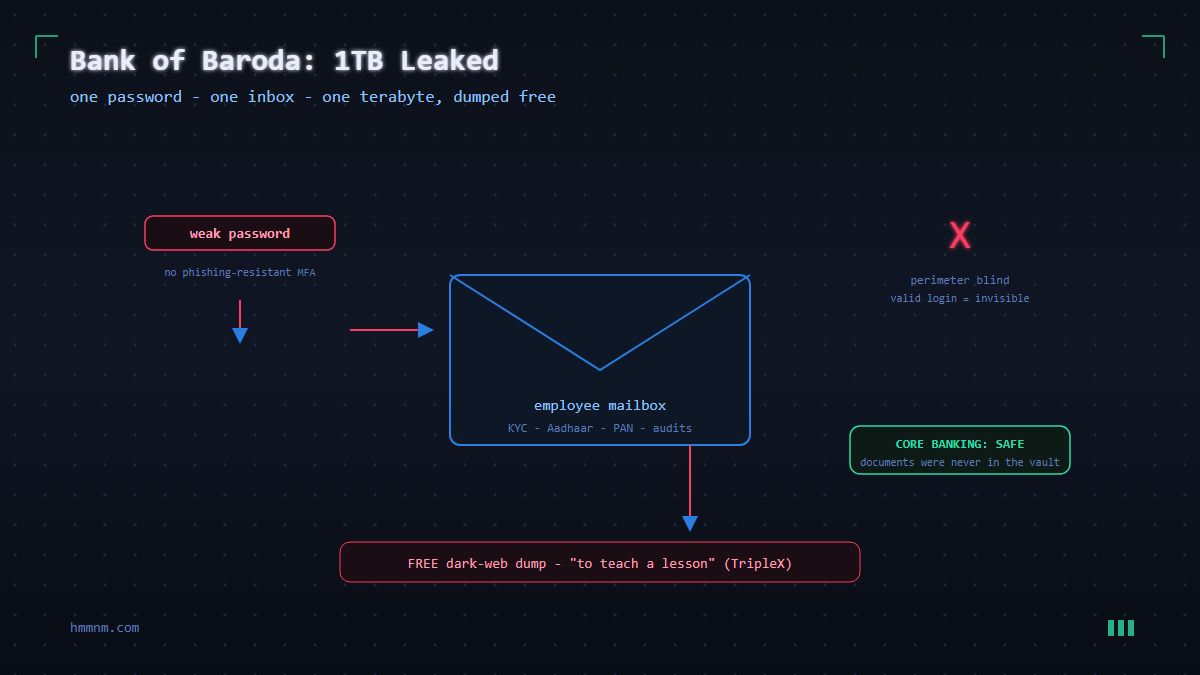
On July 24, 2026, a ransomware crew barely three months old listed one of India’s largest banks on its dark-web leak site — and then did something unusual. It didn’t ask for money. It just published. Roughly 1 terabyte of Bank of Baroda data, free to anyone, “to teach a lesson.”
Three days later, the bank confirmed the root cause, and it contained no zero-day, no nation-state toolkit, no melted firewall. One employee’s email account. One password. This is the anatomy of how that password became a terabyte — and the five exact points where the attack could have been stopped cold, before a single file ever left the building.
The Bank of Baroda breach (July 2026) was a pure data-extortion attack via email account compromise — not a core banking hack. The group TripleX used a weak or stolen password on a single employee mailbox, treated that inbox as a document warehouse (KYC forms, Aadhaar and PAN scans, loan files, audit reports), quietly copied everything the identity could reach, and dumped ~1TB publicly for free to maximize reputational damage. The core banking system was never touched because it didn’t need to be: the data had already accumulated where the identity was. The attack dies at five break-points: phishing-resistant MFA, no email-as-document-store, least privilege on identity-to-data paths, behavioral exfiltration detection, and a rehearsed disclosure clock (CERT-In 6 hours, DPDP Rules 72-hour report). Every one of these is standard, boring, deployable technology. The breach was ordinary failures compounding — which is exactly why it is so instructive.
What happened: the 96-hour timeline
The speed of this incident, from criminal listing to national headline, is itself a lesson in modern breach dynamics. The public forensics — the bank’s own statement, researcher reviews of the leaked samples, and reporting from Business Standard, Deccan Herald, and BankInfoSecurity — establish this sequence:
| Date (2026) | Event | Significance |
|---|---|---|
| ~May | TripleX first observed; profile clusters around financial and professional services | A new-generation extortion crew hunting soft identity perimeters, not hardened cores |
| June | TripleX claims 2TB breach of PT Bank Negara Indonesia; leaks contracts and passport data | Proof of pattern: publish-not-negotiate, banks as targets |
| Jul 24 | Bank of Baroda listed on ransomware.live leak tracker; ~1TB claimed, dumped free | No ransom demand — reputational maximization as the weapon |
| Jul 25 | Researcher Srikanth Lakshmanan (CashlessConsumer) reviews sample files, tags RBI and Cyber Dost | Independent verification beats institutional disclosure to the punch |
| Jul 26 | “Root folder” screenshots of the dump circulate widely on X; RBI and CERT-In silent | Customers see their bank’s internal tree on social media first |
| Jul 27 | BoB confirms compromise of one employee’s email account; states core banking systems not accessed; forensic probe launched | Disclosure gap of ~3 days under regulators’ eyes; scope still unconfirmed |
Hold that timeline against two clocks: India’s CERT-In directions require incident reporting within six hours of detection, and the DPDP Rules notified in November 2025 require data fiduciaries to notify the Data Protection Board and affected individuals without undue delay, with a detailed report within 72 hours. Whether those clocks were honored is now a regulatory question, not just a PR one — the penalties under the DPDP Act run up to ₹200 crore (about $21 million).
The style of attack: data extortion without encryption
To understand why this breach looks the way it does, you have to understand the attacker’s business model — because the model determined the technique.
Double extortion, evolved: publish-first
Classic ransomware encrypts files and sells you the key. Double extortion steals the data first, then threatens to publish: pay, or we leak. TripleX skipped a step — or rather, collapsed it. There was no countdown timer, no negotiation portal, no price. The data was published for free, with the group stating it did so “to teach a lesson.”
That is a deliberate strategy with three payoffs for the attacker:
- Maximum brand damage: a free public dump gets mirrored, torrented, and discussed far more than a locked negotiation — the reputational harm is the point, and it is total.
- Advertising: future victims browse the leak site. A bank reduced to a root-folder screenshot is the best sales collateral an extortion crew can buy with one weak password.
- No negotiation risk: nothing to trace, no payment rail, no undercover negotiation that researchers might monitor.
For the victim, this changes the economics of defense. Against negotiators, containment and lawyers play a role. Against publishers, the only winning move is preventing exfiltration itself — because once the dump is public, every downstream harm (fraud, phishing, regulatory exposure, class actions) is irreversible.
No malware required: the credential-only intrusion
The second defining trait: based on everything the bank and the leak-site notes have said, this attack involved no malware payload at all. No ransomware binary, no encryptor, no implant that antivirus could catch. The attacker logged in as a valid user, with valid credentials, and did valid things — read mail, open attachments, download files.
This is the quiet triumph of identity attacks over perimeter attacks. Signature-based tools are blind here. To security tooling, the attacker was the employee. The only systems that can see this attack are the ones watching behavior: what this identity normally touches, from where, at what volume, and how fast that changed.
Inside TripleX’s profile
Everything about TripleX says “fast-moving data monetizer” rather than “big-game encryption crew”:
| Trait | Observation | What it implies for defenders |
|---|---|---|
| Age | First observed ~May 2026 — three months old at attack time | New crews inherit mature playbooks; you are not facing novices, you’re facing rebranded expertise |
| Targets | Financial services and professional services (BoB, PT Bank Negara Indonesia) | Sectors with high densities of identity documents per employee mailbox |
| Method | Data theft and publication; free dumps; claims of weak-password entry | Initial-access bar is low — credential hygiene is the control that matters |
| Scale claims | 2TB (BNI), ~1TB (BoB) | Terabyte-scale hauls imply weeks of quiet access to document stores, not a quick smash-and-grab |
The attack chain, link by link
Reconstructed from the bank’s statement and the group’s own claims, the intrusion is a five-link chain. Each link is ordinary. Each link was breakable. That is the entire lesson of the case.
Link 1 — Initial access: one password, no exotic exploit
The bank said “compromise of an employee’s email account.” The group blamed a weak password. Reconciling the two gives the usual initial-access menu for mailbox compromise:
- Phishing: a convincing fake login page harvests the credential.
- Credential stuffing / reuse: a password exposed in some older, unrelated breach was replayed here because it was reused.
- Weak or bypassable MFA: no second factor at all, or one fatiguable with push-bombing or interceptable with a real-time phishing proxy.
Notice what is absent: no zero-day, no supply-chain compromise, no insider. The overwhelming majority of real-world breaches begin exactly this way, and the fix is correspondingly unglamorous.
Link 2 — The inbox as treasure chest: years of data accumulation
Here is the uncomfortable truth this breach made national news: corporate inboxes become document warehouses. Over months and years, an ordinary employee mailbox accretes:
- KYC forms sent for approval — photographs, ID documents, address proofs attached “just to review”
- Loan files forwarded branch-to-branch for appraisal signatures
- Audit reports and compliance spreadsheets attached to review threads — including, per researcher review of the dump, what look like internal audit and RBI audit-readiness documents in multiple versions
- Vigilance records, internal communications, app audit reports
None of it was supposed to live in email forever. All of it did. The moment the attacker controlled the account, they needed no further exploitation: they could simply read, search, and download as that employee, with that employee’s permissions. The leaked haul that researchers sampled — customer names, Aadhaar and PAN details, passport-size photographs, address proofs, loan records — is precisely the “ready-made KYC kit” one incident response specialist described: everything a fraudster needs to open mule accounts, bypass KYC checks, and forge convincing scam calls, pre-assembled.
Link 3 — Blast radius: when one identity reaches a terabyte
A single mailbox is bad. A single mailbox wired into shared drives, distribution lists, and cloud document repositories is how a personal inconvenience becomes an institutional catastrophe. The attack’s leverage came from access design: the path from one compromised identity to bulk customer KYC data and internal audit repositories should never exist — yet it did, unmonitored and unsegmented.
The leak wasn’t 1TB because the password was especially weak. It was 1TB because that one identity had a path to an enormous amount of sensitive data, and nothing along the way constrained or flagged the journey from “login” to “mass download.”
Link 4 — Exfiltration: the quiet terabyte
Somewhere between compromise and July 24, hundreds of thousands of files left the building in bulk downloads, syncs, or forwards. In a well-instrumented environment, a sudden anomalous large-scale pull — new geolocation, session volume spikes, attachment mass-export — lights up dashboards within minutes. In an under-instrumented one, exfiltration at terabyte scale is indistinguishable from an employee doing their job enthusiastically. Everything indicates this was the latter: the first public knowledge of the intrusion was the leak listing itself, not an internal alert.
Link 5 — Publication: the free dump
With data in hand, the attacker executed the publish-not-negotiate playbook described above. No demand means no abort path, no payment debate, no latency for the victim to prepare. Listing on a public tracker ensures researchers, journalists, regulators, and customers all discover it simultaneously — compressing the bank’s response window to zero and making the disclosure gap itself part of the story.
What was NOT breached matters most: the CBS distinction
Bank of Baroda was firm, and credible, on one point: the Core Banking System — the hardened transactional heart where balances live and money moves — was not accessed. The leaked material profile (documents, spreadsheets, scans, reports) is exactly what accumulates in mailboxes and document stores, not what lives inside a hardened core ledger.
This distinction defines the blast radius:
- It is not a money-movement hack. Customer balances were not drained, and transaction integrity was not at issue.
- It is an identity-document catastrophe. Aadhaar and PAN copies, photographs, account and loan data, net-banking user details — the exact raw material of account-takeover, SIM-swap, KYC-fraud, and social-engineering attacks downstream.
- It is an internal-trust wound. Audit-readiness files, vigilance records, and app audit reports expose the bank’s own compliance posture and investigation methods to adversaries.
The strategic observation for every financial institution: the crown jewels were safe, and it didn’t matter. The data that regulators, customers, and fraudsters care about had quietly migrated out of the vault and into the collaboration layer. Your security perimeter ends wherever your data’s actual residence begins.
How this attack could have been stopped — five break-points
This is the section that matters. Not “lessons learned” as a shrug, but the specific, existing, purchasable, deployable controls that would have severed the chain at each link — any single one of which turns the 1TB headline into a non-event.
Break-point 1: Phishing-resistant MFA on every identity (kills Link 1)
A stolen or guessed password becomes nearly worthless when the second factor is a hardware-backed passkey or FIDO2 credential rather than an SMS code or a push approval. Phishing-resistant MFA binds the login to the legitimate service, defeating credential harvesting pages and real-time proxies alike.
- Enforce FIDO2/WebAuthn or equivalent for all email and SSO — not just privileged accounts. The BoB mailbox was, presumably, not an admin’s.
- Ban weak and reused passwords with breached-password screening; block the credential-stuffing replay path outright.
- Kill MFA fatigue: number matching, push rate-limits, and lockouts on push-bombing patterns.
Cost-benefit: identity vendor line-item versus 1TB of KYC data and the regulatory exposure that follows it. If your bank’s email still accepts a bare password, this breach is your business case.
Break-point 2: Stop using email as a document store (kills Link 2)
If the sensitive documents had lived in a governed repository — access-controlled, expiring, logged — the compromised mailbox would have been worth one person’s correspondence, not a terabyte. The control is data governance, not security heroics:
- Route KYC, loan, and audit files into systems of record with role-based access, retention, and expiry — never as email attachments “just for a minute.”
- Purge and migrate: run discovery on existing mailboxes and drives for identity-document patterns (Aadhaar-format numbers, PAN-format strings, ID scans); auto-move to protected stores or auto-delete stale copies.
- DLP on mail flow: block or quarantine outbound attachments containing ID-document patterns to unclassified destinations; flag mass-attachment export.
- Data minimization: the bank is still wrestling with the downstream harm of documents it probably didn’t need to retain in that form at all. Retention discipline is breach-radius discipline.
Break-point 3: Least privilege and attack-path segmentation (kills Link 3)
The multiplier was reach: one identity, many repositories. Shrink what any single identity can touch and the worst case becomes “one folder,” not “one terabyte.”
- Entitlement audits (CIEM-style): continuously find over-privileged and dormant identities; enforce least privilege on mailboxes, distribution lists, shared drives, and cloud storage.
- Attack-path mapping: model how a compromised identity connects to sensitive data across the estate — then close the toxic routes. Attackers think in paths; defenders must too. This is the same identity-to-detonation discipline we use when securing agent identities against privilege creep — a mailbox with a quiet path to a terabyte is the human-identity version of an over-scoped service credential.
- Segment collaboration: a branch employee’s mailbox has no business reading audit-readiness repositories. Group memberships and distribution lists deserve the same review cadence as firewall rules.
Break-point 4: Behavioral exfiltration detection (kills Link 4)
The attack’s longest, most vulnerable phase was the exfiltration itself — bulk copying over what was probably weeks. That is an enormous detection window, and it closed unused. UEBA-style analytics learn what “normal” looks like per identity, so that a 2 a.m. mass download from a new geography doesn’t blend in:
- Baseline and alert: session volume, attachment-export counts, mailbox sync from new devices, download bursts from shared drives.
- Rate-limit and step-up: force re-authentication or quarantine when an identity’s data pull crosses percentile thresholds — make exfiltration mechanically hard, not just visible.
- Watch the exit, not just the door: perimeter tools watched the login (and saw a valid one). Almost all the damage available to stop happened at the egress stage. If your SIEM coverage doesn’t include identity-behavior use cases, this is the gap this case exposes.
Break-point 5: A rehearsed disclosure clock (blunts Link 5’s damage)
You cannot un-publish a dump, but the difference between a 3-hour and a 3-day acknowledgment is measured in customer trust, regulator goodwill, and fraud-window length. In this incident, independent researchers and social media informed the public hours before the bank did — and under India’s regime, that gap is now itself a compliance finding waiting to happen.
- CERT-In 6-hour reporting as a hard operational SLA with an on-call owner, not an aspiration.
- DPDP Rules 72-hour detailed report to the Data Protection Board plus individual notifications without undue delay — with pre-drafted templates naming what data classes, what risks, what steps customers should take.
- Pre-authorized comms: holding statements approved by legal before the incident, customer-facing FAQs ready to publish, a single spokesperson tree. Directors should assume an incident is inevitable and decide in advance how they will communicate — the first 24 hours shape the outcome.
The regulatory aftershock: DPDP, CERT-In, RBI
Bank of Baroda is one of India’s largest public-sector banks — over $240 billion in assets, operations in 15 countries. Which makes this the first true stress-test of India’s new breach regime at national-champion scale:
| Obligation | Clock | Posture in this incident |
|---|---|---|
| CERT-In incident reporting | 6 hours from detection | No public confirmation of filing; CERT-In silent through the window |
| DPDP Act + Rules: notify Data Protection Board and affected individuals | Without undue delay; detailed report in 72 hours | Bank acknowledged scope questions remain open; affected-customer count not disclosed at statement time |
| DPDP penalties | Up to ₹200 crore (~$21M) | Unquantified exposure contingent on investigation findings |
| RBI cybersecurity and customer-protection norms | Continuous supervisory expectation | Forensic probe launched; supervisory review presumed |
The composition of the leak guarantees the regulatory story will outlast the news cycle: when the compromised set includes the bank’s own audit-readiness material, the question stops being “was customer data protected?” and becomes “what did the bank’s own internal record say about how it protects data?” — a question no compliance team wants answered in public.
If you’re a Bank of Baroda customer: practical steps now
Your money and your documents are different exposures. The core banking system was reportedly untouched — this is an identity-and-privacy event. Act accordingly:
- Expect convincing scams. Leaked KYC data makes fraudsters sound legit: they may quote your real PAN, Aadhaar digits, or loan details. A real bank never asks for your full password, OTP, or PIN — ever.
- Never install APKs sent over WhatsApp or SMS, however urgent the “KYC re-verification” framing.
- Turn on every control: MFA on net-banking, strong unique passwords, transaction alerts.
- Monitor statements and credit for unfamiliar transactions or loan enquiries over the coming weeks; consider UIDAI’s mAadhaar controls if you suspect Aadhaar-based misuse.
- Report suspicious contacts to cybercrime.gov.in or the 1930 helpline immediately — early reporting freezes fraud rails.
The transferable lessons for every institution
- Identity is the perimeter — fund it like one. The vault was fine; the mailbox wasn’t. Budget follows headlines: let it follow identity controls this time.
- Your data’s residence is your attack surface. Documents that migrate into the collaboration layer inherit its weakest identity’s protections. Audit where crown-jewel data actually lives, including the copies.
- Detect the exit, not just the entrance. Valid-credential intrusions are invisible at the door and screaming at the exit. Instrument egress.
- Publishers can’t be negotiated with. Against free-dump extortion, prevention-of-exfiltration is the entire game; containment strategies tuned to ransom negotiation are irrelevant here.
- Disclosure speed is capability, not charm. Researchers on social media will always be faster than a bank’s press office — unless the bank pre-builds the muscle. The gap between them is a fraud window.
- New crew, same chain. TripleX was three months old and executed a textbook identity-to-exfiltration chain. Rebranding is cheap; the chain is stable; the defenses against the chain are known. Build against the chain, not the name.
FAQ
How did attackers breach Bank of Baroda?
Through the compromise of a single employee’s email account, most likely via a weak, reused, or phished password, with MFA absent or bypassable. The group TripleX attributed entry to a weak password. There is no indication of a zero-day or core-banking exploit; the intrusion used valid credentials only.
Was Bank of Baroda’s core banking system hacked?
No. The bank’s statement says core banking systems were not accessed and remain secure, and the leaked data profile (documents, KYC forms, audit files) is consistent with mailbox and document-store exposure. The breach is a privacy and identity incident, not a money-movement hack.
Who is TripleX?
A data-extortion group first observed around May 2026, clustering on financial services victims. It previously claimed a 2TB breach of PT Bank Negara Indonesia. Its signature is publishing stolen data for free rather than negotiating — using reputational damage as the leverage.
What data was leaked in the Bank of Baroda breach?
Per the leak listing and researcher review of samples: customer KYC data (an estimated 100,000–300,000 account-opening forms), Aadhaar and PAN details, photographs, address proofs, account, loan and net-banking records, NRI and corporate banking data, plus internal material including branch audit reports, vigilance records, and app audit reports. Exact scope remains under forensic investigation.
Could this attack have been prevented?
Yes — at five independent points: phishing-resistant MFA (blocks the stolen password), moving documents out of email into governed stores (empties the treasure chest), least-privilege access design (shrinks blast radius), behavioral exfiltration detection (catches the bulk copy), and a rehearsed disclosure clock (limits damage). Any one of them likely reduces the incident to a non-event.
Conclusion: one password shouldn’t equal one terabyte
The Bank of Baroda breach is not a story about a genius hacker or an unstoppable weapon. It is a story about a weak password, a trusting inbox, an unmonitored path, and a quiet download — a chain of ordinary failures that compounded into an extraordinary leak, with a regulator now armed to make the aftermath expensive.
That is oddly reassuring, because ordinary failures have known fixes: strong identity controls, ruthless least privilege, data kept where it belongs, detection aimed at the exit, and disclosure rehearsed like a fire drill. In a well-architected environment, one password cannot become one terabyte. Closing the distance between those two sentences is the entire lesson — and every bank, fintech, and enterprise holding other people’s identity documents should conduct it this quarter, not eventually.
For the companion case — a bank breach that started not with a password but with a firewall at a vendor 74 banks had never heard of — see the Marquis/SonicWall supply-chain attack analysis. And for what it costs to find these weaknesses before criminals do, see our penetration testing cost and pricing guide.
References
- BankInfoSecurity — Bank of Baroda Breach Tests Disclosure Readiness (Jul 27, 2026) — bank statement, DPDP Rules penalties, KYC-kit assessment
- Business Standard — Bank of Baroda probes data breach; core banking secure (Jul 2026)
- Deccan Herald — 1TB of customer details, Aadhaar, phone numbers leaked on darknet (Jul 2026)
- Threatsys — Bank of Baroda Data Leak: Inside the Alleged 1,000GB Breach (Jul 28, 2026) — timeline, data inventory, customer guidance
- Cy5 — The Bank of Baroda Data Breach, Decoded (Jul 28, 2026) — attack-chain analysis and prevention mapping
- CERT-In directions — 6-hour incident reporting requirement
- MeitY — Digital Personal Data Protection Act, 2023 and DPDP Rules
- Internal: Marquis SonicWall supply-chain breach analysis — the vendor-side mirror of this failure
- Internal: Agent identity and least privilege — identity blast-radius control applied to machine identities
- Internal: Penetration testing cost and pricing guide 2026