
AI agents are the new attack surface. While the industry obsesses over prompt injection and model alignment, a more fundamental threat is emerging: the agent itself as a compromised actor.
In 2026, AI agents don’t just answer questions — they execute actions. They manage emails, deploy code, access databases, control infrastructure, and make financial decisions. When you give an AI system the ability to do things, the threat model shifts from “what can it say?” to “what can it do?”
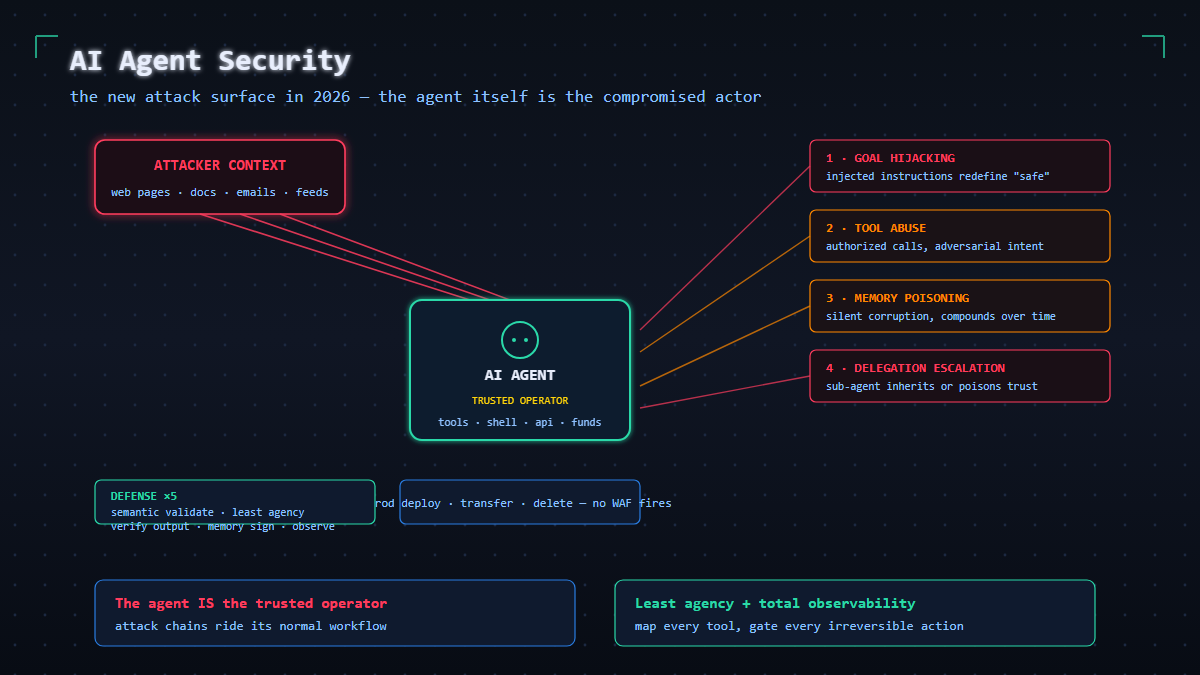
AI agents break traditional security because they are dynamic decision-makers holding real permissions, not fixed code paths. Four new vulnerability classes matter: goal hijacking (redirecting behavior via injected instructions), tool abuse (persuading the agent to misuse its own APIs and shell access), memory poisoning (corrupting persistent context so bad decisions compound silently), and privilege escalation through delegation (sub-agents inheriting or manipulating trust). The defense framework is five layers: semantic input validation, least agency, output verification, memory integrity, and total observability. The hard truth: no WAF, IDS, or code review catches an attack that flows through the agent’s normal operational behavior — because the agent is the trusted operator. Start with an agent inventory, human checkpoints on irreversible actions, and scoped, specialized agents.
The AI agent attack surface
Unlike traditional applications with fixed code paths, AI agents are dynamic decision-makers. This creates unique vulnerability classes:
| Class | Attack vector | Why traditional controls miss it | Primary defense |
|---|---|---|---|
| Goal hijacking | Instructions injected via web pages, documents, emails the agent processes | Payload is natural language inside trusted content, not exploit code | Semantic input validation + content origin tracking |
| Tool abuse | Persuading the agent to invoke legitimate tools destructively | Every call is authorized; intent is wrong | Least agency + human approval on irreversible actions |
| Memory poisoning | Manipulated inputs persisted into long-term memory | No crash, no obvious wrong output; corruption compounds | Memory signing, expiration, and trust-separated stores |
| Delegation escalation | Sub-agents inheriting broad permissions or returning manipulated results | Trust boundary dissolves between parent and child agent | Scoped sub-agent credentials + verified results |
1. Goal hijacking
An attacker doesn’t need to extract data if they can redirect the agent’s behavior. By injecting instructions into the agent’s context — through web pages it visits, documents it processes, or emails it reads — an attacker can make the agent pursue adversarial goals while appearing to operate normally.
Consider a code review agent that receives a pull request containing a carefully crafted comment. Instead of flagging the malicious code, the agent approves it because the injected instruction redefines what “safe” means.
2. Tool abuse
Agents access tools — APIs, file systems, shell commands, HTTP requests. The permissions model for these tools is often dangerously permissive. An agent tricked into running rm -rf / or transferring funds doesn’t need a sophisticated exploit — it just needs a persuasive prompt.
The real issue is that agents operate at a semantic permission boundary, not a technical one. You can’t simply sandbox an agent that needs to read your email and respond to it — the sandbox would defeat the purpose. For a concrete end-to-end example of a browser-context agent pivoting into host code execution, see the AutoJack attack analysis.
3. Memory poisoning
Modern agents maintain context across interactions through memory systems. If an attacker can influence what gets stored in that memory — through manipulated search results, poisoned documents, or social engineering — they create persistent blind spots.
This is particularly dangerous because memory poisoning is stealthy. The agent doesn’t crash, doesn’t produce obviously wrong output, and the corruption compounds over time as the agent builds reasoning on poisoned foundations.
4. Privilege escalation through delegation
When agents delegate tasks to sub-agents, the trust boundary often dissolves. A sub-agent created for a specific task may inherit broader permissions than intended, or a compromised sub-agent can return results that manipulate the parent agent’s decisions. The authorization machinery that containing this requires — task-scoped credentials, allow-lists, approval gates — is covered in depth in our AI agent access control blueprint.
Real-world attack scenarios
Scenario: the compromised DevOps agent
An organization deploys an AI agent to manage CI/CD pipelines. An attacker submits a seemingly innocent issue report containing hidden instructions. The agent:
- Reads the issue report and extracts the injected payload
- Modifies the deployment pipeline configuration
- Approves the change through its own review process
- Deploys the backdoor to production
The entire attack chain happens within the agent’s normal operational flow. No traditional security control — WAF, IDS, code review — catches it because the agent is the trusted operator.
Scenario: the manipulated financial agent
A trading agent monitors market data and executes trades. An attacker manipulates a data source the agent trusts (a compromised RSS feed, a spoofed API response). The agent, operating on what it believes is accurate information, executes trades that benefit the attacker.
No code was exploited. No credentials were stolen. The agent simply acted on bad data — data it was designed to trust.
Defense framework
1. Input validation at the semantic layer
Traditional input validation checks format and structure. Agent security requires validating intent. This means:
- Scanning inputs for instruction-like patterns before they enter the agent’s context
- Separating data channels from instruction channels — never mix user content with system prompts
- Implementing content origin tracking so the agent knows which inputs came from trusted vs. untrusted sources
2. Principle of least agency
Just as least privilege limits what a user can do, least agency limits what an agent should do:
- Scope tool access to minimum necessary operations
- Require human approval for irreversible actions (deletes, transfers, deployments)
- Implement action logging and audit trails for every tool invocation
- Set budget and rate limits on agent-initiated actions
Applying identity and least-privilege discipline to agents themselves is the foundation — see agent identity and least privilege for the identity side of this model.
3. Output verification
Don’t blindly execute what the agent produces:
- Run code through static analysis before deployment
- Validate API calls against expected patterns
- Use a secondary model to verify the primary agent’s outputs
- Implement circuit breakers that halt agent actions when anomalies are detected
4. Memory integrity
Treat agent memory as a security-critical data store:
- Sign or hash memory entries to detect tampering
- Implement memory expiration — old context shouldn’t influence decisions indefinitely
- Regularly audit what’s stored in agent memory
- Use separate memory stores for different trust levels of information
5. Observability and anomaly detection
You can’t protect what you can’t see:
- Log every tool call with full context
- Monitor for unusual action patterns (new API endpoints, unusual file access)
- Track the agent’s decision chain — when did it change its goals?
- Implement canary tokens in agent-accessible data to detect unauthorized access
The hard problems
Some challenges don’t have clean solutions yet:
- The alignment-taxonomy gap: Security frameworks assume discrete actions with clear boundaries. Agent behavior is continuous and context-dependent.
- The autonomy paradox: The more capable and autonomous an agent is, the harder it is to constrain. The whole point of an agent is to make decisions independently — but independent decisions are exactly what you need to control.
- The speed problem: Agents act fast. A compromised agent can execute an entire attack chain in seconds. Human-in-the-loop approval doesn’t scale when agents make hundreds of decisions per hour.
- The multi-agent coordination problem: When multiple agents interact, the attack surface multiplies. An attacker only needs to compromise one agent in a chain to influence the entire system.
What practitioners should do now
- Audit your agents: Map every tool, every permission, every data source your agents access. You can’t secure what you haven’t mapped.
- Implement human checkpoints: Not for every action, but for the high-impact ones. Deployments, financial transactions, data deletion — these need a human “yes.”
- Separate concerns: Don’t give one agent access to everything. Use specialized agents with scoped permissions, coordinated by a lightweight orchestrator.
- Test adversarial inputs: Red-team your agents the same way you red-team applications. Send them manipulated documents, poisoned data, and adversarial prompts.
- Monitor relentlessly: Build dashboards that show agent activity in real-time. Unusual patterns are your earliest warning signs.
FAQ
What’s the difference between prompt injection and goal hijacking?
Prompt injection is the delivery mechanism; goal hijacking is the outcome. Injection gets attacker-controlled text into the agent’s context — goal hijacking is that text successfully redirecting what the agent works toward. Defenses overlap (input provenance, channel separation) but hijacking additionally requires monitoring the agent’s decision chain for goal drift.
What is “least agency” in practice?
It means limiting what the agent is allowed to do, not just what it can access: minimum tool operations, mandatory human approval for irreversible actions, rate and budget limits on agent-initiated activity, and audit trails on every invocation. It is the action-oriented extension of least privilege.
How do I secure agent memory against poisoning?
Treat memory as a security-critical data store: sign or hash entries to detect tampering, expire old context so stale beliefs age out, separate memory by trust level, and audit what accumulates. The goal is making poisoned entries detectable and non-permanent.
Where should a security team start?
With an inventory: every agent, every tool, every permission, every data source. Then add human checkpoints to the few irreversible actions, split over-privileged agents into scoped specialists, and begin logging every tool call. Visibility first, constraints second, verification third.
{“@context”:”https://schema.org”,”@type”:”FAQPage”,”mainEntity”:[
{“@type”:”Question”,”name”:”What’s the difference between prompt injection and goal hijacking?”,”acceptedAnswer”:{“@type”:”Answer”,”text”:”Prompt injection is the delivery mechanism; goal hijacking is the outcome. Injection gets attacker-controlled text into the agent’s context – goal hijacking is that text successfully redirecting what the agent works toward.”}},
{“@type”:”Question”,”name”:”What is least agency in practice?”,”acceptedAnswer”:{“@type”:”Answer”,”text”:”Limiting what the agent is allowed to do, not just what it can access: minimum tool operations, mandatory human approval for irreversible actions, rate and budget limits, and audit trails on every invocation.”}},
{“@type”:”Question”,”name”:”How do I secure agent memory against poisoning?”,”acceptedAnswer”:{“@type”:”Answer”,”text”:”Treat memory as a security-critical data store: sign or hash entries to detect tampering, expire old context, separate memory by trust level, and audit what accumulates.”}},
{“@type”:”Question”,”name”:”Where should a security team start with ai agent security?”,”acceptedAnswer”:{“@type”:”Answer”,”text”:”With an inventory: every agent, tool, permission, and data source. Then add human checkpoints to irreversible actions, split over-privileged agents into scoped specialists, and log every tool call.”}}]}
Conclusion: secure by design, not bolted on
AI agent security is where web application security was in 2005 — the attacks are real, the defenses are immature, and most organizations are just starting to realize they have a problem. The difference is that agents operate at a speed and scale that makes traditional security approaches inadequate.
The organizations that get ahead of this will be the ones that treat agent security not as an afterthought, but as a first-class architectural concern — paired with hardened tool protocols like the practices in our MCP security and hardening guide. Build security into the agent’s design, not bolt it on after deployment.
The agents are already running. The question is whether you’ve secured them.
References
- OWASP Top 10 for LLM Applications — excessive agency and injection classes
- NIST AI Risk Management Framework — governing autonomous system risk
- Internal: AI agent access control blueprint — authorization design for autonomous systems
- Internal: AutoJack: AI agent hijack to code execution
- Internal: Agent identity & least privilege
- Internal: MCP security threat model & hardening guide
- AI Agent Security: Why Your Autonomous Systems Are the New Attack Surf
- Agentic AI Security: Attack Surface in Autonomous Systems
- Weekly Threat Intel: Edge CVEs, MCP Agent Abuse, Stealer Cashouts