AI deepfakes are no longer a novelty — they have become one of the most dangerous weapons in modern cyberattacks. In 2026, synthetic media has evolved from face-swap entertainment to enterprise-grade identity fraud, social engineering at scale, and disinformation. This guide maps the three attack families, the scenarios security teams must rehearse, and the layered framework that still holds against machine-crafted deceit.
The 2026 Deepfake Threat Landscape
What started as entertainment technology has matured into a full-spectrum attack tool. The barrier to entry has plummeted — open-source tools generate convincing deepfakes in minutes on commodity hardware. The landscape splits into three families.
Voice Deepfakes: The Silent Intruder
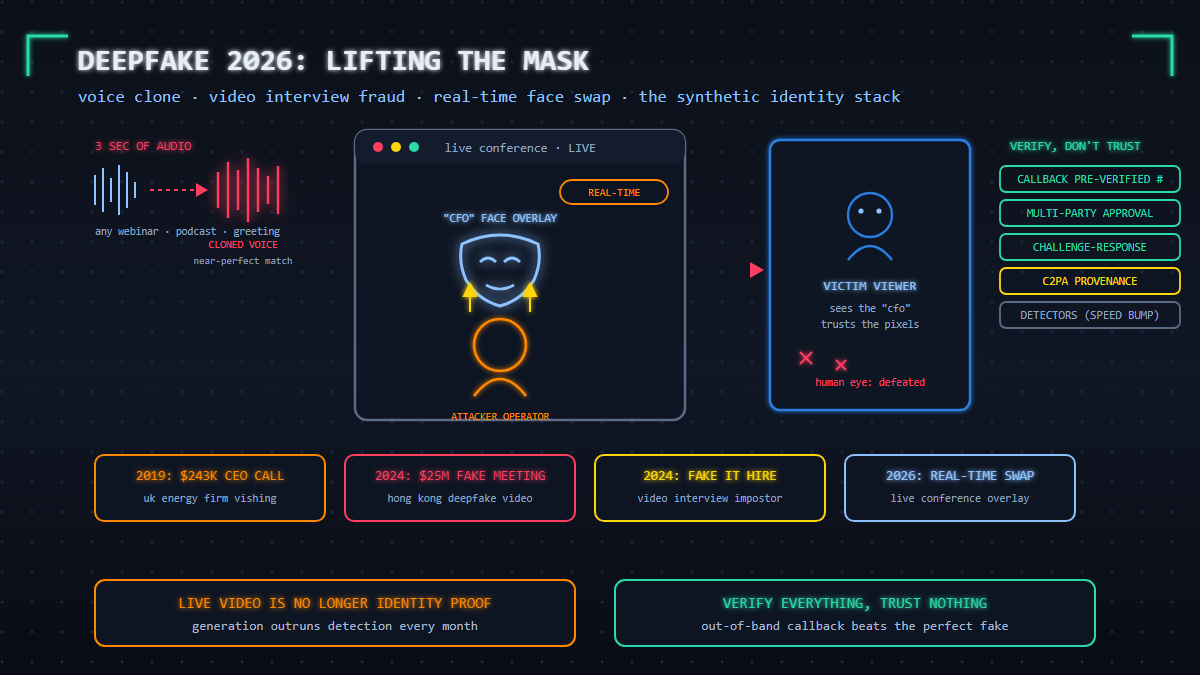
Voice cloning has reached near-perfect accuracy from tiny samples — a few seconds of audio is enough to build a convincing clone. The landmark warning came in 2019, when a UK-based energy firm was defrauded of $243,000 after attackers impersonated the parent company’s CEO by phone; the 2024 Hong Kong case, where an employee wired $25 million after a deepfake video meeting, showed where the ceiling now sits (see our voice-cloning threat analysis). Attack vectors include:
- Vishing: AI-generated calls impersonating executives, IT support, or vendors to extract credentials or authorize wire transfers
- Voicemail fraud: Deepfake voicemails that bypass email-based phishing filters entirely
- Authentication bypass: Defeating voice-biometric systems used in banking and enterprise identity verification
Video Deepfakes: Face of Deception
Video deepfakes are now sophisticated enough to fool trained professionals, live:
- Executive impersonation: Fake video calls with C-suite executives for financial fraud — the $25M Hong Kong case in 2024 was just the beginning
- Employee onboarding fraud: Deepfake job candidates passing video interviews to gain insider access — the technique behind the widely reported 2024 fake IT worker incident uncovered at a security firm itself
- Evidence fabrication: Manipulated video in legal proceedings and corporate investigations
Real-Time Deepfakes: The New Frontier
The most dangerous evolution is real-time deepfakes — AI that maps a target’s face onto an attacker’s during live video conferences, with latency low enough that the imposture holds in natural conversation. FBI public warnings have specifically flagged deepfakes used in remote-job interviews and MFA verification calls. The consequences:
- Live video calls can be impersonated mid-conversation
- Video-verification MFA is no longer a trustworthy factor on its own
- Social engineering becomes effectively undetectable to the human eye
Attack Scenarios Security Teams Must Rehearse
Scenario 1: The Urgent Wire Transfer
An attacker generates a deepfake video of the CFO ripped from a public earnings call. Finance staff receive an “urgent follow-up” video message from the “CFO” authorizing an immediate transfer to a new vendor account — matching voice, face, and mannerisms.
Defense: Out-of-band verification for all transactions above a threshold; multi-party authorization with callback to pre-verified numbers, never numbers supplied in the request itself.
Scenario 2: The Insider That Isn’t
A deepfake candidate passes multiple video interviews, accepts a remote offer, and begins onboarding. Within weeks they access source repositories, customer databases, and internal communications; by discovery time, data is exfiltrated.
Defense: In-person or government-ID-verified identity checks for privileged roles, liveness detection during onboarding, and cross-referencing the candidate’s digital footprint across platforms.
Scenario 3: The Market-Moving Disinformation
A competitor or nation-state publishes deepfake video of a company’s CEO making inflammatory statements. The stock dips, customers revolt, and regulators open inquiries — hours before the company can prove the video fake.
Defense: Pre-established crisis communication protocols, cryptographic watermarking of official corporate media, and continuous monitoring for unauthorized synthetic media using detection APIs.
| Scenario | Deepfake Type | Target Failure | Core Defense |
|---|---|---|---|
| Urgent wire transfer | Video + voice exec clone | Single-channel approval | Out-of-band callback + threshold |
| Fake remote hire | Real-time interview face | Identity verification | Liveness + ID proofing |
| CEO disinformation | Posted fabricated video | Public trust | Watermarking + crisis comms |
| Help-desk vishing | Cloned voice | Credential reset process | Challenge-response secrets |
| Biometric bypass | Replayed/cloned voice | Voice authentication | Multi-factor, voice not sole factor |
Detection Techniques That Actually Work
Technical Detection
- Frequency analysis: Synthetic audio leaves unnatural frequency patterns that spectrogram analysis exposes
- Temporal consistency: Frame-by-frame checks for blinking patterns, micro-expressions, and lighting inconsistencies
- Generator artifact detection: Telltale artifacts at image edges and backgrounds left by generative models
- Cryptographic provenance: Verifying media origin through the C2PA content-credentials standard
But treat every detector as a speed bump: generation improves faster than detection. The widening gap is the reason process controls carry the load.
Process-Based Defense
- Challenge-response protocols: Shared secrets or challenge questions during sensitive communications
- Multi-channel verification: Never trust a single channel — voice, video, or email — for critical actions
- Timing anomaly flags: Requests outside normal hours or patterns get extra scrutiny
- Behavioral biometrics: Typing rhythm, mouse movement, and interaction style as supplementary signals
Building the Deepfake Defense Framework
- Detect: Deploy deepfake detection at communication entry points and treat results as signal, not verdict
- Verify: Multi-factor verification for high-value transactions and access requests — identity is a process, not a gate
- Educate: Train employees on deepfake awareness; the human element remains critical and targeted
- Respond: Maintain incident response playbooks written specifically for synthetic-media incidents
- Monitor: Continuously scan public channels for unauthorized synthetic media of your brand and executives
The same verify-everything ethos that anchors Zero Trust applies to human identity: continuous verification, minimal standing trust. And as AI compresses every attack stage, the organizations that endure treat identity assurance as an operational discipline.
The Road Ahead
Generation will keep outpacing detection. Security teams must shift from “detect and block” to a verify-everything, trust-nothing paradigm. The deepfake era rewards organizations that treat identity verification as continuous process rather than one-time gate — because the fakes are already here, and they improve every month.
FAQ
How little audio does a voice clone really need?
Publicly available cloning tools produce convincing output from just a few seconds of clean sample audio — a snippet easily harvested from a webinar, podcast, or voicemail greeting. Assume any executive voice that has ever been recorded can be cloned.
Can’t detection tools just catch deepfakes?
They help — spectrogram analysis, temporal-consistency checks, and provenance verification like C2PA all contribute. But generation improves faster than detection, so detectors should raise confidence, not make final decisions. Procedural controls (callbacks, multi-party approval) decide what actually matters.
What was the biggest real deepfake fraud so far?
The 2024 Hong Kong case: an employee at a multinational transferred roughly $25 million after a video conference in which every other participant — including the CFO — was a deepfake. It remains the clearest proof that live video is no longer proof of identity.
What’s the single highest-impact control?
Out-of-band verification with callback to a pre-registered number for any financial transaction or privileged access change above threshold. It costs almost nothing and defeats every deepfake scenario in this guide, because it never depends on the authenticity of the request itself.