
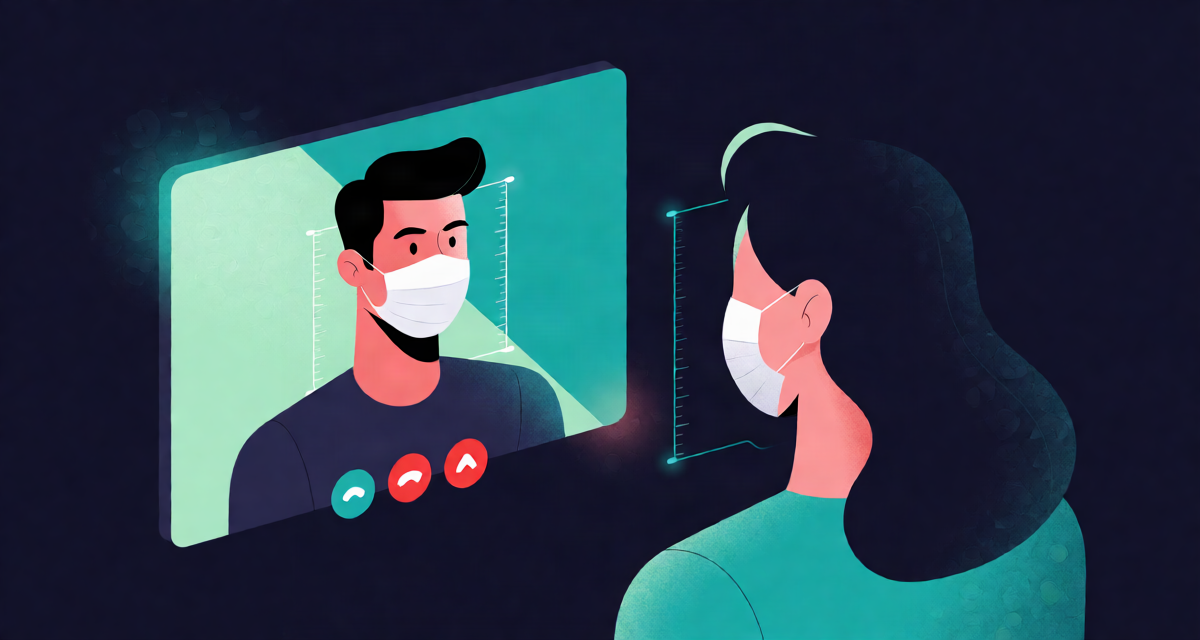
Detection is now an arms race fought in milliseconds: as deepfake video calls reach sub-200ms latency, defenders need spectral forensics, liveness challenges, and provenance chains — not just eyeballs. This is the 2026 detection and defense playbook.
Quick Answer
Deepfakes entered the enterprise kill chain by way of the Arup $25M video-call fraud, voice-clone BEC, and deepfake job candidates landing remote IT roles. Detection that works in 2026: temporal consistency analysis (frame-to-frame micro-inconsistencies), frequency-domain audio forensics, rPPG biological-signal detection (synthetic faces lack blood-flow micro-color shifts), challenge-based liveness, and C2PA content provenance. The deployment model that works: layered — policy + out-of-band verification first, technical detection second, because no single detector beats a determined generator. Detection accuracy on sophisticated fakes stabilizes in the 85–95% band, so treat every detector output as signal, not verdict. The voice-clone social engineering mechanics are covered in our companion piece on AI deepfake voice cloning; this guide is the defender’s side.
The State of Deepfakes in 2026
What started as face-swap entertainment has matured into an enterprise-grade attack vector. Four things changed:
- Quality: current models produce near-real synthetic video and audio good enough to pass casual — and sometimes formal — human review
- Zero-shot generation: voice clones from a few seconds of audio, faces from a single photo; no training corpus required
- Real-time streaming: deepfake video calls are viable with sub-200ms latency, enabling live impersonation
- Democratization: open-source stacks and cheap APIs put convincing synthesis within reach of any fraud team
This is one flank of the broader AI attack wave — the same generative curve behind AI-driven autonomous attacks and mapped in our defender’s guide to AI-powered attacks.
How Deepfakes Enter the Kill Chain
Business Email Compromise, Evolved
Traditional BEC relied on lookalike domains. Now a deepfake video call “confirms” the wire, a voice clone follows up by phone, and an LLM-written email in the executive’s style closes the loop — the multi-channel stack documented in the voice cloning threat analysis.
Social Engineering at Scale
- Customer support impersonation: cloned voices defeat phone-based authentication scripts
- Family emergency scams: AI-generated relative voices requesting urgent transfers
- Job interview manipulation: deepfake candidates pass video screening for remote roles — see the timeline below
Disinformation and Market Manipulation
Synthetic media moves markets without touching a single account. The May 2023 fake “Pentagon explosion” image — crude by 2026 standards — briefly dipped U.S. indices before verification caught up. A convincing executive deepfake making a false announcement is now a standard market-abuse scenario.
Identity Fraud and Access Bypass
- Synthetic faces attacking KYC verification flows
- Voice cloning defeating speaker-recognition MFA
- Deepfake footage supporting fraudulent credential issuance
When the deepfake wins, the intruder lands in your identity plane — which is why least-privilege identity design and zero trust architecture remain the backstop no impersonation can talk its way past.
Real-World Deepfake Attacks: A Timeline
| Year | Incident | Impact | Method |
|---|---|---|---|
| 2019 | UK energy firm CEO voice fraud | ~$243,000 transferred | Cloned boss’s voice on call |
| 2023 | Fake “Pentagon explosion” image | Brief U.S. market dip | AI-generated image, viral spread |
| 2024 | Arup deepfake meeting (Hong Kong) | $25M transferred | Multi-person deepfake video call |
| 2024 | Deepfake robocalls (US primary) | Voter suppression attempt | Cloned political voice |
| 2024 | Deepfake IT worker hired remotely | Insider access at security firm | Deepfake avatar in video interviews |
| 2025–26 | Synthetic KYC bypass attempts | Fake account openings at banks | Face generation + liveness spoofing |
How Deepfakes Are Made (and Where They Leak)
GANs
The classic generator-discriminator duel. Still effective, but largely displaced for synthetic media by diffusion methods.
Diffusion Models
State of the art: Stable Diffusion-class models and custom variants, with ControlNet and IP-Adapter stacks that replicate a specific person from minimal reference images.
Autoencoders for Face Swapping
Encoder-decoder architectures (DeepFaceLab lineage) swap faces inside real video; temporal-consistency post-processing removes the frame-to-frame jitter detectors used to catch.
Voice Cloning
XTTS-v2, YourTTS, and proprietary APIs clone voices zero-shot from seconds of audio, capturing prosody, emotion, and accent — see the voice cloning threat piece for attack mechanics.
Detection Techniques That Actually Work
Temporal Consistency Analysis
Deepfake video leaks micro-inconsistencies across frames — blink cadence, drifting shadows, mouth movement lagging phonemes. Frame-by-frame consistency tooling flags them.
Frequency-Domain Audio Forensics
Synthetic speech carries spectral artifacts inaudible to humans: anomalous high-frequency energy, missing harmonics natural voices always contain.
Biological Signal Detection (rPPG)
Remote photoplethysmography reads subtle skin-color variation from blood flow. Synthetic faces don’t have a pulse — the core signal in Intel’s real-time detector.
Challenge-Based Liveness
Random prompts, depth sensing, and IR cameras break most real-time injections; passive behavioral liveness is maturing as the frictionless layer.
Multi-Modal + Provenance
Layer visual forensics, audio forensics, behavioral patterns, and contextual verification — then bind authentic media to C2PA provenance chains so verification travels with content.
The Defense Framework: Four Layers
Layer 1 — Policy and Awareness
- Out-of-band verification for every high-value transaction, no exceptions for “the CEO”
- Challenge phrases for executive communications
- Deepfake-specific social engineering training with simulated calls
Layer 2 — Technical Controls
- deepfake detection on communication channels (video conferencing, voice workflows)
- Biometric authentication with liveness — voiceprint alone is convenience, not security
- Watermarking or signing for verified corporate media
Layer 3 — Detection Infrastructure
- Real-time detection in video conferencing platforms
- Audio forensics on voice-verified transaction lines
- C2PA-based provenance tracking for inbound media
Layer 4 — Incident Response
- Deepfake incident playbooks with defined triage owners
- Rapid verification chains for suspected synthetic media
- Coordinated legal/PR/IT communication plans — public deepfakes are brand incidents, not just security incidents
Tools and Solutions for 2026
| Tool | Type | Best for | Notes |
|---|---|---|---|
| Sensity AI | Detection platform | Enterprise deepfake detection | Real-time video analysis |
| Reality Defender | Multi-modal detection | Audio + video + text | API-based, integrates with comms |
| Microsoft Video Authenticator | Video analysis | Quick screening | Browser-based, confidence scores |
| Intel real-time detector | Hardware-accelerated | Live video calls | rPPG blood-flow signal |
| iProov | Liveness detection | Biometric verification | Active + passive liveness |
| C2PA tooling | Provenance | Content authentication | Verifiable capture chain |
The Future of the Arms Race
- AI vs AI: detectors adversarially train against current generators; expect accuracy to settle in the 85–95% band for sophisticated fakes — plan for misses
- Regulation: EU AI Act enforcement and deepfake disclosure laws mandate detection capability and labeling — but only on legitimate platforms
- Provenance adoption: C2PA chains work technically; adoption speed is the open question
- Real-time windows: live-call detection must run in sub-100ms budgets, favoring hardware-accelerated and liveness-based approaches over heavyweight forensics
Frequently Asked Questions
Can deepfake detection keep up with generation in 2026?
It keeps up, but never wins outright. Layered detection holds 85–95% accuracy against sophisticated fakes, so detectors are signals for humans and process — never autopilot verdicts. Assume occasional misses and keep out-of-band verification as the final gate.
What is rPPG deepfake detection?
Remote photoplethysmography: cameras measure microscopic skin-color changes caused by blood flow. Real faces pulse; synthetic ones don’t. It powers real-time detectors like Intel’s because it works on live video without cooperation from the subject.
What’s the most reliable defense against live deepfake calls?
Challenge-based liveness plus out-of-band verification: real-time prompts the injector can’t fulfill, and a callback on a known number for any consequential request. Culture matters as much as tooling — “the voice sounded right” must never be an authorization factor.
Does C2PA stop deepfakes?
It doesn’t stop creation — it flips the default. C2PA cryptographically binds provenance to content from capture onward, so authentic media carries verifiable history and synthetic media stands out by its absence. Its power depends on adoption across cameras, platforms, and newsrooms.
{“@context”:”https://schema.org”,”@type”:”FAQPage”,”mainEntity”:[{“@type”:”Question”,”name”:”Can deepfake detection keep up with generation in 2026?”,”acceptedAnswer”:{“@type”:”Answer”,”text”:”Layered detection holds roughly 85–95% accuracy against sophisticated fakes. Detectors are signals for humans and process, never autopilot verdicts; out-of-band verification remains the final gate.”}},{“@type”:”Question”,”name”:”What is rPPG deepfake detection?”,”acceptedAnswer”:{“@type”:”Answer”,”text”:”Remote photoplethysmography measures microscopic skin-color changes caused by blood flow. Real faces pulse; synthetic faces don’t. It powers real-time detectors like Intel’s on live video without subject cooperation.”}},{“@type”:”Question”,”name”:”What’s the most reliable defense against live deepfake calls?”,”acceptedAnswer”:{“@type”:”Answer”,”text”:”Challenge-based liveness plus out-of-band verification: real-time prompts an injector can’t fulfill, plus callback on a known number for any consequential request. Voice alone must never be an authorization factor.”}},{“@type”:”Question”,”name”:”Does C2PA stop deepfakes?”,”acceptedAnswer”:{“@type”:”Answer”,”text”:”It doesn’t stop creation — it flips the default. C2PA binds cryptographic provenance to content from capture onward, making synthetic media stand out by its missing provenance. Effectiveness depends on adoption.”}}]}
References
- Arup deepfake fraud case — Hong Kong, $25M (2024); UK energy CEO voice fraud (2019)
- Intel FakeCatcher rPPG research; Microsoft Video Authenticator; Reality Defender; Sensity AI; iProov
- C2PA — Coalition for Content Provenance and Authenticity specification
- EU AI Act 2026 enforcement timeline
- Hmmnm — AI Deepfake Voice Cloning: The Social Engineering Threat
- Hmmnm — AI-Powered Cyber Attacks: A Defender’s Guide
- Hmmnm — Zero Trust Architecture for AI Systems
- Hmmnm — Agent Identity and Least Privilege
The detection-and-defense playbook, operationalized
Turning deepfake defense from awareness into engineering: the first layer is verification architecture — the callback-and-second-channel discipline from the voice-cloning playbook extended to video (no identity document, face, or voice is accepted as sole verification for consequential actions). The second is provenance infrastructure: content-credential schemes (C2PA-lineage standards) attach cryptographic origin to media, and enterprises can mandate them for internal communications where impersonation risk concentrates — the standards are young but the adoption curve is real, and internal deployment is the controllable starting point.
The third layer is detection tooling for the media that reaches your people: synthesis-artifact detection (model-fingerprinting, generation-artifact analysis) deployed at the channels where deepfakes arrive — email attachments, meeting platforms, social channels monitored for executive impersonation. Honest calibration required: detection accuracy varies by generation quality, and the tools are a filter rather than a wall; they buy time and produce evidence rather than certainty.
The fourth layer is the human one, updated for specifics rather than slogans: train against the actual current-generation fakes (synthesized CEO videos, cloned vendor voices, generated identity documents in onboarding fraud), and rehearse the verification reflex until it is procedural. The era where seeing was believing is over organizationally; the playbook that replaces it is four layers deep and none of them optional.
Four layers, none optional, all available now: verification architecture, provenance infrastructure, artifact detection, and trained humans — the deepfake playbook stands complete on paper and awaits only organizational deployment, which the incident calendar will keep requesting until it arrives.
Complete on paper, awaiting deployment, requested monthly by the incident calendar — the deepfake playbook current status, and the familiar shape of every defensive doctrine that ever mattered.