
When Hackers Hunted the WHO: Cyberattacks in a Pandemic’s First Weeks

On 24 March 2020, Reuters reported that hackers had stood up a near-identical malicious imitation of the World Health Organization’s internal email portal, infrastructure aimed at stealing passwords from staffers coordinating the global pandemic response. The same reporting documented that around 450 active WHO email addresses and passwords, plus thousands more belonging to people working on the COVID-19 response, had been leaked online. It was not an isolated incident but part of a documented surge in targeting of health bodies that spring. This piece reconstructs the verified incidents of March 2020 and the wider lesson that crisis response organizations are priority intelligence targets.


Continue ReadingWhen Hackers Hunted the WHO: Cyberattacks in a Pandemic’s First Weeks

Marriott’s Second Breach: 5.2 Million Guest Records Exposed

At the end of March 2020, Marriott disclosed its second major breach in two years: the login credentials of two franchise properties had been abused in late February 2020 to siphon 5.2 million guest records, including names, addresses, phone numbers, birthdays, loyalty details, and in some cases travel itineraries and room preferences. Unlike the 2018 Starwood catastrophe that exposed up to 383 million records, this intrusion was caught and contained within weeks, but it reignited regulatory scrutiny on both sides of the Atlantic. This retrospective covers the intrusion path, the data involved, the disclosure timing, and the aftermath for one of hospitality’s biggest names.

Continue ReadingMarriott’s Second Breach: 5.2 Million Guest Records Exposed

The FBI’s COVID-19 Warning: IC3 and the Scam Surge of March 2020

On 20 March 2020, the FBI’s Internet Crime Complaint Center published a public service announcement warning that cyber criminals were exploiting the COVID-19 pandemic at scale: phishing lures referencing stimulus payments and fake cures, malicious apps, and infrastructure spoofing health authorities. It was one node in a broader wave of official guidance that spring, with CISA and the UK’s NCSC issuing joint advice on pandemic-era remote work and video conferencing security, and IC3’s later reporting would show complaint volumes surging through 2020. This retrospective explains what the warning said, what the threat landscape actually looked like that spring, and how a global crisis became an attack-surface multiplier.

Continue ReadingThe FBI’s COVID-19 Warning: IC3 and the Scam Surge of March 2020
Read more about the article Agentic AI Security: Attack Surface in Autonomous Systems
Agentic AI Security: Attack Surface in Autonomous Systems

Agentic AI Security: Attack Surface in Autonomous Systems

A practical guide to agentic AI security covering goal hijacking, tool misuse, identity and privilege abuse, memory poisoning, multi-agent trust issues, and defense frameworks for autonomous AI systems.

Continue ReadingAgentic AI Security: Attack Surface in Autonomous Systems
Read more about the article Phishing Evolution: From Email Scams to AI-Powered Attacks
Phishing Evolution: From Email Scams to AI-Powered Attacks

Phishing Evolution: From Email Scams to AI-Powered Attacks

Trace the evolution of phishing attacks from crude 1990s email scams to AI-powered deepfake campaigns. Discover how attackers leverage machine learning and automation to create convincing social engineering attacks.

Continue ReadingPhishing Evolution: From Email Scams to AI-Powered Attacks
Read more about the article How to Pentest OT Networks Without Halting Production
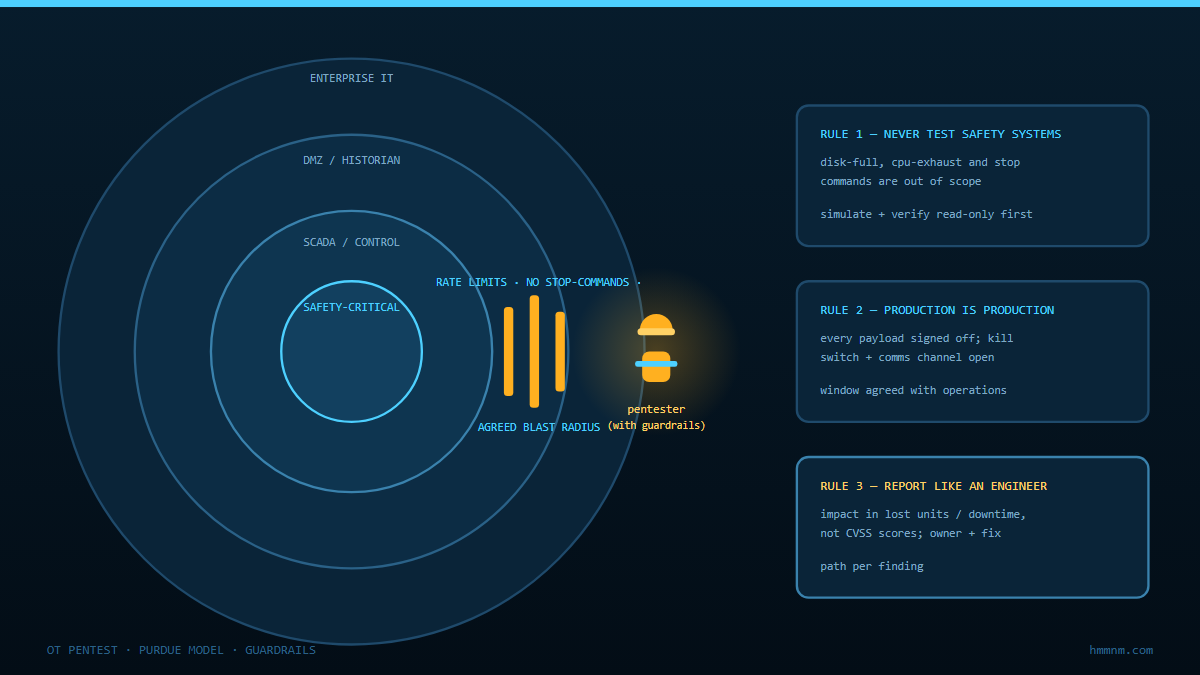
OT pentest Purdue model zones with guardrails

How to Pentest OT Networks Without Halting Production

Oldsmar proved an intruder can move a plant setpoint from a browser tab. This is the safe method: passive-first discovery, read-only active testing, writes proven on clone benches, and findings ranked in downtime currency — not CVSS.

Continue ReadingHow to Pentest OT Networks Without Halting Production
Read more about the article Identity Security: Modern Attacks on Users, Sessions & Trust
Identity Security: Modern Attacks on Users, Sessions & Trust

Identity Security: Modern Attacks on Users, Sessions & Trust

How identity became the new perimeter in modern cybersecurity. Explore MFA bypass techniques, OAuth consent phishing, device code attacks, token theft, and defense strategies for identity-centric security.

Continue ReadingIdentity Security: Modern Attacks on Users, Sessions & Trust

Marriott’s FTC Settlement: 20 Years of Audits for Starwood’s Ghosts

On October 9, 2024, the FTC announced a pair of consent orders — Marriott and its Starwood subsidiary — resolving claims that skimped security contributed to the 2014-2018 Starwood intrusions and a 2018 breach affecting over 131 million consumers from which attackers extracted 5.25 million unencrypted passport numbers. The order imposes 20 years of independent assessments and a claims program offering $150 cash orotomy spending on security — close kin to the UK ICO’s £18.4M fine and the states’ $52M settlement. This account traces the 2014→2018 intrusion, the regulatory pile-on, and what a two-decade oversight tail teaches about inherited security debt.

Continue ReadingMarriott’s FTC Settlement: 20 Years of Audits for Starwood’s Ghosts