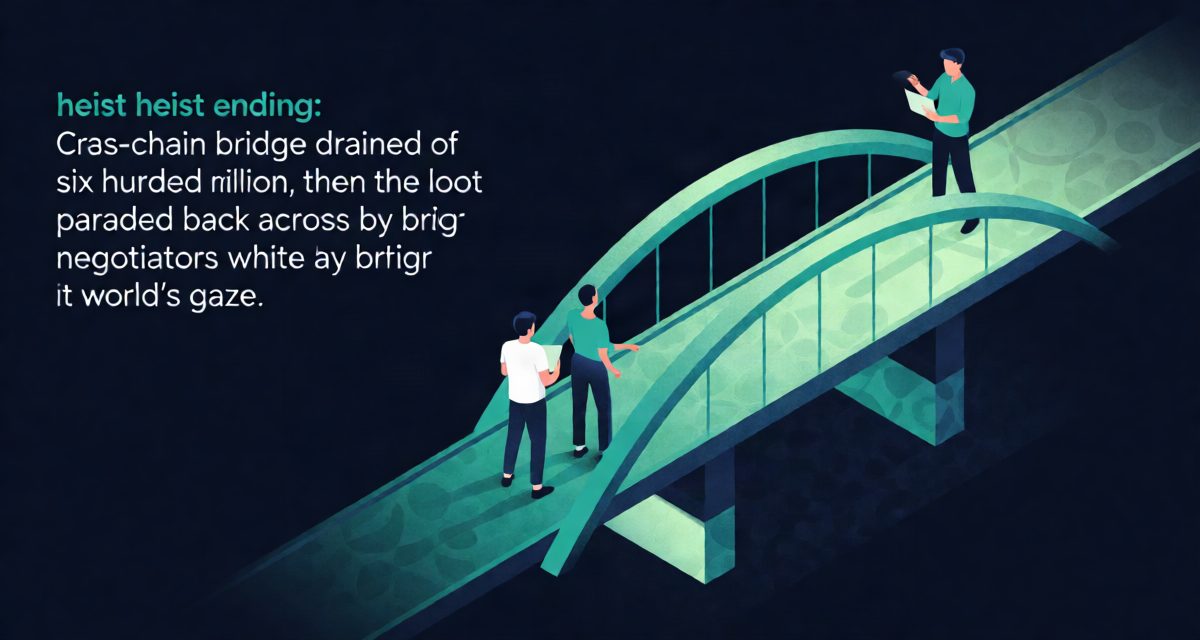
August 2021’s strangest saga came from DeFi. Poly Network — a cross-chain interoperability protocol bridging assets between Ethereum, BSC, and Polygon — was drained of roughly $611M in tokens (then ~$610M: $273M ETH/BSC/Polygon splits across the three chains) by an attacker who abused a flaw in the protocol’s cross-chain credential verification: specifically, the keeper-role management allowed a malicious modified proof to pass and replace keeper addresses on target chains (a forged/PoDLE-style signature confusion around the `verifyHeaderAndSig`/EthCrossChainManager contract logic — a header-signature malleability trap). The jaw-drop followed: after slow-motion public negotiation (Poly’s open letters pleading “your actions constitute theft,” on-chain messages from the attacker, briefs flying from researchers decoding the exploit), the attacker progressively returned everything — first the $4.5M “test” tranche, then sharded/multi-sig-locked tranches, completing ~all funds by late August (excluding a $33M freeze resolved later) — and pocketed only a $500k bounty offered by Poly plus an “IOU” of goodwill, an epoch-defining freak in breach history.
The August 2021 Poly Network hack (10 August 2021, ~$611M stolen — then the largest DeFi theft ever) exploited a flaw in Poly Bridge’s cross-chain manager contracts: the attacker (dubbed “Poly Hacker” or per Poly’s letters “Mr. White Hat” after cooperating) crafted a malicious substitution of the keeper-list verification data so the bridge’s target-chain contracts accepted attacker-controlled keeper addresses as legitimate — navigation into the EthCrossChainData contract replaced the keeper-role signer set, letting the attacker unilaterally approve cross-chain asset unlocks. No private-key theft, no insider, no blockchain consensus failure — an application-layer permission-logic bug in the bridge’s “who may authorise withdrawals” check (implementation-wise, a forged header+signature payload satisfying the contract’s overly-trusting verification). Stolen: ~$273M on Ethereum, ~$252M on BSC, ~$85M on Polygon (mix of tokens incl. SHIB, FEI, DAI, WBTC, ETH). The freak twist: over the following 12 days, after public/global attention (Tether froze $33M USDT promptly; exchanges flagged addresses; researchers SlowMist/peckshield decoded paths), the attacker returned funds progressively — 100% eventually by 24 August (the frozen $33M unfroze and returned later, closing the book fully by late September per Poly statements) — citing intentions ranging from “fun/curiosity,” to hacktivism-adjacent statements, to safety-of-funds claims; accepted a $500k bug bounty from Poly (initially refused/returned) and turned down offers to keep part of the funds as a “white-hat” reward. Poly’s post-mortem: replaced keeper multisig architecture with more distributed validation, audited contracts (CertiK/other re-audits, with the irony of prior audits not catching the flaw widely noted), and launched a “Poly Unicorn” NFT thank-you campaign. Lessons for 2026 cross-chain design: bridge permission logic is consensus-critical (treat keeper-role changes like hard-fork-grade changes: timelocks, multi-party attestation, on-chain slashable stake); signature/header verification must bind to canonical chain state (no malleable substitution paths); audit scope must cover role-management flows, not just transfer math; and incident-response transparency (Poly’s open letters, real-time coordination with Tether/exchanges) demonstrably shaped outcomes even in a crypto-native crisis — dynamics we unpack further in our coverage of cryptographic resilience where relevant.
What happened
Attack-window timeline: 10 August 2021 ~12:00 UTC — anomalous cross-chain transactions flagged (SlowMist first public decoder); within hours Poly confirmed three-chain drains totalling ~$611M and tweeted the open-letter plea; Tether blacklisted/froze $33M USDT within the day; major exchanges (Binance, OKEx, Huobi/HTX predecessors) coordinated address monitoring. The attacker’s on-chain messages began same-day — playful notes (“FOR FUN?” style taunts mixed with negotiation), then a pivot to cooperation: transaction history showing test transfers and engagement with Poly’s posted PGP communications channel. Returns: 11 August — $260M tranche returned (multi-sig locked requiring Poly+attacker keys); 12 August — original fork of remaining ETH-chain funds initiated; by 23–24 August — “98%+ returned” milestone; late September — final closure including the unfrozen Tether tranche. Poly’s accounting (cross-checked in press) closed the books at effectively 100% recovered, $500k bounty paid, no prosecution (identity never officially confirmed; “Mr. White Hat” moniker stuck; rumours of state-adjacent or Western-teen origins never substantiated).
Why returned? The mix of motives offered (and never fully separable from operational reality): assets too hot to launder (Tether/exchange freezes made cash-out difficult), genuine grey-hat framing, attention theatre, and Poly’s non-threatening negotiation posture. Whatever the truth, the practical takeaway aged well: instant consortium response (stablecoin issuer, CEX fronts, on-chain analytics) can make even record thefts illiquid — a lesson repeated by later bridge incidents with more-honest criminals and worse outcomes.
How it worked
The exploit in one diagram:
Poly Bridge normal flow:
  source chain lock tx -> relayed header + signatures
  -> target chain EthCrossChainManager verifies
  keeper signatures -> executes mint/unlock

attacker flow (10 Aug 2021):
  1. craft malicious "header+sig" payload embedding
     ATTACKER-CHOSEN keeper public keys in the
     data the manager contract parses
  2. submit via legitimate-looking cross-chain
     transaction path (no key theft - the contract
     trusted the keeper-list DATA inside the
     verified payload rather than binding keepers
     to canonical on-chain state)
  2b. net effect: EthCrossChainData's keeper set
     overwritten to attacker keys on target chains
  3. unilaterally "approve" cross-chain unlocks:
     drain ~$273M ETH-chain, ~$252M BSC, ~$85M
     Polygon tokens
  4. exfil across DEX swaps/tornado-era mixers -
     then stall under freezes + global attention

root cause class: privileged-role bootstrap bound to
malleable payload data instead of canonical state
The bug family — role/permission logic inside bridge contracts trusting user-influenced cross-chain payloads — became the defining DeFi attack surface of 2021–2022 ($2B+ bridge losses across Ronin, Wormhole, Nomad, Harmony), exactly the design lesson we catalogue in crypto security coverage.
Impact and numbers
| Metric | Value | Source |
|---|---|---|
| Date | 10 August 2021 | on-chain/press |
| Total stolen | ~$611M (ETH 273M / BSC 252M / Polygon 85M) | Poly/SlowMist |
| Then-record | Largest DeFi theft at the time | press consensus |
| Frozen en route | $33M USDT (Tether) | Tether/Poly |
| Returned | 100% by late Sept 2021 | Poly statements |
| Bounty | $500k (accepted late) | Poly |
| Exploit class | Cross-chain keeper-role substitution | SlowMist/peckshield analyses |
Timeline
| Date | Event |
|---|---|
| 2021-08-10 | Exploit executed; ~$611M drained; Poly open letter; Tether freezes $33M |
| 2021-08-11 | First tranche returned under multi-sig lock |
| 2021-08-12→23 | Progressive returns; “98%+” milestone |
| 2021-09 (late) | Final closure incl. unfrozen USDT; books at 100% |
| 2021–2022 | Bridge-audit overhaul; keeper architecture re-designed |
Why it still matters in 2026
Poly Network matters twice over: as the technical archetype of bridge permission-logic failures — the attack class that cost Web3 more than any other single category in 2021–2022 (Ronin $625M, Wormhole $326M, Nomad $190M, Harmony $100M all within a year, all in the same “who can authorise movement” family) — and as the governance/IR unicorn: a mega-theft defused by transparent negotiation consortium freezes, and attacker cooperation, without law enforcement as first responder. For 2026 practitioners: bridge design has absorbed the lesson (multi-party attestation committees, timelocked role changes, canonical-state binding, slashable validator stake are now standard checklists), but the deeper pattern — emergent multi-system trust boundaries (chain A data interpreted by chain B contracts) exceeding their audit coverage — recurs wherever interoperability layers multiply (cross-cloud APIs, MCP-style agent toolchains, federated identity). The IR lesson institutionalised: asset-freeze consortia (stablecoin issuers, exchanges, analytics) are standing defence-in-depth, but they’re a backstop, not a design layer — the fixes that matter happen in the permission logic itself, per the canon we maintain in crypto/cryptography coverage.
Detection and hardening takeaways
- Bind privileged roles to canonical state. Keeper/validator/role updates must derive from canonical chain state or committee attestation with timelocks — never from data embedded in the payload being verified; that single binding breaks the Poly substitution pattern outright.
- Time-lock and multi-party role transitions. Any change to “who can authorise withdrawals” should require m-of-n independent approval plus a delay window, so a single forged/captured path can’t rewrite authority instantly — the control whose absence made Poly a one-transaction hijack.
- Audit role-management flows like transfer flows. Prior audits had stared at token math; the killer lived in header/signature verification and keeper bookkeeping. Threat-model privilege changes, upgrade paths, and pause/unpause authorities as first-class exploit surfaces.
- Pre-arrange asset-freeze consortium playbooks. Tether’s $33M freeze was decisive; have issuer/CEX/analytics contacts, documented legal hooks, and rehearsed comms — in a crisis, hours matter and this backstop buys time irreversibly.
- Monitor cross-chain anomaly velocity. Real-time diffing of “cross-chain requests vs keeper-set state” (and alerting on role-data mismatches inside payloads) is cheap detection glue that flags substitutions before drains complete — SlowMist’s 12:00 UTC catch shows minutes-scale telemetry pays.
FAQ
Who was the Poly Network hacker?
Never officially identified. The attacker communicated via on-chain messages and (later) a PGP channel with Poly, self-framing variously as curiosity-driven and constructively grey-hat; Poly dubbed them “Mr. White Hat.” Rumours ranged from lone teenager to state-adjacent crew with no confirming evidence. No charges were ever filed attributable to the case — itself a data point in crypto’s attribution-hard era.
How did they return the funds “safely”?
Staged: first tranches went to multi-sig addresses requiring both attacker and Poly keys (mutual hostage guarantee), then progressive releases as trust and legal-finality discussions matured, with the Tether-frozen tranche last. The mechanism mattered as much as the intent — both sides engineered the return so neither could defect profitably at any step.
Did anything actually change in bridge security?
Yes, materially: keeper-style single-verification flows gave way to attestation committees with independent keys, timelocks, and (in major post-2022 bridges) slashable staked validator sets; audits now explicitly cover role-management and upgrade paths; and real-time monitoring of cross-chain state-diffs became table stakes. The following year’s bigger losses (Ronin et al.) happened mostly on designs that predated these controls — the industry absorbed Poly’s lesson asymmetrically, which is exactly why it’s still taught.
Related Reading
- What Studying 33 Historic Cyberattacks Taught Me About Defending Systems Today
- Passwordless in 2026: Why Passkeys Are Finally Killing the Password (and How Attackers Are Adapting)
- 2022–2024: Lapsus$, Change Healthcare & the XZ Backdoor
- Authoritative reference: CISA Known Exploited Vulnerabilities
- Nomad Bridge: The $190M Config Bug That Became a Mob Looting
- Ronin Bridge: The $625M Heist That Ran on Five Keys
- Harmony Horizon: $100M for Two Stolen Keys