
Quick Answer
In early October 2023, genetic-testing company 23andMe disclosed a credential-stuffing breach: attackers replayed username-password pairs leaked from other services, took over roughly 14,000 accounts, and then abused the DNA Relatives feature to scrape profile and ancestry data of millions of genetically-linked users — users who never reused a password in their lives. The final tally reached roughly 6.9 million profiles, and the episode became the textbook case for downstream data exposure through trusted feature abuse.
The breach rewrote breach math. Downstream exposure through trusted feature abuse: your exposure no longer depended on your own password hygiene but on whether any genetic relative — known or unknown to you — had weak credentials on the same platform holding your most intimate data.
What happened
The initial access was mundane: credential stuffing, industrial scale, using password dumps from unrelated breaches circulated in criminal markets. 23andMe’s early October security bulletin described attackers logging into ~14,000 accounts (0.1% of the stated user base) with valid credentials. No exploit, no zero-day — just reuse economics at the login endpoint.
The amplification was novel. Once inside an account, attackers queried the DNA Relatives feature, which surfaces genetic matches who have opted in to kin discovery. By compromising a few thousand accounts with diverse ancestry footprints, the attackers reached into millions of linked profiles — names, photos, birth years, location estimates, proportion of shared DNA, and (per reporting) some health-relevant ancestry details. 23andMe later confirmed the scrape spanned ~6.9M users. A subset of the data, heavily weighted toward users of Ashkenazi Jewish and Chinese descent (per the threat actor’s own marketing), appeared for sale on criminal forums, with extortion-adjacent claims attached.
The targeting pattern raised fears of ethnicity-specific misuse — diaspora surveillance, doxxing pools, identity fraud — and drew regulators in on both sides of the Atlantic. By late November, 23andMe confirmed the scope; by December, it disclosed the figure of 6.9M and changed its disclosure language in ways that sparked a second controversy (see below).
Why DNA data breaks breach models
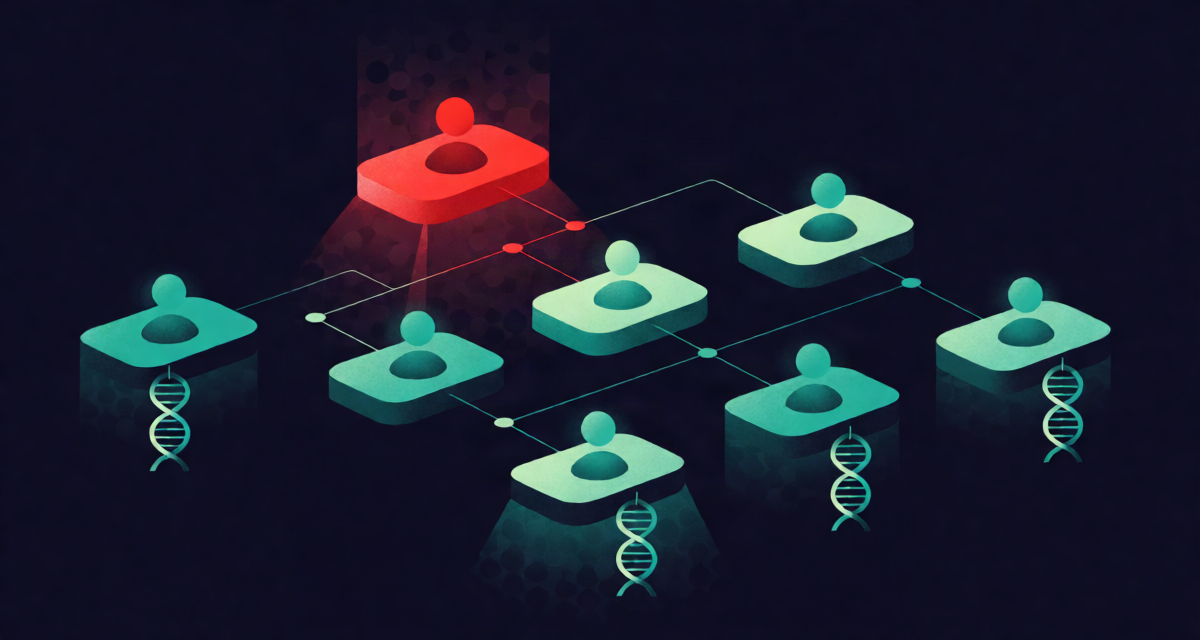
Most platform data is per-user siloed: compromise Alice’s account, get Alice’s data. Genetic data is inherently relational: your genome implicates your relatives, including relatives you don’t know exist. A feature like DNA Relatives — legitimately beloved by adoptees and genealogy hobbyists — is simultaneously an implied-consent bridge from any single account to a wider graph of non-consenting nodes.
Compliance models struggled with this. Was the 6.9M count one breach or 6.9M breaches? Whose consent governed profile data visible through a relative’s opt-in? 23andMe’s eventual legal posture argued users bear responsibility for password reuse and that scraped relative-data fell outside standard breach-notification framings — positions that generated lawsuits, congressional inquiries, and eventually a bankruptcy-era sale of assets in 2025, with data ownership questions unresolved for buyers.
Timeline
| Date | Event |
|---|---|
| 2023-10-06 (disclosed 10-18) | Attackers stuff ~14,000 accounts using reused credentials; 23andMe begins investigating — disclosure date lags event date, per firm’s SEC filing cadence |
| 2023-10-18 | Public bulletin: credential stuffing confirmed, password resets forced, staged leak of scraped celebrity profiles appears on hacker forums |
| 2023-11 | Threat actor “Golem” advertises 23andMe datasets; targeted ethnic-descent clusters reported by researchers monitoring markets |
| 2023-12-01 (approx.) | 23andMe confirms 6.9M affected via Relatives scrape; discloses that some profile fields were programmatically accessible |
| 2023-12 onwards | 30+ consolidated lawsuits; Vermont AG inquiry; scrutiny of “credential stuffing = your fault” framing; product changes (Relatives defaults, rate limits) |
| 2024-2025 | Settlement talks ($30M reported cap); layoffs; 2025 bankruptcy filing and asset sale to TTAM Research — data-use commitments contested |
Dates marked “approx.” reflect reporting windows, not filings. The 2025 TTAM asset-purchase outcome (and data custody) remained contested at time of writing.
Defensive lessons
- Credential stuffing is a design decision’s consequence. Login endpoints without rate limiting, breach-password screening (have-i-been-pwned style), and bot friction are accepting stuffing as a business cost — until they aren’t.
- Features are breach amplifiers. Model every “share with connections” feature as an attack surface multiplier: what’s the blast radius of one compromised account walking the feature’s graph?
- Relational data needs relational consent modeling. DNA-adjacent platforms must treat graph-visible fields as shared assets governed by multi-party consent, not as single-account attributes.
- Scraped-via-feature ≠ harmless. Courts and regulators did not accept “the API worked as designed” as an exoneration; design-foreseeability became the pivot of litigation.
- Disclose scope, not narrative. The “users’ own fault” framing cost more goodwill than the breach itself; firms should plan communications for graph-scale incidents separately from account-count incidents.
The response playbook that followed
23andMe forced password resets, required two-step verification for new signups and (later) all accounts, throttled high-volume login and Relatives queries, and renamed internal visibility defaults. The wider biotech and consumer-genomics sector rushed to audit graph-exposure features — a scramble visible in Ancestry and MyHeritage policy updates over the following months. Regulators on two continents opened genetics-data proceedings, and the incident now anchors “secondary breach” case law: harm flowing from feature abuse after unauthorized access, distinct from the initial access itself.
Why it still matters in 2026
The 2025 bankruptcy-court sale of 23andMe’s assets — data included — converted a privacy incident into a permanency question: who owns a genetic graph when the company holding it fails? The 2023 breach started that chain by destroying the user trust that kept the business viable. For every platform holding relational data, the sequence (stuffing → feature abuse → graph-scale scrape → insolvency → asset sale) is now the canonical risk narrative. Great-aunt profiles weren’t the entry point; they were the payload.
FAQ
My password was unique — was my data still stolen?
Possibly, yes. If a genetic relative’s account was compromised and you were discoverable via DNA Relatives, fields you shared in that feature could be enumerated without your account ever being touched.
What data was actually exposed?
Per 23andMe’s confirmations: display names, profile photos, birth years, location regions, predicted relationships and shared-DNA percentages, and (for some users) ancestry compositions and health reports marked shareable in the feature. Raw genotype files were not accessed, per the company’s statements.
Did 23andMe get fined?
Not a classic fine first — litigation first. A reported $30M settlement framework emerged in 2024 (challenge claims process), and regulatory actions continued across US states and UK/Canada regulators; the 2025 bankruptcy reframed recovery entirely.
What replaced DNA Relatives defaults?
Tighter opt-in gating, connection-count throttling, and visibility controls that default to minimal exposure until users explicitly widen them — the design pattern this breach made mandatory, now standard across genealogy platforms.
When your relatives are the attack surface
The 23andMe credential-stuffing breach (October 2023, ~6.9 million profiles accessed via ~14,000 compromised accounts) formalized the relational data model as breach multiplier: the initial accounts fell to password reuse — no platform compromise at all — but the exposed data included profile and ancestry information of genetically related users who were never breached themselves. The relative-as-payload structure broke the mental model where each user risk is individually priced: your exposure includes accounts you did not choose, held by platforms you never used.
The doctrine consolidated: password reuse remains the breach engine at population scale despite a decade of credential hygiene (the compilation economics price it perfectly), MFA adoption on data-dense consumer platforms is the control that breaks the chain, and relational data requires relational breach modeling — impact assessment that follows the data graph (shared family trees, shared matches, shared health-adjacent inferences) rather than the account list. The regulatory aftermath treated the graph as the scope, correctly, and the data-minimization lesson acquired its genetic-dialect: platforms holding relational data hold it on behalf of people who never consented to that platform, which prices consent architecture and retention discipline at a new tier.
The consolidation: the incident joined the Facebook-scrape and MOAB lineage as the third exhibit in the old-data-never-dies canon, with the distinctive addition that the data’s relational structure multiplies both harm and scope beyond every account-level control. For every platform operator: model the graph before the breach does; for every user: your credentials protect people who share your genome, a framing that credential-hygiene campaigns have underexploited and that this record now prices.
The consent-and-control dimension closes the record entry: the people whose data surfaced through relatives they never nominated had no password to change, no MFA to enable, no account to delete — the graph exposed them through choices made by cousins. The platform-side answer is architectural (relational exposure modeling in impact assessment, minimization of graph-derived data, deletion that propagates through the graph), and the regulatory direction treats the graph as the data subject boundary. Your genome is a shared credential with people you cannot patch; the doctrine, at minimum, obliges the platforms holding it to behave accordingly.
Genomic platforms now operate under the relational model this incident wrote — graph-aware impact assessment, propagation-aware deletion, and consent architecture that acknowledges data subjects who never enrolled. The record keeps its closing line for the users: your credentials guard more than your accounts now, and the hygiene campaigns that say so plainly — password reuse endangers the people who share your data, not merely your own — finally have the incident that proves it. Share the framing; the genome cannot rotate.
The final placement in the credential-hygiene canon: between the compilations that price the credentials and this entry that prices the graph, the user-side doctrine is now complete — unique passwords because reuse multiplies, MFA because accounts fall regardless, and periodic exposure checks because old data never dies. The platforms hold their half of the obligation; the users hold theirs; and the record between them prices every gap honestly, which is all a record can do.
Related Reading
- What Studying 33 Historic Cyberattacks Taught Me About Defending Systems Today
- Passwordless in 2026: Why Passkeys Are Finally Killing the Password (and How Attackers Are Adapting)
- 2022–2024: Lapsus$, Change Healthcare & the XZ Backdoor
- Authoritative reference: CISA Known Exploited Vulnerabilities
- Genesis Market Takedown: Sessions Are the New Passwords
- Marriott’s FTC Settlement: 20 Years of Audits for Starwood’
- Facebook 533M Leak: Old Scraped Data Never Stops Burning